
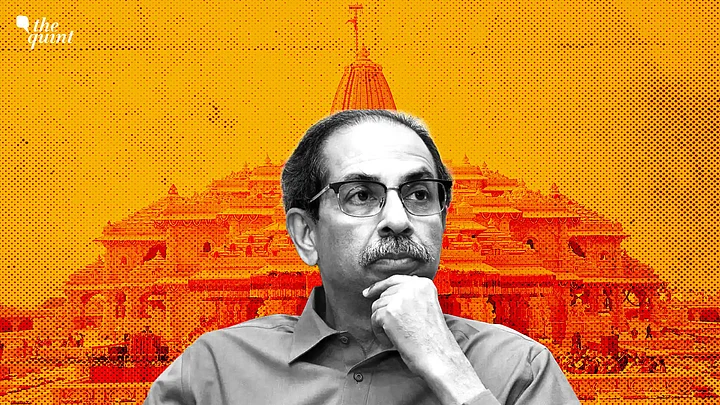
The recent maha aarti conducted by no less than Shiv Sena chief Uddhav Thackeray at Dadar’s Hanuman Mandir invoked a sense of deja vu. With the entrance to one of Mumbai’s busiest train stations blocked by a sea of Shiv Sainiks, the cries of "Jai Sri Ram" and "Jai Bhavani Jai Shivaji" rang out during the last week's event at Mumbai's landmark temple. But, even as it brought back a flood of unpleasant echoes from the past, it could not have been more different from what the term "maha aarti" had previously implied.
Maha aartis have been triggers for anti-Muslim violence in Maharashtra during Mumbai’s deadly post-Babri Masjid demolition riots of December 1992-January 1993. Despite intelligence to this effect, and police asking for a ban on them, the then Chief Minister Sudhakar Naik had refused to stop the rituals, calling them religious occasions.
But the Devendra Fadnavis-led Bharatiya Janata Party (BJP) government is not the weak-kneed Congress government of the riots. That’s why it is surprising that Uddhav Thackeray’s maha aarti was allowed to take place at all. That the BJP would be its target was known beforehand. That’s also the reason the maha aarti announcement evoked no dread among Muslims or any peace-loving Mumbaikars this time.
It is in these two aspects wherein both the strength and the weakness of Uddhav’s "return to Hindutva" campaign lies.
Sena's Return to Hindutva
Undoubtedly, Hindutva has emerged as a life-saver for a party chief shocked by mass defections of six of his nine MPs, some of them party veterans. It’s also the plank easiest for Uddhav to fall back on, given that he was groomed by the original Hindutva politician.
Bal Thackeray’s Shiv Sena was based on two issues: primacy for the Marathi sons of the soil in India’s financial capital, and the domination of Hindus in society, with frequent resort to (police-backed) violence to achieve both. Uddhav was never aloof from this Sena. Indeed, he was anointed as Thackeray’s political heir.
This vantage position as an insider within the Hindutva spectrum makes Uddhav uniquely qualified among all Opposition leaders to take on the BJP, both as India’s ruling party and as the only party currently identified with Hindutva. He alone can use the key phrases of Hindutva’s history to attack those taking the ideology to its logical conclusion today.
Thus, his mocking invocation of "Mandir wahin banayange" and "Ayodhya to sirf jhaanki hai/Kashi Mathura baaki hai", both favourite slogans of the Ayodhya movement, don’t jar.
Indeed, the Ram Mandir scam is tailor-made to benefit Uddhav. His father’s famous boast that Shiv Sainiks helped demolish the Babri Masjid; his own party’s alleged predominant role in the prolonged riots that broke out in Mumbai the day the mosque was demolished, and his party’s alliance with the BJP in the crucial 2014 elections, repeated in 2019—all give him an unassailable base to launch attacks on those who, as he said, came to power on the Ram Mandir plank with his party’s help, only to loot the temple after building it.
When Uddhav declares, "Ab Hindu maaf nahi karega’’, in a clever twist to Atal Bihari Vajpayee’s provocative declaration "Ab Hindu maar nahi khayega", made after the 1970 Bhiwandi riots, it makes complete sense. Ironically, the Shiv Sena was indicted by a judicial commission for those riots.
Legitimacy to Oppose Mandir Politics
This background makes it difficult for the BJP to counter Uddhav’s attack, the way they can counter similar attacks by other parties.
Though it was Samajwadi Party chief Akhilesh Yadav who first brought the scam into the public eye, his father Mulayam Singh Yadav's orders as CM to fire upon those involved in the first assault on the Babri Masjid in 1990, will always be held against him.
As for the Congress, the tag of "secularism" it flaunts, makes it an enemy of the Ayodhya movement, despite the many compromises made with the movement by its tallest leaders—from Rajiv Gandhi, under whose watch the Babri Masjid locks were opened, to Narasimha Rao, who did nothing while the masjid was being demolished.
The Aam Aadmi Party, too, has been vocal about the scam, but the BJP has a ready answer in Arvind Kejriwal’s harsh comments on the Ram Mandir movement made in the past.
But all that the BJP could come up with after Uddhav’s stinging maha aarti speech was a feeble counter by Maharashtra CM Fadnavis: "I’m happy that Uddhav Thackeray has finally remembered Lord Ram.’’ That could also explain why the Shiv Sena (UBT) was allowed police permission to hold the maha aarti—not doing so would have given the party an excuse to brand the BJP as "anti-Hindu".
However, what’s significant is that Uddhav’s sudden passion to "save Ram" through a "Ram Raksha Andolan" (announced at the maha aarti) poses no threat to Muslims.
For, Uddhav’s brand of Hindutva is not the same Hindutva that currently dominates the country.
Striving for a More Secular Saffron?
Uddhav has often defined his Hindutva by quoting the definition of dharma laid down by Sant Gadge Maharaj, whose biography was written by his grandfather Prabodhankar Thackeray. It contains the basic tenets of Uddhav's Hindutva: "Food for the hungry, water for the thirsty, clothing for the naked, shelter for the homeless, care for the sick, education for the children of the poor, love and protection for animals and birds, hope for those in despair.’’
Whether he really believes in this definition or not, it is evident now that Uddhav cannot go back to the Hindutva of his father. Even during his joint rally with his estranged cousin Raj at Mumbai’s Shivaji Park on the eve of the Brihanmumbai Municipal Corporation (BMC) elections, Uddhav did not fail to attack the BJP’s "Hindu-Muslim narrative’’.
Quoting verses composed by folk balladeer Shahir Amar Shaikh, one of the founders of the Samyukta Maharashtra Samiti along with his grandfather, Uddhav reminded the sea of Shiv Sainiks that the Jana Sangh played no role in the Samyukta Maharashtra movement, and that the man who ordered the firing that claimed 106 lives during that movement was Morarji Desai, a Hindu. In fact, Uddhav went as far as to say that those who broke the Shiv Sena in 2022 were "Marathi manoos, not Khans".
This brand of Hindutva may keep Muslims (and many secular Hindus) voting for Uddhav, as they have been doing since he broke with the BJP. But will it satisfy his supporters?
The turnout of ordinary Hindus when Uddhav was finally forced to step out of his home and visit defector MP Sanjay Bima Patil’s constituency confirmed what the BMC results revealed: Mumbai’s Marathi manoos has not forsaken the Thackeray heir.
But Hindus today have become used to exhortations of hatred against the 'other'.
For Uddhav, the 'other' is Narendra Modi’s BJP, not "jihadis" or "ghuspaithiyes" (intruders) or beef eaters. While only a leader unabashed about declaring himself a proud Hindu can confront the BJP on matters concerning faith, will Uddhav Thackeray’s sharp rhetoric be enough to subvert the BJP’s version of Hindutva?
(Jyoti Punwani is a Mumbai-based journalist. This is an opinion piece and the views expressed above are the author’s own. The Quint neither endorses nor is responsible for the same.)
