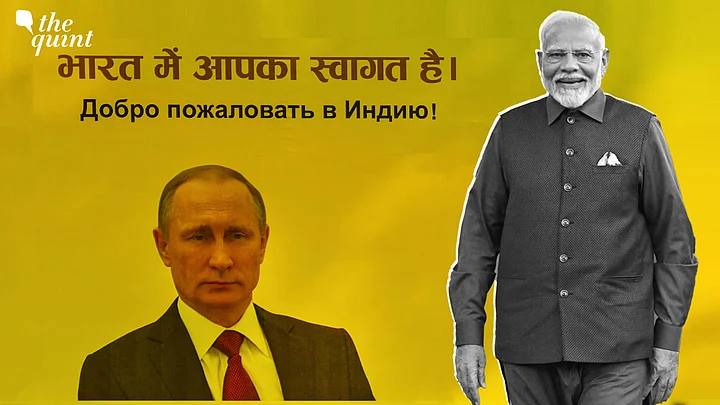
Even as Vladimir Putin flies into New Delhi for his first India visit since the Russia-Ukraine war started about three years ago, the Russian President will be keeping one eye firmly on the US. He would be watching very closely how the US President Donald Trump reacts to what his son-in-law, Jared Kushner, and his special envoy, Steve Witkoff, convey to the White House about the meeting the three just held.
In the wake of the nearly four-hour-long conversation, reportedly on resolving an intractable conflict with a neighbour that has been supported by the North Atlantic Treaty Organisation (NATO), optimism is high.
It is possible that Putin may announce a deal during his trip to India—if allowed by the recalcitrant European powers that have brought their revulsion towards Moscow to Delhi. Their attempt is to turn Indian public opinion against Russia and scuttle New Delhi’s ties with its traditional ally in a bid to make Russia friendless.
A Hark Back to Indo-Soviet Legacy
Quite visibly, they have not succeeded, despite the editorials doing the rounds in Delhi’s papers and engagement with Delhi’s intelligentsia. The unvarnished truth is that the Indians—despite the fact that they give preference to go to the US and Europe to work or migrate to these countries—consider Russia and its precursor state, the Soviet Union, as an all weather friend, who has stood by India through thick and thin.
Old timers do not forget how the Soviet Union backed India and it’s tough Prime Minister, Indira Gandhi, during its war with Pakistan that saw the liberation of Bangladesh, and also gave her the support to stand up to the US when it was backing Islamabad.
Ever since that momentous period, the US has tried to change its impression about itself and ordinary Indians views about their adversary state by showering it with special favors, but nothing has really worked. India and Russia continue to be close friends- whatever any country may think.
Expectedly, India helped get over a cash crunch that Russia was experiencing after the US imposed the most claustrophobic sanctions on Moscow following the start of the Russian war on Ukraine. India, which was a symbolic buyer of Russia’s Ural light oil, raised the quantity by 1,000 percent.
As hammered out in the five-member BRICS forum—which has now expanded to 11—the payment was made in national currency. During the time when the Soviet Union was alive, India used to trade in rupee-rouble. The roubles were converted to dollars through the so-called 'WITCH' firms (an acronym for firms like Wipro, Infosys, TCS, Cognizant, and HCLTech). It's not clear whether a similar kind of effort was put in, to help Russia earn dollars from their transactions with India.
Now that the US government has hiked tariffs by 25 percent to make India stop buying Russian oil, New Delhi is expectedly scaling down its oil purchase from Russia. But it is taking its own sweet time in doing so, perhaps in the hope that by then, Russia and Ukraine would have found a way to smoke the peace pipe.
This hope was triggered by US President Donald Trump's display of seeming desperation for a Nobel Peace prize and a promise to end the war in Ukraine "in 15 days". Quite evidently, Putin trusts the deep states of US and Europe who had other ideas about the ongoing conflict.
Security, Rupee-Rouble Debt Likely to be on Agenda
From a geopolitical security standpoint, the Russian President's visit to India is very significant. Besides beefing up India’s defence purchases like the anti-missile system S-400 and 500, India has been keen to buy Russia's fifth-generation aircraft. India knows the importance of air defence and the four-day war with Pakistan recently made it amply clear that the country needs quality anti-missile shields to take on drones and hypersonic missiles.
Had India not had the S-400, Pakistan could potentially have pulverised the Indian defences through Turkish-made drones or Chinese missiles.
India has already signed a military logistics treaty with Russia before Putin arrived in New Delhi. This agreement is similar to what New Delhi has signed with the US.
However, the biggest issue that Putin is facing now is how to settle the ballooning rupee-rouble debt.
Ideally, the Russians should buy Indian goods from these funds, but it would appear that Russian locals do not have too much of an appetite for Indian goods. Putin knows that the trade issue is important and is keen to announce how it proposes to balance it. In one of his interactions with reporters, he said that India-Russia trade should be in excess of $63 billion, especially when its trade turnover with a tiny nation such as Belarus has reached $50 billion, and added that India-Russia trade has to go higher. It will be interesting to watch how Kremlin sorts this issue.
Needless to say, Putin is a bright man—said to not use even a piece of paper to help him in his political negotiations—and would come well prepared for this important visit.
India Must be Wary
India, in turn, will explore how the Russian President perceives New Delhi's cutback on Russian oil under US pressure. Will he take it unkindly or in his stride?
Nevertheless, what Russia would demand from India is perhaps advice on how to deal with a rising China.
India came to grief in the four-day war due to Chinese missiles and aircraft allegedly showing up to trump India's advances against Pakistan. The fact was also raised by a US report titled The US-China Economic and Security Review Commission’s 2025 recently, which noted how Beijing offered logistical, diplomatic and intelligence-related support to Islamabad during the escalation and even amplified Islamabad’s narrative in later days.
Though Russia, which has seen its dependence on China rise by 30 percent amid the Ukraine war, may not able to do much on this count, Russians have claimed to have helped in defusing tensions between India and China in the past. Kremlin can help New Delhi negotiate a better deal when conversing with Beijing.
That being said, there is a lot riding on peace in the Asian region. Any conflagration would destroy Russia and consequently its efforts to create a new world order.
India has its own views on this evolving global change that has accelerated after the Ukraine war. India does not want to de-dolllarise or use BRICS as a counterpoint to the US centred world.
It believes that its rise can take place through US and not by cosying up to China, which has its own view of the world. Though Russia has allowed visa-free travel to the Chinese to even its most unpopulated parts like Siberia, it remains ambivalent about Moscow's return to primacy.
The end of the Ukraine war would likely mean a diminishing of the NATO countries. This could present Moscow with an opportunity. Is it likely to rise to the occasion and restrategise?
Some of these questions will likely find answers during Putin's visit to India.
(Sanjay Kapoor is a veteran journalist and founder of Hardnews Magazine. He is a foreign policy specialist focused on India and its neighbours, and West Asia. This is an opinion piece. All views expressed are the author’s own. The Quint neither endorses nor is responsible for them.)