
ADVERTISEMENTREMOVE AD

Fuel Price Hike: The Rs 3.87 that Could Break India's Middle Class

This is the biggest test that PM Modi has faced since he first came to power in 2014.

Published
story-hero-img
i
Aa
Aa
Small
Aa
Medium
Aa
Large

When a typical young person from a middle class family starts working, they are usually unmarried, some still live with their parents, they are burdened with fewer of the responsibilities that life will later throw at them.

But that is what career expectations are all about—regular promotions, and decent pay hikes, that will help young people ‘settle’ in life. Perhaps, get their first car, enough money to get married and start a family, and some day, earn enough to qualify for a housing loan, and buy a home of their own.

That is what makes increment time so tense, and exciting.

Employees in every corporate office wait to see by how much their salary hike will beat inflation. More often than not, this is a hazy number, not really backed by facts.

ADVERTISEMENTREMOVE AD

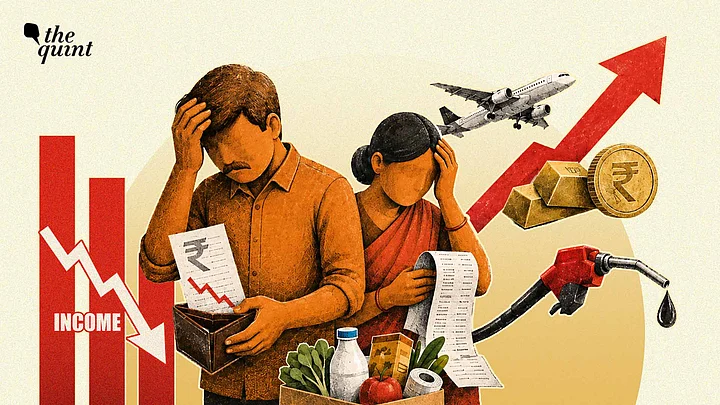
Declining Increments, Rising Cost of Life

A 10 percent increment might seem satisfactory, in a year when retail inflation is at 8 percent; while a 4 percent raise will be disappointing even though the cost of living might not have risen at all. This is despite the fact that in the first instance one’s purchasing power would have risen by just 2 percent, and in the second by twice as much.

Yet, even though very few of us know the actual inflation level at any point, there are some things that we buy, which make us ‘feel’ that our cost of living has gone up. The most important of these psychological signals is the price of petrol at the local pump. When it rises, we feel worried about our family budgets, even when the direct impact might not be that much.

Over the past few days, petrol prices have gone up by Rs 3.87 per litre. If your car has a mileage of roughly 10 km per litre, and you have to commute about 25 km per working day and another 20 km on the weekends, your monthly petrol bill would have increased by roughly Rs 250.

That’s less than what you would spend on a single breakfast order on Swiggy or Zomato. Yet, psychologically, it sends off an alarm in your brain. There’s a valid reason for this. Fuel prices—especially that of diesel—affect everything around us.

Freight costs go up; farmers have to spend more on diesel-powered pumps; factories and offices see their generator bills rise. So, there is a multiplier effect on the price of all goods and services. We are seeing that happen in wholesale prices already, since commercial fuel rates had risen earlier. Wholesale prices—or the price that firms and traders pay—rose by 8.3 per cent last month. That’s the highest increase in three and a half years.

Retail inflation has also started creeping up. It was almost zero in October last year, but has risen to nearly 3.5 per cent in April. And since fuel prices for consumers were raised only recently, economists expect retail inflation this month to be the highest since end-2024.

We consumers have already been feeling some this. Food orders have already become more expensive, because commercial LPG prices rose much earlier. Vegetables and fruits, which had become cheaper till April, have started becoming expensive again. The LPG crisis has also resulted in an exodus of daily wagers from our cities. So, itinerant service providers—domestic helps from apps, plumbers, electricians, deliveries—have all become scarce and a little more expensive.

But that’s only part of the story.

No Safety Net

The other big reason why the middle class is getting antsy about prices and the economy, is that many of them have either seen no salary increases this year, or might even have had to take pay cuts: the only consolation is that the layoff bloodbath of 2025 seems to have abated a bit, at least temporarily.

The clear indication of what has happened comes from the latest quarterly financial results of listed companies.

The Centre for Monitoring India’s Economy (CMIE) has compiled data for over 1,500 companies, which have already published their financial results for the Jan-March 2026 quarter. Their net sales have risen by more than 10 percent, post-tax profit has risen by a whopping 34 percent, but their salary bill has increased by just 3.5 percent.

Adjust that for inflation, and the real purchasing power of their employees has increased by a measly 0.3 percent compared to the same period last year. Keeping in mind that top managers get a lion’s share of any pay hike that takes place in a quarter, it means most others would have seen a decline in their real income.

You could argue that most companies announce increments in the April-June quarter, and one should wait for those numbers to see whether there are good pay hikes this year. But year-on-year comparisons for each quarter work as a proxy for new hires and increases in headcount. In January-March 2023, for instance, the wage bill of listed companies had increased by nearly 20 percent; in the same quarter in 2024, it went up by 11 percent. The slowdown in wage growth started in June 2024 and has continued since then.

There are various other data sources that confirm that India’s middle class has been facing a sharp slowdown in its income growth.

But one thing that had kept it going was the rise in asset prices—stocks, real estate, and gold.  This had balanced things out even when incomes weren’t growing. Even that has disappeared now.

The benchmark indices, Nifty and Sensex, have collapsed since January this year. Real estate prices in most metros have either stagnated in the past six months, or even fallen in some places. The only asset that was rising—gold—has also become too expensive for any fresh investments.

ADVERTISEMENTREMOVE AD

Economy Not 'Feeling Good'

All this would have been offset, had there been a general ‘feel good’ factor in the economy around us. The exact opposite is happening right now. Social media is awash with pundits talking about the flight of foreign funds from the Indian markets. Corporate voices are asking people to prepare for an economic crisis.

Prime Minister Narendra Modi and his Cabinet colleagues are promoting austerity, and asking people to consume less. The rupee has hit an all-time low, losing against every major global currency since the beginning of the year.

If anything, the economic developments around us, especially how they are being perceived by the middle class, have come together to produce a ‘feel bad’ effect.

This is worrying, since fears of an impending economic crisis will cause consumers to buy less, and that, in turn, will cause corporates to invest less, and hire fewer people. So, it will become a self-fulfilling prophecy of sorts—the fear of a slowdown will end up causing the slowdown.

The government has no easy solutions in front of it. If it turns to austerity, it will increase the chances of an economic collapse. On the other hand, if it tries to spend its way out of the crisis, that could accelerate inflation and further weaken the rupee. This is the biggest test that PM Modi has faced since he first came to power in 2014. 

(The author was Senior Managing Editor, NDTV India & NDTV Profit. He tweets @Aunindyo2023. This is an opinion piece. The views expressed above are the author’s own. The Quint neither endorses nor is responsible for them.)

Speaking truth to power requires allies like you.
Become a Member
Monthly
6-Monthly
Annual
Check Member Benefits
×
×