
In the past week, I have been hearing a lot of people discuss Prime Minister Narendra Modi's appeal to stop buying gold and reduce travel.
His message is only for those who could already afford all these earlier, right? So, what about people like us who couldn't?
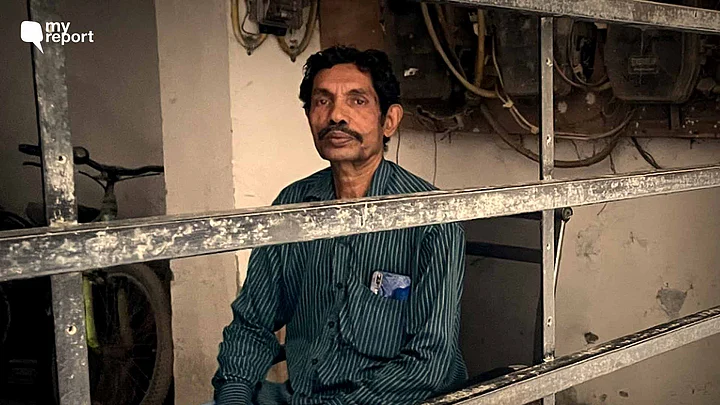
I work as a security guard at a residential building in Southeast Delhi's Okhla locality. We weren't buying gold, nor were we making foreign trips or driving around in cars and burning fuel. Yet, we are facing the brunt of the hike in fuel and LPG prices.
For me, the everyday struggle for survival has become tougher.
'Gas Crisis Derailed My Monthly Expense'
I live in a makeshift room under the staircase of the building I guard. Since I don't have a permanent address in Delhi, I don't have an LPG connection. I have been buying gas in small 5 kg cylinders for years.
Before the gas crisis started in early March this year, I'd buy gas at Rs 100 per kg from local vendors who sell gas in small quantities, filling our 5 kg cylinders from their normal bigger cylinders.
I make Rs 8,000 per month—and an additional Rs 400 each for the eight cars in the building that I clean. My wife works as a domestic help, and earns Rs 7,000 a month.
Ever since the crisis began post the Iran war, the price of gas has gradually increased from Rs 100 to Rs 350 per kg. Some of these vendors are even selling gas for Rs 400 after the Prime Minister spoke about cutting down on fuel usage.
So now, for 5 kg of gas, which used to cost me Rs 500, I am paying at least Rs 1,750 for gas that lasts anywhere between a week and 10 days.
A large part of my monthly earning is now going straight towards gas. This comes at a time when I’m already struggling to repay the Rs 50,000 loan I took 7-8 months ago for my wife’s gallbladder surgery, while also continuing to cover the cost of her medicines and ongoing treatment.
'Way Back Home Looks All The More Difficult'
I came to Delhi from Malda district in West Bengal nearly 20 years ago when I was physically fit to work as a daily-wage labour on construction sites. But, as age caught up with me, my body cannot keep up with hard labour.
I am 61 now, and have three sons and a daughter. People often say children become your support in old age, but I cannot expect my sons to take care of me. My sons are masons, struggling to survive as daily-wage workers themselves. Their fight to survive is no different from mine.
This April, I finally managed to go back to Malda after four years. Why did it take so long? Because there was never enough money left to even afford a trip home. Now, I don’t know when I will be able to go again.
Every month, Rs 4,000-5,000 disappears on gas alone. Grocery costs have gone up too—what once cost me Rs 4,000-5,000 a month now takes at least Rs 7,000-8,000.
You can measure inflation in the smallest things: the roti that cost Rs 5 before the Iran war became Rs 6, then Rs 7, and today it costs Rs 8.
What are we supposed to do? Where are we supposed to find money? When we ask the building owners for an increment, they say they are struggling too, that their expenses have gone up, and they cannot afford to pay more.
Being a migrant worker, without a permanent address, we are often excluded from government support like ration benefits. Where am I supposed to bring proof of address from? What address do I even have—my tiny cardboard room under the staircase?
I feel trapped. I cannot go back home because, at this age, where will I find work there? And while there is work here, inflation has broken our backs. Nothing is left after expenses—no savings, no security.
Whenever there is a crisis, it feels like people like us—the poor—are the first to suffer the blow. Today, the government is saying, ‘Don’t buy gold.’ But someone should tell them—forget gold, we are struggling just to afford food.
(All 'My Report' branded stories are submitted by citizen journalists to The Quint. Though The Quint inquires into the claims/allegations from all parties before publishing, the report and the views expressed above are the citizen journalist's own. The Quint neither endorses nor is responsible for the same.)
