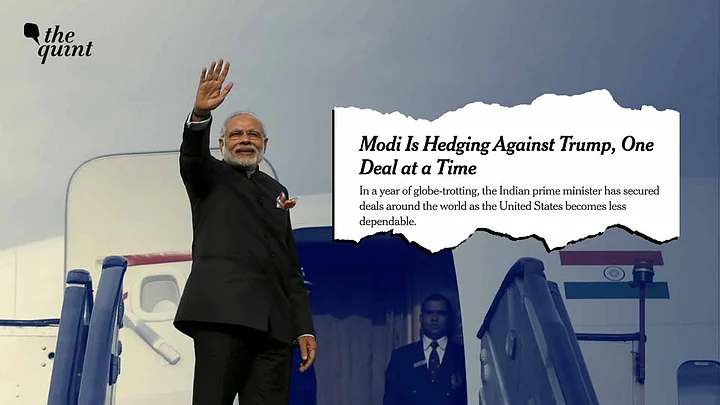
In an article late August, Prime Minister Narendra Modi’s foreign policy received a thumbs up from a very prominent US newspaper which has usually been a harsh critic of his governance record. The newspaper reported that faced with US President Donald Trump’s erratic conduct, especially on trade and tariffs, Modi, showing remarkable energy, undertook travels to many countries to stitch ‘deals’.
Equally, many countries’ leaders visited India to “secure access to the world's fastest growing large economy”.
The fact that India was able to successfully steer and find common ground during the BRICS Delhi Summit to issue a Declaration would have been in keeping with the report’s thrust.
The newspaper’s write-up would have been appreciated by the Modi government especially because its relations with this newspaper have been largely acrimonious.
In 2019, External Affairs Minister S Jaishankar, referring to its criticism, asserted that India’s reputation was not decided by a newspaper in New York.
Diplomatic Expansion or Trumpian Strong-arming?
How should the newspaper’s comments be interpreted, especially as the newspaper is a harsh critic of the Trump administration? Does it reflect the fear, in some US circles, that Trump’s pressures and erratic conduct is endangering the India-US relationship whose upward trajectory has enjoyed wide bipartisan support for two decades?
This section feels that instead of further cementing India-US ties, Modi is being forced to look to fostering or strengthening partnerships with other countries, many of whom have been stung by Trump’s policies and actions too.
It does so because US analysts would have particularly noted Modi’s outreach to Europe, which has been reciprocated. This is despite Trump’s tantrums and invective against Europe transatlantic ties remain very consequential in world trade, technology transfers, and capital movement. This is not likely to change.
This stated, it is necessary to examine if Modi has undertaken more foreign travels over the last two years than he did since becoming PM in 2014. Except for the COVID-19 pandemic years, Modi maintained a hectic pace of foreign travel for bilateral and multilateral visits. The number of the trips since 2025 has not shown a dramatic increase.
The Trade Gambit
India traditionally has had a trade surplus with the US. In financial year 2025-26, India surplus was $33.8 billion in merchandise trade. In addition, in the services sector, the surplus was over $4 billion. The US market in goods and services is exceedingly important for India.
Both were deeply disturbed by Trump’s imposition of tariffs on Indian goods last year—and his visa policies that restricted the activities of the Indian tech companies. Both countries are now in the midst of working on a trade deal.
On 9 September, India’s Commerce Secretary Rajesh Agarwal was quoted in the press as saying, “The India-US Trade Pact is more or less finalised, with only a few issues being discussed by the two sides, and it will be signed at the appropriate time”. Such positive noises are being made by Delhi and Washington for some months. It is known that Trump wants India to open up sensitive areas in the agriculture sector—and that will be politically costly for Modi.
Hence, despite these soothing sounds, it is only when the trade pact is inked and ratified that there will be some certainty for Indian exporters. The word ‘some’ is used deliberately because Trump has a history of tearing up bilateral and multilateral agreements. Hence, even with a pact, there will not be any complete certainty as long as Trump remains in office.
In these circumstances, it was prudent for Modi to spread India’s trading and services options—as well as to make it clear that India will protect its energy security in a manner which was advantageous to it.
Hence, the continuance of buying Russian oil was correct—and it was good that Modi defied the American and European pressures on this account.
The problem, however, is that there are no markets which can really replace the US market for India’s goods and services sectors.
That can be seen in the fact that in merchandise exports, India has a trade surplus with only six of its 25 leading trading partners—and that its merchandise deficit is over $333 billion.
Admittedly, a lot of this deficit is because of imports of hydrocarbons but the elephant in the room is China, with which India’s trade deficit has reached $112 billion despite all of Modi’s efforts at atmanirbharta (self reliance). There are no prospects of this changing soon. Thus, the purple prose of the Ministry of Commerce’s statement some months ago is exaggerated.
The statement noted, “These agreements are for farmers… They are for entrepreneurs, women-led MSMEs exporting garments, leather and handicrafts with new competitiveness. They are for talent… IT professionals, chefs, yoga instructors who now have choices and clear mobility pathways to work, to study, and to build futures supported by post-study work visas, mobility, and social security relief. They are for organic products and traditional wellness systems of AYUSH. They are for digital services, powering the worlds’ AI. They are for catalysing investments and making our FTA partners, our stakeholders”.
'Dealing' with the AI Revolution
Apart from trade, there is also an enormous challenge that India faces because of the breathtakingly rapid advance of the current fourth industrial revolution encompassing AI and robotics. In these areas, the leading countries are the US and China. European states, Japan, and South Korea are puny players in the AI field.
Cutting-edge work that will define many aspects of human life is taking place only in the US and China. Unfortunately, unlike the third industrial revolution encompassing IT and computers—when India could and did play a role, now it will find it very difficult to do so.
The deals being made by Modi will not assist in this process because the partner-countries of these deals cannot assist in the AI field. This part has been missed by the US newspaper article altogether. The international order is in a churn. The middle powers, especially those with nuclear weapons, may be able to defend themselves especially when faced with existential crises. But, for real progress, the path lies through progress in cutting-edge technology in AI.
Not all the attempts at reaching out to the world can help in this process. Neither will multilateral documents of summits such as BRICS address the situation except marginally.
The only path lies through a commitment of becoming a truly scientific and technological power. Contrary to what the article suggests, the path to that does not lie through trade deals and opening up ties with other states.
(The writer is a former Secretary [West], Ministry of External Affairs. He can be reached @VivekKatju. This is an opinion piece, and the views expressed above are the author’s own. The Quint neither endorses nor is responsible for the same.)