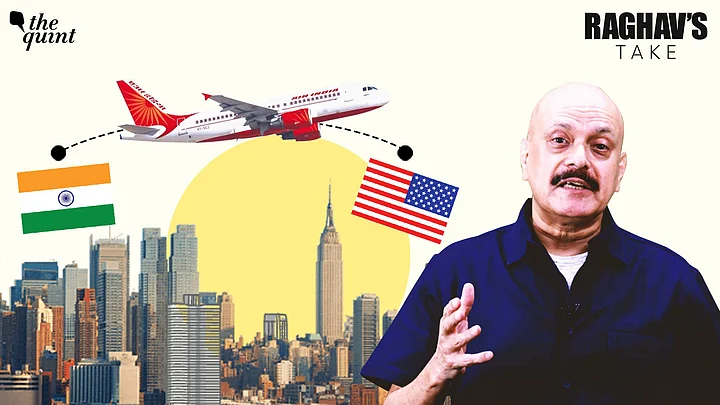
It seemed like a crazy thing to do, but I flew to America last week. On Air India!
My friends beseeched me—“They’ve just had two international aircraft return from mid-flight glitches in the last ten days. In any case, why go now with missiles whistling past your window?”.
I shrugged off their exaggerated concerns—“C’mon, those were exceptional snafus. In one instance, they just got the wrong aircraft airborne, so that was idiotic, but there was nothing wrong with the machine. In the other, it was the problematic Boeing Dreamliner. But I am flying on the brand-new Airbus 350-900. It’s as safe as a mother’s cradle. And there’s no question of brushing against shrieking missiles, because (a) I will be on an aisle seat and (b) we will be taking a wide detour, refueling in Rome, and landing in New York after 22 hours. I am going guys, see you!”.
We reached the airport, bright and dandy, at half past midnight, a safe three hours before take-off. The usually bustling check-in counters were desolate. Not a soul was in sight. I turned to my wife and said, “See, people fear flying in the war, so it’s perhaps going to be an empty aircraft. Great, the toilets will stay clean!”.
I spoke too soon. We ran smack into the most crowded immigration lines I’ve ever encountered at Terminal 3 of Indira Gandhi International Airport in New Delhi. Clearly, people had checked in much earlier than usual. Almost 90 percent of the travelers in the first/business security lines were foreigners. That too was unusual. Everybody seemed to be flocking out of the fog of war that has enveloped the blighted arc from the Middle East through Hormuz to South Asia. From serpentine queues to buy gas cylinders, to the inflation and wealth destruction caused by a spiking rupee—finally the dread of food and other shortages—obviously, foreigners were vamoosing.
Much to the (presumed) chagrin of the naysayers, AI-101 was uneventful and comfortable—except for the toilets. The dimwit who designed the business class cabin must have giant kidneys with a reservoir to store piss. Why else would he create two tiny shit-pots for 32 passengers, three pilots, and the entire forward crew!?
It was a non-stop relay for 22 hours, to dart though narrow aisles, beat the old lady in hot pursuit, fling yourself into the cubicle and relieve your trembling bladder. Rinse and repeat, every three hours or so, depending on when the last beer was drained.
Surreal, Isolated, and Safe in New York
Finally, we landed in New York. It’s surreally normal. No queues for gas. No worry lines on pedestrians’ faces. Nobody looked over her shoulder to see if a drone was buzzing perilously close. No fog. No war. Just an eager wait for the Easter weekend to celebrate.
America had triggered mayhem in the Middle East and Asia, but at home, it was placid, peaceful. I guess America is just too far even for ICBMs (inter-continental ballistic missiles).
Think about it—for over a hundred years, America’s airspace has been militarily violated just twice. First by Kamikaze Jap pilots at Pearl Harbour in the Second World War. And on 9/11, by suicidal hijacked planes. Other than these abnormal transgressions, America’s splendid isolation, guarded by two large ponds on both sides, has allowed it to heap misery on the world but stay un-pockmarked itself.
In fact, the Second World War gave wings to America. Europe and Asia were devastated. Others were too poor or small. So, America took charge and became the unquestioned global leader. It built gleaming new infrastructure while the rest of the world merely reconstructed what had been destroyed. Its universities sparkled with knowledge and innovation. America became the most envied entrepreneurial hub on earth. It junked the gold standard and made the US dollar the world’s reserve currency. It built strong military bases across the globe, amplifying its superpower aura and gouging on oil and other precious resources. Once the Soviet Union collapsed, America reigned supreme, unchallenged.
But a positive chemistry now imbued American isolation. Even as it stood majestically alone, geographically safe from wars and destruction, America opened its mind and borders to a flood of gifted immigrants. That chemically changed America, from a secluded titan with a narrow, self-serving worldview, to a magnet for brilliance.
America became multicultural, plural, absorbing and nurturing astonishing skills from everywhere or wherever. That also gave America the ability to understand the world’s diversity, to step away from a white/Christian tunnel vision, to emerge as a globally synthesised and widely accepted leader.
But Now We Are in DJT Country!
It’s bewildering how America abdicated that exalted status in one turbulent year under the tempestuous Donald Trump. I may be totally wrong, way off the mark, but as I walk the streets of New York, I sense an indifference to the carnage America is wreaking on innocents in the Middle East. People are shopping, laughing, taking selfies, skateboarding, shaking beers, and martinis. It’s as if the unconcern, the remoteness, the amnesia of yesteryears has returned to repossess America. “It’s happening too far away, to people I don’t know or can relate with, it’s unlikely to disrupt my life, except for a higher gas price…So should I really stop and think and care or just get on with it?”.
I berate myself for being simplistic, even cynical. Aren’t these ordinary people just doing ordinary things? Surely, they are unhappy about the war in faraway Iran, but why should they look morose to show their concern? Why should they want to look devastated?
Or is America undergoing a reverse chemical reaction towards a re-isolation? Since immigrants are being outlawed, ostracised, bad mouthed, has America begun to shut its mind, along with the borders? That’s a frightening thought, but also a possible explamation of the mounting indifference, the creeping amnesia…so distressingly visible on the streets!
As I get set to board AI-102 for my return to India, I pray for two things. That I am wrong about how I read the mood in New York. And that Air India has added two toilets to the front cabin of the A350-900.