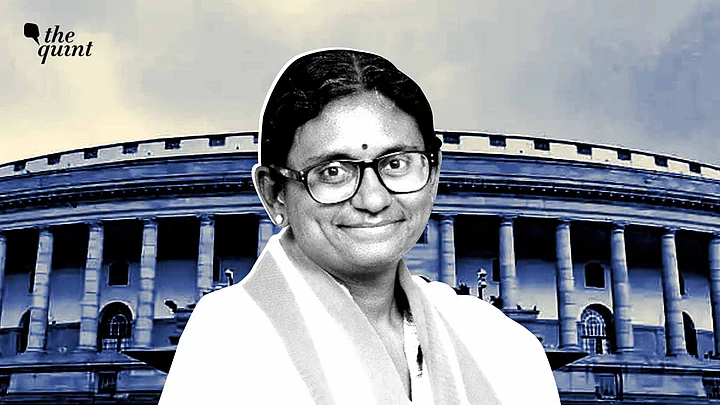
The controversy over the rejection of Congress Rajya Sabha candidate Meenakshi Natarajan’s nomination form in Bhopal on 10 June is more than about one Rajya Sabha seat or one candidate. It is about the Bharatiya Janata Party (BJP)'s aggressive style of politics that uses every available political lever to put Opposition parties on the defensive.
The Supreme Court on Friday dismissed the petition moved by Natarajan against the rejection. A Bench of Justice PK Mishra and Justice AS Chandurkar said that an election petition was not maintainable after the commencement of election process.
The basic facts of the recent controversy are clear.
For the three Rajya Sabha vacant seats in Madhya Pradesh, the state Assembly math would have allowed two for the BJP and one for the Congress, for which Natarajan was the candidate. The BJP, however, made its motives clear by fielding Mahesh Kevat as the third candidate.
His nomination would have been possible only with the cross-voting of 8 to 10 Congress candidates.
The failure to list a private complaint against Natarajan (not a case) in a Telangana court, and its subsequent notice, was cited as the reason for rejecting the candidacy. State Congress president Jitu Patwari, however, alleged that there was no heading or section in the nomination form under which this could have been mentioned in the form.
Anger and frustration were visible among Congress workers in Bhopal and Delhi as party cadres and MLAs staged a series of protests. A senior Congress leader admitted that the cadre was “demoralised and dejected”, but added that the party was “down but not out.”
Many felt that the rejection of the nomination was part of a larger political environment, where Opposition parties increasingly find themselves fighting not just elections but also a constant battle against the ruling party’s tactics. Even as the Congress accused the BJP's political tactics, the BJP argued that the Congress was responsible for its own failure due to poor planning and internal mismanagement.
Institutional Hostility Against Opposition
Natarajan, a former MP from Mandsaur, alleged that the controversy began when the BJP decided to field a third candidate despite not having the required numbers.
According to her, the move was designed to create uncertainty and put pressure on the democratic process. She argued that the issue was not limited to her candidature but was connected to the larger question of protecting democratic values. She said, "First the BJP indulged in vote chori, and now in seat chori".
The BJP, however, presented a different argument. Chief Minister Mohan Yadav and BJP state president Hemant Khandelwal blamed the Congress leadership for the crisis, claiming that the party had failed to manage its own affairs. Publicly, the BJP shifted responsibility towards the Congress, but behind the scenes, the episode revealed a carefully planned political strategy.
A senior BJP leader admitted to The Quint that the party had worked on securing support from MLAs and was short of the required numbers by only a small margin. He claimed that the party had a backup strategy ready. When political negotiations did not appear successful, the BJP moved towards a legal challenge.
This approach reflects the BJP’s broader political style—one that combines electoral strategy, legal avenues, and pressure tactics. The party has shown a willingness to explore every possible opportunity to weaken opponents and expand its political advantage. Critics argue that this has created an uneven political environment where Opposition parties are forced to constantly defend themselves against unexpected moves.
The Election Commission of India (ECI) and other institutions, meanwhile, face questions over their role and response. In a democracy, institutions responsible for overseeing elections are expected to maintain public confidence by ensuring transparency and fairness.
The ECI's gates were closed for the Congress leaders who wanted to meet the officials in Delhi immediately after the rejection of the nomination form in Bhopal.
Lessons for Congress
The Congress’ biggest failure in this episode, however, was its inability to anticipate the BJP’s strategy. The party did not appear to have a backup plan or a dummy candidate ready.
Jitu Patwari argued that considering the history of Rajya Sabha elections and the party’s numbers, nobody expected such a situation. But that explanation also highlights the larger weakness within the organisation—the failure to prepare for political possibilities created by an opponent known for its aggressive tactics.
A senior Congress leader admitted that while the party has young leadership at the state level, the situation required more experienced political handling. The leadership needed to act faster and manage the crisis with greater precision.
Phool Singh Barraiya, Congress MLA from Bhander in Datia district, told The Quint, "We failed to anticipate this scenario," and admitted that the party "should have a backup plan."
The confusion over transporting Congress MLAs further exposed organisational weaknesses. For several hours, the airport authority did not allow the aircraft carrying party MLAs to take off. But, prior to this, there was uncertainty over who should board—only MLAs, family members, supporters or staff. In a high-pressure political battle, such confusion can prove costly.
The Rajya Sabha controversy may eventually be decided through legal and constitutional processes, but its political message is already clear.
Unless Opposition parties learn to anticipate such moves and build stronger systems of response, they will continue to find themselves reacting to a political game whose rules are constantly being rewritten.
(Deshdeep Saxena is an independent jouranlist reporting on news and politics from Madhya Pradesh.)