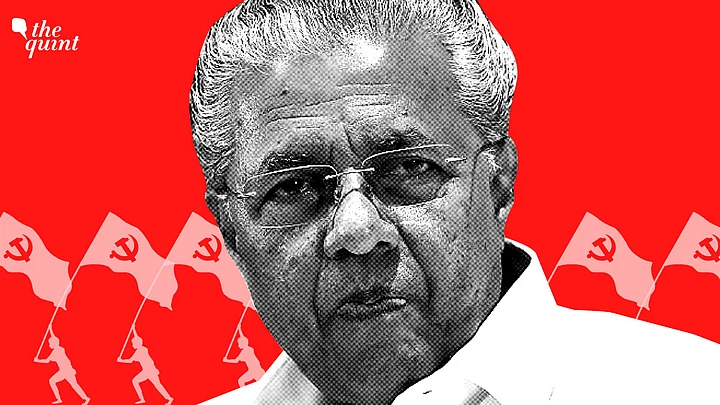
On the night of 3 May, Pinarayi Vijayan quietly changed his social media bio. He removed “Chief Minister of Kerala” and replaced it with “Polit Bureau Member, Communist Party of India (Marxist).” The counting had not yet begun, but the man who had governed Kerala for a decade already knew.
On 4 May, the numbers confirmed it. The Congress-led United Democratic Front (UDF) swept Kerala with 102 of 140 seats, reducing the Left Democratic Front (LDF) from the 99 it won in 2021 to 35—a loss of 64 seats, the most devastating swing in the state’s modern electoral history. Thirteen of Vijayan’s 21 cabinet ministers were defeated. Vijayan managed to retain Dharmadam—the Kannur constituency he had held since 2016, the seat that sits beside his native village of Pinarayi to Congress candidate VP Abdul Rasheed. By evening, he had submitted his resignation. The CPI(M) Polit Bureau issued a statement promising “introspection” and “corrective measures.”
But this is not just a Kerala story. It is a national inflection point. For the first time since 1977—nearly half a century—no Indian state has a communist government. The Left governed West Bengal from 1977 to 2011, Tripura from 1993 to 2018, and Kerala from 2016 to today. When one fell, another held.
The chain that began when EMS Namboodiripad formed the world’s first democratically elected communist government in Kerala in 1957—the government that proved Marxists could win power through the ballot box—has, as of this evening, no address anywhere in the world’s largest democracy.
At their peak, India’s communist parties held 62 Lok Sabha seats and were powerful enough to nearly block the India-US nuclear deal in 2007. Today they hold four seats in Parliament and zero chief ministers’ offices.
Vijayan's Legacy: What He Built...
The scale of the defeat should not, however, be read as a repudiation of the record, because no honest assessment of Kerala politics over the past decade can deny what Vijayan delivered. The Kochi Metro, the Vizhinjam port, K-FON—India’s first state-owned fibre optic network designed to reach every household—the Life Mission housing programme, near-universal LPG penetration, a Covid-19 response that was a global reference point in its first wave, the 2018 flood response that drew international recognition, and the Nipah containment for which the Institute of Human Virology in Baltimore honoured him personally.
Last November, he declared Kerala free from extreme poverty under a four-year alleviation programme—the first Indian state to make that claim.
He governed Kerala through more consecutive crises than any chief minister in any Indian state has faced, and he governed them with a competence that his critics, however much they disagreed with his style, have struggled to match.
He also built the CPI(M) in Kerala into an electoral machine that won six consecutive elections under his leadership, centralised decision-making to a degree unprecedented in the party’s Kerala history, enforced discipline, marginalised dissent—including his long-running factional rival VS Achuthanandan—and turned a coalition-dependent party into a leader-dependent one. That dual legacy—the governance record and the centralised control—is both his achievement and the source of the catastrophe the party now faces.
A leader-dependent machine, when the leader falls, does not transition smoothly. It collapses. Thirteen ministers defeated is not a swing. It is a structural failure of an organisation that had no second line because the first line never permitted one to develop.
...And What He Did Not Build
In a decade as Chief Minister and 17 years as state secretary before that, Vijayan did not groom a single leader capable of stepping into his role with independent public credibility. The CPI(M) in Kerala is a party of deep organisational strength—cadres, unions, cooperatives, local government networks—but no political personality behind Vijayan commands the kind of recognition or authority that can hold a state election together. This is not an accident of circumstances but the consequence of a leadership style that consistently prized control over cultivation, loyalty over independence, and discipline over creative disagreement. Today’s result is the price of that choice.
More importantly, Vijayan did not build a national Left movement. He governed India’s most successful Left state for a decade during which the CPI(M)’s national presence shrank to four Lok Sabha seats, was erased from Bengal, and vanished from Tripura.
Kerala was a showcase of what Left governance could deliver, but it was never converted into a springboard for Left politics beyond the state’s borders.
The irony is that the economic conditions in India during Vijayan’s tenure—youth unemployment at 23.2 percent, graduate unemployment at 42.3 percent, stagnant real wages, an unaffordable housing market, the explosion of precarious gig work without contracts or protections—were more favourable for a Left message than at any point since the 1970s. But the message never travelled, because the party’s language, cadre structure, and cultural appeal remained rooted in another era. Vijayan’s political energy was directed entirely at governing Kerala rather than rebuilding the Left nationally. He held the last fortress. He did not use it to reclaim any territory.
What the Loss Creates
Vijayan’s defeat—102 seats for the UDF against 35 for the LDF—creates something his continued victory could never have created: space for the CPI(M) in Kerala to undergo the generational, strategic, and ideological renewal that the party has been discussing in its national documents for years but never implementing where it matters most.
The space is, first, generational. The CPI(M) has set 75 as the upper age limit for central committee membership and has spoken publicly about phasing out functionaries over 70 and bringing younger faces into state and district committees and, crucially, into election candidacies. Under Vijayan, who is 81, this transition was perpetually deferred in Kerala even as it was being attempted—haltingly—in Bengal and elsewhere. It can no longer be deferred.
The loss gives the party not just permission but compulsion to hand the organisation to a younger generation.
The space is also strategic. Vijayan’s critics within the party and outside it have long argued that his centralised, combative, authoritarian style alienated natural allies—the media, civil society, the church, liberal professionals, young activists, and the kind of issue-based movements that have become the primary vehicle for political engagement among Indians under 35.
Whether those critics are correct about the cause of the defeat is debatable—anti-incumbency, fiscal stress from withheld central funds, the Gulf crisis that severed Kerala’s remittance lifeline, and the sheer weight of ten years in power are all sufficient explanations. But what is not debatable is that a different leader, with a different temperament, now has the opportunity to rebuild those relationships and to construct a more open, less rigid, more coalition-friendly Left politics in Kerala without being seen as disloyal to the outgoing chief minister.
And the space is, most critically, national. The CPI(M) after Vijayan cannot afford to remain a Kerala party, because the conditions for a Left resurgence in India are more favourable than they have been in a generation—but only if the party can learn to speak to the 25-year-old in Bengaluru or Patna or Jaipur who earns Rs 30,000 a month, has no savings, no health insurance, and no realistic prospect of owning a home before middle age.
That person does not care about dialectical materialism or the history of the international communist movement. That person cares about rent, EMIs, whether the platform they work for will deactivate their account tomorrow, and whether anyone in Indian politics is offering a serious answer to the question of why a country growing at 6-7 percent a year cannot provide its educated young people with stable, dignified employment.
The Left’s policy prescriptions—right to work, universal healthcare, platform labour regulation, progressive taxation, affordable public housing—are precisely what this generation needs. Vijayan never built the bridge between Kerala’s governance record and this national constituency. His successors must, or the Left in India will follow the trajectory of Bengal—from fortress to ruin in a single generation.
The Bengal Warning
Bengal’s trajectory after the CPI(M)’s defeat in 2011 is the cautionary tale that Kerala’s Left must study with clinical attention. The CPI(M) governed West Bengal for 34 unbroken years and, when it lost, had no plan for opposition, no generational transition strategy, no new language for new voters, and no willingness to confront the structural reasons for its defeat—the land acquisition crisis at Nandigram and Singur, the alienation of the Muslim vote, the stagnation of the cadre base, the party’s transformation from a movement into a bureaucracy. Fourteen years later, it has not won a state election, its vote share has cratered, and it is fighting for survival in a state it once dominated as completely as the CPI(M) has dominated Kerala.
The parallels are uncomfortable. Like Bengal’s Left in 2011, Kerala’s Left in 2026 has lost not on policy but on incumbency, style, and the accumulation of grievances that ten years of one-party, one-leader governance inevitably produces. Like Bengal, the organisational culture rewards loyalty over initiative, seniority over creativity, and discipline over dissent.
The CPI(M) Polit Bureau’s statement tonight—promising “introspection” and “corrective measures”—is precisely the kind of language Bengal’s party used in 2011. It preceded not reform but paralysis. The question is whether Kerala’s CPI(M) is capable of the radical self-examination that Bengal’s CPI(M) never undertookor whether, like its eastern counterpart, it will blame the defeat on external factors and spend the next decade discovering that the voters who left are not coming back.
The Last Address
Pinarayi Vijayan’s legacy is not the defeat, because the defeat is the state’s oldest electoral pattern reasserting itself—a pattern so deep that breaking it once, as he did in 2021, was already the most remarkable achievement of any Kerala politician in half a century.
His legacy is the decade—six elections won, two terms as chief minister, infrastructure built at a scale his predecessors did not attempt, crises navigated with a competence that set national benchmarks, a state declared free from extreme poverty, and a government run with the kind of focused, outcome-oriented, unapologetically assertive leadership that Kerala had not seen before and may not see again.
He was not loved by everyone, and he was not supposed to be. He was a communist who governed like a CEO, an organiser who ruled like a patriarch, and a leader who proved that the Left can win, can govern, and can deliver—but who also demonstrated, through the very completeness of his control, that building a party around one person is not the same as building a movement that survives that person’s departure.
Today, with the LDF reduced to 35 seats, the cost of that lesson has been measured.
But the loss is larger than one man or one state. In 1957, Kerala proved that communists could win power in a democracy. Since 1977, the Left always governed somewhere in India—Bengal, Tripura, Kerala, taking turns holding the line. Bengal fell in 2011. Tripura fell in 2018. Kerala fell today. For the first time in nearly half a century, the Left governs nowhere in the world’s largest democracy. The party that once held 62 Parliamentary seats and made prime ministers nervous now holds four, and as of this evening, zero chief ministers’ offices.
(VK Shashikumar is a former roving foreign affairs correspondent who covered West Asia, and later set up the investigations team at CNN-IBN (now News18.). This is an opinion piece and the views expressed are the author's own. The Quint does not endorse or is responsible for them.)