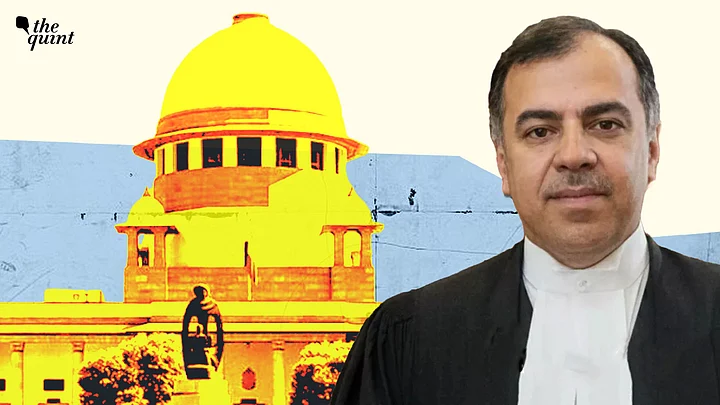
The recent order by Justice Pankaj Bhatia of the Lucknow Bench of the Allahabad High Court—where he requested the Chief Justice to not assign him bail matters—is a moment of profound institutional crisis. Not because a judge made an error, but because of the manner in which the error was corrected.
While the Supreme Court of India possesses the undoubted authority to set aside orders it deems legally unsustainable, the language employed by the Bench of Justices JB Pardiwala and KV Viswanathan in the Chetram Verma case crossed the line from judicial correction to personal censure.
By labelling Justice Bhatia’s order as "one of the most shocking and disappointing" and directing the circulation of this rebuke to the Chief Justice, the Supreme Court did more than reverse a legal decision—it struck at the very confidence of a sitting judge.
The subsequent order by Justice Bhatia, admitting that the remarks had a "huge demoralising and chilling effect" on him, stands as living proof of the unintended but very real consequences of such public castigation.
Beyond Legal Factitude
It is crucial to establish that the debate here is not about the legal correctness of the original bail order. The Supreme Court found that the High Court had failed to consider the statutory presumption under Section 118 of the Bharatiya Sakshya Adhiniyam (BSA) regarding dowry death, and that the reasons provided were insufficient.
In a hierarchical system, the Supreme Court was right to intervene and set aside the bail. However, the function of an appellate court is to correct the order, not to demolish the judge. The Supreme Court could have simply set aside the bail and remanded the matter for fresh consideration, perhaps with guidelines on what factors needed to be weighed. Instead, by using language that questioned the very judicial acumen of the author judge, it transformed a legal correction into a public humiliation.
This distinction is critical: if every erroneous order leads to a personal indictment of the judge, the judicial process becomes a minefield of fear rather than a forum for independent decision-making.
Justice Bhatia & the Business of Bail Disposal
At the Allahabad High Court, Lucknow Bench, Justice Pankaj Bhatia is widely regarded as one of the finest judges on the bench. He presides over a court that never judges a file by the gown—meaning it does not assess cases based on who the litigant or lawyer is—but solely by the arguments advanced and the merits of the matter. This time, he was allocated the bail roster, referring to the roster system under which specific categories of cases are assigned to a particular judge for a period of a few months.
The disposal of cases is the lifeblood of a functioning judiciary, and on this critical parameter, Justice Pankaj Bhatia's record speaks volumes. During a brief period of just over two months—from 7 October 2025 to 19 December 2025—Justice Bhatia disposed of approximately 3,451 regular bail applications, 104 bail cancellation applications, and 162 anticipatory bail applications.
When compared with other courts and judges, these figures are significantly better, both in terms of sheer disposal rate and the relief granted to litigants. This level of productivity demonstrates a judge who is not only efficient but also sensitive to the liberty of individuals, understanding that delays in bail matters often result in prolonged pre-trial incarceration.
However, this very efficiency has created a troubling paradox. On one hand, the judiciary at all levels repeatedly emphasises that pendency and delay are the biggest challenges facing the justice system, and judges are urged to dispose of matters swiftly.
Yet, on the other hand, when a judge like Justice Bhatia disposes of a high volume of bail applications—inevitably exercising discretion in favor of liberty in many cases, a single order that finds disfavour with the appellate court can invite public censure.
The recent remarks by the Supreme Court, branding one of his orders as "shocking," have had precisely such a chilling effect, causing him to seek removal from the bail roster altogether. When a judge known for his disposal rate and merit-based approach is demoralised to the point of recusal, the system loses not just one judge's contribution, but sends a message to the entire judiciary: that deciding cases quickly and liberally comes with personal risk. The result is a slower, more cautious, and ultimately less accessible justice system, ie, the very opposite of what is needed.
Akbar Nagar Demolition
In a significant interim order passed in Syed Hamidul Bari vs State of UP, Justice Pankaj Bhatia intervened to stay a large-scale demolition drive in the Akbar Nagar I and II areas of Lucknow.
The petitioners, who claimed to be in possession of the land for 40 to 50 years, faced demolition proceedings initiated by the Lucknow Development Authority under Section 27 of the UP Urban Planning and Development Act, 1973, on the ground that the land fell within a green belt or 'Doob Kshetra'.
Although the petitioners could not prima facie demonstrate title over the property, the Court took serious note of the fact that the area was densely populated with relatively poor residents, that municipal facilities had been provided by the government, and that the demolition was being pursued in a "tearing hurry" without giving proper effect to the existing rehabilitation scheme.
The Court held that the right to livelihood, being an integral part of the right to life under Article 21 of the Constitution, was prima facie affected by the proposed demolitions.
Observing that it was the bounden duty of the State to ensure that this fundamental right is not violated while discharging its other obligations, Justice Bhatia directed the Lucknow Development Authority to grant four weeks' time to the inhabitants to apply under the rehabilitation scheme.
The demolition drive was stayed until the next date of listing, with the further direction that only after steps for resettlement are taken could the authority obtain physical possession of the property. Unfortunately, later the matter went to another bench in appeal and the demolition was carried out.
Photo-Affidavit Judgment
In another progressive interim order, Justice Pankaj Bhatia had directed that the charge of Rs 500 levied by the High Court Bar Association and Oudh Bar Association for photo identification of affidavits shall not be realised from litigants.
The Court termed the practice "retrogressive" and contrary to the vision of Digital India, observing that forcing litigants to travel from far-off places solely for photo identification created unnecessary roadblocks in accessing justice.
The Court noted that while Bar Associations have the power to take welfare measures for their members, such measures cannot be linked to the quantum of litigation filed before the Court. It was further revealed that despite earlier Division Bench orders restraining such collections, the practice continued, with the Bar Associations attempting to justify the same through internal resolutions.
As an additional interim measure, the Court directed the Registry to accept affidavits sworn before Notary Publics appointed anywhere in the country, holding that such affidavits are valid under the Notaries Act, 1952. The Court observed that the list of 272 defects being raised by the Stamp Reporting Section, including those relating to notarised affidavits, had no force of law as they were not prescribed under the Allahabad High Court Rules.
Recognising the constitutional right to access justice, Justice Bhatia directed that the list of defects pertaining to affidavits shall not be raised by the Registry for petitions supported by notarised affidavits. The order was directed to be circulated to the Stamp Reporting Section for compliance, with a warning that any violation would attract contempt proceedings. The matter was also placed before the Chief Justice to consider administrative measures for suitably modifying the rules to prevent such hardships to litigants in the future.
A 'Chilling' Effect on the Judge
The chilling effect that Justice Bhatia candidly admitted to is precisely the danger that institutional purists fear. When a judge feels compelled to recuse from an entire roster—not because of bias, but because of a fear of the consequences of exercising discretion, then the administration of justice suffers.
Justice Bhatia’s request that bail matters not be assigned to him in the future is an implicit acknowledgment that the trauma of the censure has made him second-guess his own ability to adjudicate freely. This is a loss for the institution.
A judiciary where judges are afraid to grant bail, fearing that a higher court might not just reverse them but humiliate them, inevitably tilts the scales towards incarceration. The presumption of innocence and the liberty of the individual become collateral damage in a system that punishes judicial error with psychological sanctions.
Adding to the tragedy is the context of Justice Bhatia’s overall judicial record. While the Supreme Court focused on one order it deemed lacking, those who practice before the Lucknow Bench consistently regard Justice Pankaj Bhatia as one of its finest judicial minds.
The Indian judiciary is currently grappling with a crisis of pendency and backlog. The system demands judges who can dispose of matters efficiently, and on that metric, Justice Bhatia’s track record is exemplary. A review of his portfolio reveals a judge who handles a heavy volume of cases, understanding that for the common litigant, justice delayed is justice denied. His disposal rate reflects a commitment to clearing the clogged arteries of the justice system.
To brand such a judge with a "most shocking" label based on a single case is to ignore the totality of his contribution to the bench.
Oudh Bar Association Resolution: A Formal Pen Down
The Oudh Bar Association, representing the Lucknow Bench of the Allahabad High Court, had formally written to the Chief Justice of India Surya Kant expressing serious concern over "repeated adverse remarks" made by the Supreme Court against judges of the Allahabad High Court.
In its four-page representation, the Association specifically sought the review and expunction of the recent stigmatic remarks passed against Justice Pankaj Bhatia, whose bail order was termed by the Supreme Court as one of the "most shocking and disappointing orders" it had come across. The representation, signed by President Pt S Chandra and General Secretary Lalit Kishore Tiwari, urged the CJI to advise all accompanying judges of the apex court to avoid passing such adverse remarks, emphasising that judges already work under mounting pressure due to ever-increasing pendency of cases.
The Association argued that remarks of this nature have a "demoralising and chilling effect" not only on the particular judge but on the members of the Bar at large. It stated that while the Supreme Court exercises appellate jurisdiction, there is sometimes an "overreach" in passing remarks on the capability of a judge, which has a "serious jolting psychological effect" on the judicial mind.
The representation highlighted that Justice Bhatia's justice delivery capacity is "unquestionably appreciated by the members of the Court Annexed Bar at large," and noted that just four days after the Supreme Court's censure, Justice Bhatia had passed an order requesting the Chief Justice not to assign him the bail roster in the future. The Association stressed that protecting the morale and working capacity of High Court judges is vital for maintaining a "transparent, fearless and independent judicial system in the interest of Justice."
A Moment of Reckoning
In conclusion, this episode should serve as a moment of introspection for the highest echelons of the judiciary. The Supreme Court is not merely a court of law; it is the guardian of the morale of the entire judicial ecosystem. Its words carry the weight of authority, but they must also carry the wisdom of restraint.
Justice Pankaj Bhatia’s request to be relieved of bail matters is a poignant reminder that judges are not automatons dispensing justice devoid of emotion; they are human beings who feel the sting of public reproach.
In defending Justice Bhatia, we are not defending a potentially erroneous order—we are defending the principle that judicial correction must be devoid of personal denigration.
We, the young lawyers who are still struggling in terms of learning, practice, and procedure, are defending the right of every judge to err and learn, without being broken in the process. If the highest court does not protect the spirit of its judges while correcting their judgments, the foundation of an independent and fearless judiciary will begin to crack.
(Areeb Uddin Ahmed is an advocate practising at the Allahabad High Court. He writes on various legal developments. This is an opinion piece and the views expressed above are the author’s own. The Quint neither endorses nor is responsible for them.)