
ADVERTISEMENTREMOVE AD

Jaya Bachchan and the Media-Friendly Myth of the 'Bitter' Woman

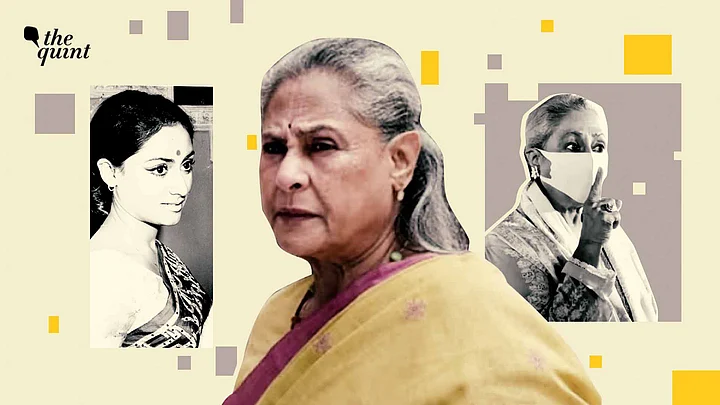
Jaya has been recast as the bitter wife, the nag, the killjoy. The woman who “couldn’t keep her husband happy.”

Published
story-hero-img
i
Aa
Aa
Small
Aa
Medium
Aa
Large

Jaya Bhaduri was a bona fide star long before the Bachchan name became an indelible part of her identity. She was all of 13 years when she made her cinematic debut in Satyajit Ray’s 1963 feminist drama Mahanagar. Her stardom was that of an organic kind, not the manufactured social media fame celebrities chase nowadays.

As my mother would say, there was not a single person with a brain cell who did not love Bhaduri as an actor and public personality during her heydays.

But, a woman in our society becomes “difficult” the moment she refuses to perform likeability. And as women we all know, we become the most intolerant of participating in our own dehumanisation when we start ageing and crone wisdom finally hits us like the thousand bricks of ancestral inheritance. The maiden may be lusted after, the mother may be revered, but the crone is promptly discarded or feared by society, a fate that became inevitable for Bachchan.

ADVERTISEMENTREMOVE AD

A Woman That Scorns

Things were predictably hunky-dory when she married Amitabh Bachchan in 1973 at a time when her pull as a thespian was far greater than her husband’s. It was not till a few years later, when he worked with Rekha in Do Anjaane (1976), that rumours of an affair started stoking the flames of a fire that would continue raging on more than half a century later. Tales of this clandestine affair metastasised into pop-cultural folklore over time but refused to come out of the shadows.

What’s worth interrogating is not just the affair itself—because affairs are depressingly common—but how the fallout has been distributed.

Amitabh Bachchan, the married man with far more power and cultural capital, remains unscathed. Rekha, despite her repeated public declarations of love for a married man, sindoor, and shenanigans has been recast as a wounded, romantic figure nursing a forever longing that can never be absolved. But Jaya Bachchan has been recast as the bitter wife, the nag, the killjoy. The woman who “couldn’t keep her husband happy.”

The cruelty towards her has often intensified online, where it routinely mutates into misogynistic fantasy with comments declaring that Amitabh “deserved” Rekha instead, that Jaya is a punishment, that her anger justifies betrayal.

Of course, Bachchan is not beyond reproach. She has said and done things that are elitist, tone-deaf, and politically problematic. But moral inconsistency is not what fuels the hatred directed at her. What truly unsettles people is her refusal to soften herself for public consumption—to age quietly, to laugh it off, to remain palatable.

In a recent tête-à-tête with Barkha Dutt, Jaya Bachchan spoke candidly about her disillusionment with the institution of marriage. She confessed that she does not want her granddaughter, Navya Naveli Nanda, to get married. Bachchan did admit, while almost blushing, that the fact that her love for Big B started at “first sight” might make her current-day stance on marriage hypocritical.

She went further ahead to suggest that Big B might even be of the opinion that marriage was the biggest mistake of his life. Despite it all, she declared being married to the same man for 52 years is the most she could do for the one she loved so dearly. The ironic bitterness of such a situation was not lost on anyone.

This interview has coincided with a cultural shift in the public consciousness. Feminist observers of pop culture now give Bachchan a kind of grace long denied to her.

Her public persona of that of a curmudgeon, who loves to scold the press and push selfie-obsessed fans away, is finally being understood instead of being labelled “crazy” or “unhinged”.

The Duality of Fandom

From being adored by all, Jaya Bachchan, the no-nonsense matriarch with a thinning head full of grey hair, became the object of massive public ridicule and retort. Her demand for civic sense and better treatment from invasive paparazzi and oblivious fans drew the wrath of the same communities that would do anything to stand in the shine of her celebrity for a few moments of borrowed razzle dazzle.

While the likes of Shatrughan Sinha and Kangana Ranaut have joined the chorus of critical voices against Bachchan, there have also been a few voices of support. Social media personality and actor Sushant Divgikar shared how Bachchan has been performing charity for the needy for years and kept it all away from the media and how she has “helped several children in various cities, towns and villages with education, monthly and yearly rations and even helped their families with additional funding for daily needs and essential goods!”

A Legacy Beyond the Personal

Bachchan is one of the longest-serving women MPs in the Rajya Sabha, with a parliamentary career stretching back to 2004. Over this period, she has maintained an attendance rate of around 82 percent and has been a visibly active presence in the House. However, beyond this record of participation, the tangible legislative outcomes of her tenure remain limited. According to PRS data, she has not introduced a single private member’s bill during her long stint in Parliament, pointing to a lack of direct legislative sponsorship.

Her contributions have instead taken the form of generalist interventions and party-aligned critiques, rather than sustained legislative authorship or institutional reform.

This mirrors her public life. Bachchan occupies space, but is rarely allowed to define it on her own terms. She is scrutinised more for her tone than her substance, more for her sharpness than her silences. Perhaps that is why Jaya Bachchan remains such a polarising figure. She reminds us that ageing women are going to be punished if they are justifiably angry, that betrayed wives are going to be held to higher standards than their cheating husbands, and that women with boundaries will never be celebrated.

However, despite all her perceived flaws, Bachchan’s legacy will far exceed that of her public crucifixion. Her talent as a performer, especially in the era of “middle cinema” will be a legacy worth remembering. Her passion as a politician too will live on synonymously with her sacrifices as a mother.

You don’t have to like Jaya Bachchan. But the disproportionate venom directed at her says far more about those spouting it than it ever will about her.

(The author is an independent film, TV and pop culture journalist who has been feeding into the great sucking maw of the internet since 2010. This is an opinion piece. The views expressed above are the author’s own. The Quint neither endorses nor is responsible for them.)

Speaking truth to power requires allies like you.
Become a Member
Monthly
6-Monthly
Annual
Check Member Benefits
×
×