
ADVERTISEMENTREMOVE AD

Bharat Taxi’s Big Pitch Comes With Fine-Print Risks

Like gig workers were rebranded as 'delivery partners', Bharat Taxi drivers will presumably become 'vehicle owners'.

Published
story-hero-img
i
Aa
Aa
Small
Aa
Medium
Aa
Large

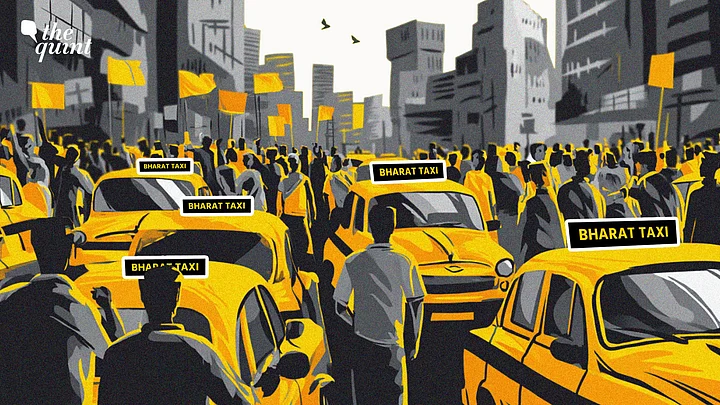
As the New Year dawned, I read about platform-based gig workers in parts of India going on a strike in the critical holiday period to demand better pay and working conditions. At the same time, I read about Bharat Taxi, a government-backed cooperative that aims for a “driver first” approach to cabs to counter the likes of Uber and Ola with cheaper passenger rides.

I asked myself two questions as I weighed reports on gig workers who are often called “delivery partners” and taxi drivers, who will presumably be “vehicle owners” in a cooperative:

1. Why is a cab driver usually not called a gig worker?

2. When does a worker become an employee, an employee a service provider, a ser vice provider a partner or an entrepreneur?

ADVERTISEMENTREMOVE AD

Are Drivers Not Gig Workers?

Fancy management and marketing words have entered our lexicon, but we need to ask, who gains or loses in platform or app-based businesses when there are tussles between business owners and workhorses as they try to serve customers using technology as a common ground?

In principle, an Uber/Ola driver is not unlike a Swiggy/Zomato/Amazon “partner”. The former delivers “human cargo” in four-wheelers. The latter usually “transports” merchandise in two-wheelers.

Yet, in what looks like a remix of India’s old caste system, there is a social difference between cabbies and gig workers that generate differing worldviews and problems.

As we await the next steps after Bharat Taxi’s launch and what looks like a rich promise of affordable yet safe passenger rides, higher share of profits and juicy commissions for drivers and a middleman- free tech experience, we need to study the details of what was, what is and what might be involved to get a better picture of where the pitfalls may lie.

Whether it is a two-wheel delivery or a four-wheel ride, we have to distinguish between the “knows” and “know-nots” on the one hand, and ‘can-do’s and ‘cannots” on the other to understand why entrepreneurs, venture capitalists, policymakers and business managers exist in the first place.

In the Bharat Taxi business, there is a lot to look forward to. But look at the fine print of potential hiccups. It is backed by the Ministry of Cooperation, a project that you may call a “UPI for cab rides” to reduce technology-based middlemen eating up the profits. With support from the venerable Amul and its farm cooperative cousins, IFFCO and rural financier NABARD, commendable cooperative sector experience may aid the growth of Sahakar Taxi Cooperative Ltd, which will administer Bharat Taxi.

On 4 January, the ministry revealed in a tweet that the app had already seen 4 lakh registrations and was ranked #9 on Google Play and #13 on the Apple app store.

Reading the Fine Print

However, I'd like to ask if cabbies will indeed be happy as “business partners”. Companies like Ola, with deep pocket funding from venture capitalists, talked drivers into taking on car loans that made them feel like business owners. Once the welcome music stopped, many drivers found themselves indebted with less take-home pay. Many were also uncomfortable with mobile wallets and card payments that helped the data-science-heavy platforms than their own entrepreneurial ambitions.

Passengers realised after a honeymoon period that surge pricing and busy-hour tariff spikes stopped them on their tracks in crowded cities. Rapido has emerged to challenge Ola and Uber with lower-cost rides, but its incentive structure seems to be a work in progress.

On paper, Bharat Taxi offers a fine middle ground. Given the success of UPI (unified payment interface) , I am tempted to raise my hat to the project and even look forward to rides. But a cab ride is not a machine-to-machine transaction under your control. There are many business gaps that need to be filled for both cabbies and passengers.

Here’s where we must ask if cab drivers will indeed feel like dairy farmers selling milk to Amul. We now have small fleet companies that offer Uber jobs to drivers without the hassles and headaches of their being “owners.” It is pertinent to note that Amul has a big management and marketing layer that helps individual farmers. In one way or another, cabbies need to be facilitated or managed beyond individual capacities.

A look at the recent gig workers’ strike and its underlying complaints and the unions’ wish list shows that if the cab driver feels like a gig worker, there might loom a set of problems.

On the other hand, if a driver-owner is treated an entrepreneur, it is not an easy ride for the person. At the end of the day, an entrepenrurial cabbie has to balance everything from city traffic and family life to finances and accounting.

Organised unions of Swiggy/Zomato/Amazon delivery workers are unhappy with the current system of commissions, performance-linked pay and tech-oriented resolution of disputes. They feel lost and exploited and want minimum assured monthly earnings and a shift system in work. In other words, they would rather be happy workers than hassled partners.

ADVERTISEMENTREMOVE AD

Corporate vs Cooperative

There are lessons for Bharat Taxi optimists here. A well-run platform company that facilitates cabbies while offering them employee benefits through a management that focuses on efficiency rather than exploitation may well work better than a cooperative. A private platform company may have a higher sense of brand ownership with matching accountability on things like passenger safety, besides marketing muscle. If a platform company avoids asinine surge pricing, it may well strike a fine balance between ground workers and customers.

Branded platforms can discipline, incentivise or train drivers in ways a cooperative may not be able to do. I would be happy to be proved wrong on this count though.

Last month, Prime Minister Narendra Modi’s government announced an omnibus set of labour codes to simplify compliance for employers while ensuring benefits like occupational safety, timely pay, minimum wages and social security for various categories of workers including platform-based gig workers. A purely profit-and-commission-based Bharat Taxi needs to ensure it does not fall short on the benefits promised by the code.

It is the nature of humans, even big business, to eat the cake and want it too.

Just as big businesses want protection from international competition, gig workers and cabbies want some kind of employment security and more manageable risk when they are pushed towards risk-taking and performance-linked pay.

Industrial psychologists may be the need of the hour. Everybody wants the upside of entrepreneurship and the safety of a unionised worker. Corporate managements know how to walk this tightrope in a way a cooperative may not be prepared for.

(Madhavan Narayanan is a senior journalist and commentator who has worked for Reuters, Economic Times, Business Standard, and Hindustan Times. He can be reached on Twitter @madversity. This is an opinion piece and the views expressed above are the author’s own. The Quint neither endorses nor is responsible for the same.)

Speaking truth to power requires allies like you.
Become a Member
Monthly
6-Monthly
Annual
Check Member Benefits
×
×