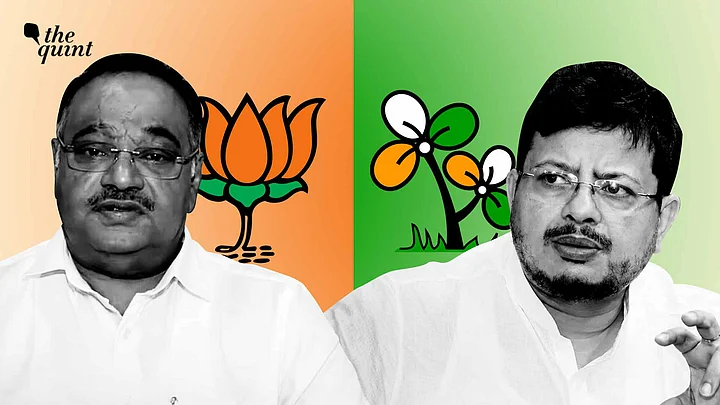
Looking at the West Bengal Legislative Assembly now poses a grimmer picture than what originally emerged for Mamata Banerjee following the decisive mandate of 4 May.
The Trinamool Congress (TMC) has imploded into three separate camps over the last week. While long-term colleagues and the TMC old guard have stuck firmly with Mamata, fewer than 20 MLAs and fewer than 10 MPs remain by her side.
Even though regional parties have faced similar skating defeats in the recent past—be it Naveen Patnaik’s Biju Janata Dal, K Chandrashekar Rao's Bharat Rashtra Samithi, Jaganmohan Reddy’s YSR Congress Party, and even MK Stalin’s DMK—none of these parties faltered and collapsed so quickly.
That underperformance in West Bengal in the 2024 general elections, which had played a role in denying the Bharatiya Janata Party (BJP) a majority, has certainly galvanised the party's invisible hand in pursuing this splinter with the intent to leave the state without an effective Opposition for 2029.
Future Strategy of 'Rebel' Camp Still Under Wraps
The Kolkata splinter, led by Ritabrata Banerjee, includes more than 60 MLAs. Ritabrata’s faction has come out in open criticism of Abhishek Banerjee’s centralisation of party decisions, sidelining of local party leaders, overreliance on I-PAC (Indian Political Action Committee), and a list of corruption cases investigated by central agencies.
For Ritabrata & Co, Mamata shares blame for her oversight. Nonetheless, they have offered Mamata the role of chief advisor for the faction. This camp has fashioned itself as the “principal Opposition” in the Assembly and the “original” Trinamool.
Breakaway MLAs are playing their cards close to chest, with vague commitments to oppose the BJP in the Bengal legislature while praising the Suvendu Adhikari government’s policies. Keeping options open, there is no confirmation on whether this will result in a merger with the BJP in Bengal or simply a breakaway TMC faction that may compete with Mamata for the party symbol.
Whether this faction remains within the TMC but out of Mamata’s control or forms a separate faction, the lack of a coherent or substantial Opposition in the Bengal Legislature would allow the BJP to roll out its policy agenda without hindrance.
The simultaneous Delhi split, with at least 19 rebel TMC MPs in the Lok Sabha, has merged into the Nationalist Citizen Party of India (NCPI) and sided with the ruling National Democratic Alliance (NDA). Despite claiming the two-thirds majority of the TMC parliamentary party, the curious step to join a regional party that is allied to the BJP but a regional force not even based in Bengal is surprising.
While the threat of legal disqualification hung over the dissident MPs—despite the two-thirds TMC MPs forming the rebel bloc—merger was the only way out. But why not with the BJP directly rather than the NCPI?
Why Did BJP Close its Doors to TMC Rebels?
The BJP regularly and readily accommodates defectors and splits from Opposition political parties' factions.
West Bengal CM Adhikari and Assam CM Himanta Biswa Sharma are the best examples of how the BJP has received electoral success using dissident leaders from Opposition parties.
The BJP has also used party splits to secure governments, with Raghav Chadha and seven Aam Aadmi Party (AAP) Rajya Sabha MPs crossing over in May 2026 to inch the BJP closer to the two-thirds majority mark in the upper house, or the Shiv Sena-NCP split in Maharashtra in 2022 to form an NDA government in the state.
Even as the BJP has regularly been criticised for allegedly being a “washing machine” for corrupt leaders who seem to flee from Opposition parties under stress of central agency investigations, the cause for not accepting the TMC dissidents is not an outcome of Opposition criticism or a supposed fear of optics. If AAP dissidents could be absorbed a month ago, why not TMC ones?
There are levels to this answer.
First, the BJP in West Bengal has 208 seats out of 293, which is more than a two-thirds majority in the West Bengal Legislative Assembly. Bengal BJP lacks the incentive to absorb the Ritabrata faction.
The 20-odd MPs in the Lok Sabha, on the other hand, are a different case. The BJP has 240 MPs and is dependent on mercurial coalition politics for governing and pushing through its agenda in Parliament. With the recent failure of The Constitution (131st Amendment) Bill, or Delimitation Bill, in 2026, the BJP is convinced that a two-thirds majority in Parliament is a requisite to consolidate power.
The Kolkata and Delhi splits may be simultaneous, but the BJP's need to absorb the defectors is significantly absent in the Assembly and urgent in the Parliament.
With the rebel TMC MPs siding with the BJP, the NDA will cross its current strength of 292 to 312+, around the two-thirds benchmark in Parliament. Given low Opposition attendance, the BJP can pass through its more contentious agenda. For the BJP, the TMC rebels in Delhi are more meaningful than those in Kolkata. It is not simply prudent opportunism of a dominant party but a clear ploy to secure stable parliamentary numbers.
Appointing an expelled MLA to hold the position of Leader of Opposition in the Bengal Assembly, against Mamata’s choice of Sobhandeb Chattopadhyay, even as the Supreme Court has upheld the party leader’s decision over that of the MLAs, even a majority of them, was only to weaken the TMC and cause panic to set in. Once the exodus in Kolkata began and panic amongst TMC leaders set in, MPs followed suit.
BJP Wants To Avoid 'Trinamoolikaran' in Bengal
But here the second reason is important—while the BJP was willing to accommodate defectors into its fold prior to the 2026 victory, the party is likely to be wary of the public angst towards TMC leaders being transmitted to itself in case of a merger. There is also a fear of “Trinamoolikaran” of the BJP in Bengal, with Samik Bhattacharya, the BJP President in the state, himself denying space to defectors who attempt to join the party following the 2026 defeat.
Moreover, public anger has taken to the streets, parading and humiliating TMC strongmen who had propelled the cut-money system of corruption in rural Bengal and the syndicate rule in Kolkata with fear and threats.
The BJP at this time also has a well-entrenched leadership, who will be less than interested in giving up the 20 seats the rebel TMC MPs hold for 2029 in case of a merger. Having suffered through the 2021 post-poll violence under the TMC and campaigned against the very people on charges of corruption, cut-money culture, syndicate extortion and criminal nexus, the hypocrisy would be palpable.
A merger would mean betrayal to both the Bengal leadership, who would not want to share power with erstwhile TMC rivals, and to the voters, who were promised an uncompromising eradication of the Trinamool raj.
Winning West Bengal is essential to holding the Anga, Banga, Kalinga frontier for 2026. Holding Bengal also depends on the ability of the BJP to differentiate between itself and the TMC government, even as many of its leaders belong to the TMC. This politics of difference is essential to keeping the voters who switch to the BJP as an alternative to the incumbent Mamata government, particularly in the Presidency area.
The NCPI Card May Or May Not Work for the Rebels
A roundabout way to solving this has been the NCPI. The move is political and not simply legal. The split virtually mimics the Raghav Chadha split, and just like the Rajya Sabha Chairperson, the Lok Sabha Speaker decides on the matter.
The TMC rebels have only been able to split the party's parliamentary wing, not the party organisation itself. Given the TMC's franchisee model, the rebel MPs have been elected on Mamata’s name and policy agenda.
One is very doubtful that joining the NCPI, a Tripura-based registered but unrecognised party, gives any definition of legitimacy before their constituents who are more attuned to Bengali ashmita. They will feel betrayed either way. Local BJP leadership wouldn’t want to split tickets with the rebel MPs either way, be it a merger or alliance.
The fear of Trinamoolikaran, entrenched leaders unwilling to share power, and voters who are more anti-TMC than pro-BJP make even the unapologetic BJP consider the rebel TMC leaders as political deadweights needed for the BJP agenda at the center, but politically untouchable for 2029.
The BJP’s motivation in talking rebel MPs out of the TMC and into the NCPI is clear. But what one fails to understand is, how prudently did the rebels judge Mamata and the TMC’s electoral future that they chose to slipping into obscurity as an option over surviving politics in the Opposition?
(Allen David Simon is a political commentator on India, writing on the intersection between political culture and governance. He is currently a Postgraduate Researcher & Deputy Head of Academics at the International Association of Political Science Students (IAPSS) and Editor at Forum of Global Studies (FGS). This is an opinion piece and the views expressed above are the author’s own. The Quint neither endorses nor is responsible for the same.)