
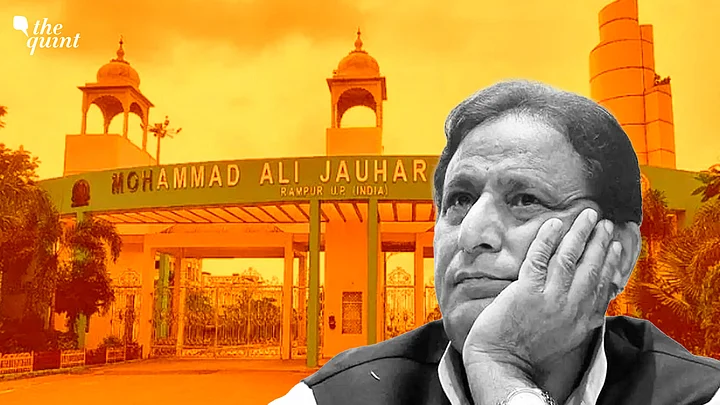
The recent order by the Rampur Development Authority (RDA) to demolish 38 of the 40 buildings of Mohammad Ali Jauhar University not only raises questions about the future of an educational institution, but also shakes the fundamental principles of the Indian democratic system, jurisprudence, and the rule of law.
The decision, taken by the Uttar Pradesh government under Section 27(1) of the Uttar Pradesh Urban Planning and Development Act, 1973, presents a deep administrative irony and an example of selective justice.
Azam Khan's political career, from his student days at Aligarh Muslim University (AMU) to his political dominance in Rampur, may be met with ideological differences or sharp criticism. Allegations of lack of transparency in land acquisition processes or the use of administrative influence cannot be completely dismissed.
But, alongside that criticism, is the larger truth that an institution as established as Jauhar University opened the doors of higher education for youth from the backward areas of western Uttar Pradesh, from both Hindu and Muslim communities.
It is entirely legitimate to ask the question: how many new universities have been founded for society by the policy makers sitting in the current power establishment?
When the power is bent upon destroying an institution where important subjects like engineering, law, medical and management are taught, then this fight is not just limited to a politician, but it becomes an attack on the basic structure of education which prepares generations of common citizens.
Bulldozer Justice or Due Process?
According to administrative arguments, no approved map existed for these 38 buildings, spanning 82,309 square meters. The university management argued that at the time of construction, the area was part of Singankheda village, outside the jurisdiction of the RDA. Even if the failure to obtain map approval from the District Panchayat or other competent authority was technically a mistake, the question arises: is complete destruction the only solution to any administrative violation?
A harsh reality of India's urban landscape is that there is hardly any major government, private, or autonomous educational institution in the country that has not experienced minor deviations from the map in the construction of a hostel, laboratory, or extension wing. Under normal administrative procedures, such cases are regularised by issuing a show-cause notice, compounding, imposing a fine, or requiring necessary improvements to the illegal areas.
Demolition has always been considered a last resort, used only when a structure is completely incurable or poses a serious threat to public safety. The order to demolish 38 buildings outright proves that retribution, not compliance, has become the primary objective.
In recent years, 'bulldozer justice' has been advertised as a political symbol and a means of swift justice. But when massive yellow machines demolish a building in front of cameras, it is not a demonstration of the State's justice.
When administrative officials frame charges, conduct their own investigations, and hand out punishments, the court system and the Constitution's preamble become meaningless.
Can a clerical or procedural error be so severe a punishment that libraries and classrooms built at a cost of crores of rupees are reduced to rubble? When a university is bulldozed, the loss isn't limited to its founder. It directly impacts the lives and livelihoods of students, researchers, professors, and non-teaching staff. Demolishing a temple of learning is a cruel joke with the future of students.
What Jauhar University Represents
The history of Rampur bears witness to the fact that the word "Jauhar" is not merely a political obsession, but is linked to the historical legacy of Maulana Mohammad Ali Jauhar, a great freedom fighter and leader of the Khilafat Movement. The name emerged as a symbol of knowledge, consciousness, and shared culture in this backward region.
When the State machinery issues an order to raze the 38 buildings of the complex associated with this name to rubble in one stroke, it not only demolishes a brick and concrete structure but also attacks a living symbol of the shared history of the freedom struggle and the Ganga-Jamuni Tehzeeb.
This is a clear example of how the administrative machinery is being used as a weapon to selectively target political and cultural identities.
The 'Public Trust Doctrine'
The Supreme Court has clearly established under the "Public Trust Doctrine" that properties or institutions for the public good should be acquired. The State is the trustee—not the owner or destroyer—of institutions established for public services (such as education and health). Even if Azam Khan's intellect and efforts were behind this university, once created the property had become a heritage of society and students.
Even if there were serious violations in the construction, the government had the option of taking over the university's management and appointing a receiver or government administrator—as is done in many other controversial public sector undertakings. But destroying the entire existing infrastructure is a blatant violation of this legal principle.
This step also creates a major contradiction with the country's National Education Policy (NEP). On the one hand, the state and the Central governments claim to improve the standard of higher education and build world-class infrastructure, while on the other, they destroy national assets by demolishing already existing state-of-the-art laboratories, research centres, and classrooms.
Equality Before Law
Article 14 of the Indian Constitution guarantees "equality before the law" and "equal protection of the laws" to every citizen. The strength of law lies in its absoluteness and impartiality.
If all other institutions violating the rules, including those run by politicians associated with the ruling party or influential corporations, are given the opportunity for regularisation, why is Jauhar University being denied that opportunity?
When actions in the justice system begin to be taken based on "who" rather than "what," it ceases to be law and becomes pure state coercion. The role of the country's constitutional courts (the high courts and the Supreme Court) in this entire scenario demands serious self-examination.
When international human rights organisations and the global media witness such selective and harsh actions against opponents of a political party or a particular group of institutions, the world's confidence in the country's democratic credentials and the stability of the rule of law is shaken.
Although the Supreme Court has repeatedly warned that the executive cannot use demolition as a punitive measure—and that no home or institution can be demolished without a proper hearing—in reality, these safeguards are often reduced to mere formalities on the ground. If the courts do not effectively prevent such swift and irreversible executive actions by the executive, the entire principle of justice collapses.
Once a building is razed to the ground, the subsequent years-long legal battle and any final verdict become a 'fait accompli'. Delays in justice, and judicial inaction in bulldozer cases, in particular, inadvertently strengthen the hands of the executive. Moreover, India, which boasts of being the 'Mother of Democracy' on the global stage, is severely undermined by such 'instant municipal justice'.
Democracy on Trial
The dozens of lawsuits against Azam Khan and his family, his continued imprisonment, and now the attempt to destroy his life's most ambitious project, Jauhar University, clearly indicate that this struggle is not limited to enforcing rules.
Victory and defeat and the change of power are normal processes in politics, but when power is used to completely eliminate a political opponent, both personally and institutionally, democracy begins to move towards tyrannical tendencies. Serving punishment after being convicted by the courts is a separate legal process, but turning a university of public importance founded by him to rubble is the height of political malice.
The greatness of any democratic nation is measured by the restraint of its institutions, administrative impartiality, and an unwavering commitment to due process.
The decision to demolish 38 buildings of Jauhar University is a living record of the collective failure of the Indian administrative and judicial system. If this administrative arbitrariness is not stopped, today this bulldozer is demolishing the legacy of one politician, tomorrow it will reduce to rubble the fundamental rights and democratic safeguards of any common citizen of the country. Justice must not only be done, but it must also be seen to be done without fear or favour.
(Azam Khan is an independent researcher and writer based in Uttar Pradesh. His work focuses on the experiences of Muslims, Dalits, and other marginalised communities in post-Independence India. This is an opinion piece and the views expressed are the author’s own. The Quint neither endorses nor is responsible for them.)
