
During the epochal state visit in 2023, only the third for an Indian leader, Prime Minister Narendra Modi quipped in his second address to a joint session of the United States Congress that 'The future is AI—America and India'.
So much so that levity in brevity quip went so far as to then former Ambassadors Eric Garcetti, Washington’s Ambassador in New Delhi and his then counterpart, Ambassador Taranjit Singh Sandhu have fond memories when they narrate the story of the special t-shirt Prime Minister Modi received from President Joe Biden on the last day of his visit three years ago which had exactly this quote on AI printed on it.
Then and Now
Much has changed in three years, and in the world of technology, nanoseconds count for eternity. Artificial Intelligence (AI) has long moved from esoteric to mainstream, and now, we recently concluded the fourth AI Impact Summit this past month in New Delhi.
This is the fourth edition, from the first at Bletchley Park in the United Kingdom, the famed site which turned a bucolic English countryside estate in Bletchley, Milton Keynes, to the geopolitical relevance as the epicenter of the Allied code-breaking and Alan Turing’s immoral genius during the Second World War.
That was the first ever summit, hosted by the British government and former Prime Minister Rishi Sunak focused on AI and safety. Since then, there have been summits in Seoul, South Korea and Paris, France, and this one in New Delhi was the first summit in the Global South.
Much discourse and conversation came out of the summit, as world leaders, and top echelon CEOs of Fortune 100 companies graced the stage with Prime Minister Modi. Conversations from trust and safety to AI in national security, to organisational efficiency to AI in foreign policy and the other AI story—that America and India technological bridge builder.
But there was one topic, that was innocuously missing—the creative industry being substituted with AI.
The Death of Effort
As newsrooms have long faced disruption, and perhaps newsrooms do need exchequers with money than the lord above to bail them out, but then the flipside of the recent purge at The Washington Post reveals the dichotomy. Even Hollywood, with its own futuristic storytelling, now sees AI replace writers and graphic artists.
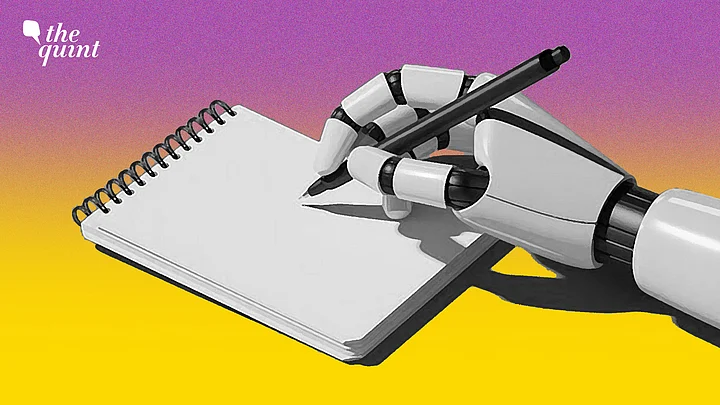
As a former journalist and an op-ed writer, I've always been chagrined to hear about people using AI as a "complete substitute" for writing. So much so, I retort, albeit facetiously, not sardonically or conceitedly, that "I use my own 'AI' to write—"Akshobh Intelligence". My hope is that folks take it for the contrived average wordplay that it is, more than anything else.
Perhaps my obstinacy against using AI to write comes from a few places.
One, I inherently find writing cathartic. Not all the time on all subjects, but most of the time. And hearing my sagacious father inculcating this sacrosanct lesson in me at a young age—"For one to be a good writer, one must be an avid and a voracious reader".
It makes complete sense; one can't write if one hasn't read, the same way one can't learn to speak if one has never heard the words.
Most of us are old enough to remember an era without smartphones, the internet, and turning in "homework" for school and "project reports" meant research, which meant effort, curiosity, and, more importantly, knowledge gained through new information. Even papers in undergraduate and graduate degrees, all done before the advent of AI— There, I've aged you all, you're welcome!
Large Language Models or LLM tools are new, and ergo, there is enough material written by all of us humans (soon to be viewed and seen as archaic as the neanderthals from days of yore), to cite, and then AI works its extrapolative magic, churns, and then produces.
But my curiosity has always been, what if we get to a place where we stop writing, and ergo, we create that trepidation we always feared—where we now have ‘a generation of smart phones and dumb people’.
Assistance to Oversimplified Dependence
Wordplay aside, it behooves us to think and rethink. If we stop writing, will we in 2036 have a situation where AI is simply quoting AI? Would that be akin to recycling unclean water or a Xerox copy of a Xerox copy of a Xerox copy—where it diminishes in quality as it gradually through a few churns?
I understand writing isn't for everyone, and some see it as a drudgery and simply using AI to get done with mundane writing of emails and short form texts is both kosher and innocuous.
However, when I think of AI and writing, I'd prefer it to be used as a tool to aid rather than a cudgel to smash the creative thinker. Almost like a guitarist with a guitar, for neither works without the other. The creative musician depends on the musical instrument to accentuate their brilliance and the guitar by itself is just another inanimate object. AI untouched is useless, it’s uses enhance our productivity.
There is much discourse or AI and safeguarding rights and privacy. But a fair question for us all to ask, is if we stop writing, ergo thinking for ourselves and have the machines do it, well, then, would we get to an era of Artificial Intelligence, where we now find that it is intelligence that is artificial?
(Akshobh Giridharadas is based out of Washington DC and writes on diverse topics such as geopolitics, business, tech and sports. He is a two-time TEDx and Toastmasters public speaker and a graduate of the Fletcher School of Law & Diplomacy. He tweets @Akshobh. This is an opinion piece. The views expressed above are the author’s own. The Quint neither endorses nor is responsible for them.)
