As Indian cities grapple with infrastructure failures, from deadly water contamination in Madhya Pradesh and a ropeway collapse in Bihar to a fatal construction-site accident in Noida and hazardous air pollution, social media has seen a surge in posts linking these crises to plans to migrate or relocate out of India.
On X and Reddit, users have shared personal accounts of cutting short visits, flying abroad temporarily, or planning potential long-term exits from the country, citing health and safety concerns and the inability to “breathe safely” during the winter months.

Here is a preview of the post.
(Source: X/Screenshot)

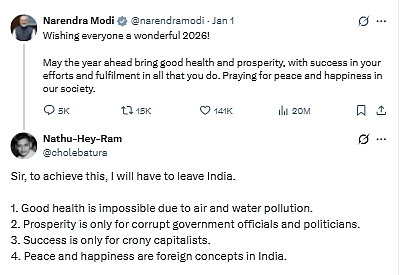
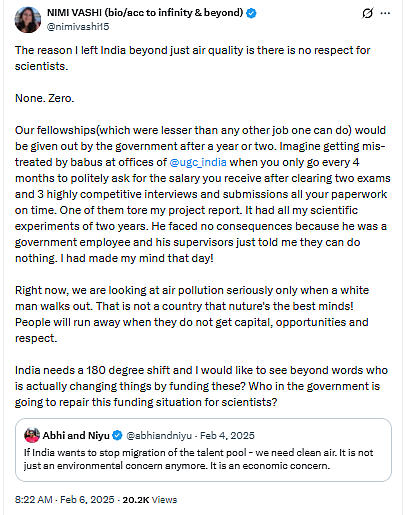
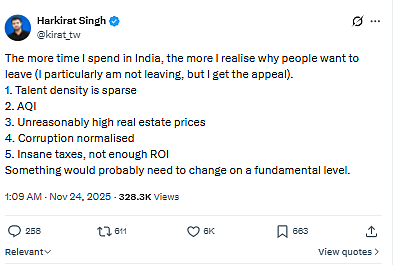
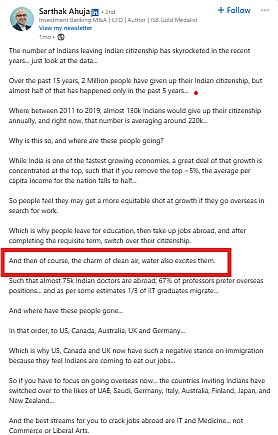
The volume and engagement around such posts indicate growing public frustration with the lack of lasting solutions to urban air pollution.
Against this backdrop, The Quint examined official data on Indians renouncing citizenship between 2014 and 2024. The data shows that over 17.1 lakh Indians gave up their citizenship during this period, moving abroad. In this story, The Quint traces the numbers, possible reasons for giving up the Indian passport and notes experts take on the subject.
What Data Shows
Between 2014 and 2024, 17,10,890 people renounced their Indian citizenship and moved to other countries. This shows a 59.58 percent increase between 2014 and 2024.
The highest number was recorded in 2022, when 2,25,620 individuals gave up Indian citizenship.
The figures dipped sharply in 2020, the year of the COVID-19 pandemic, with around 85,256 people renouncing their citizenship. Additionally, the numbers saw a sharp rise after 2020, with over 2 lakh people leaving annually.
Additionally, as per a Parliament answer from May 2025, the government does not maintain a state-wise database of those renouncing their Indian citizenship.
Countries That Attracted the Highest Number of Former Indian Citizens
As per a parliamentary answer from 2024, it listed the names of countries where Indians have moved; however, the numbers for the same were not mentioned.
A parliamentary response in 2021 took into account data from 2017 to 2021 and noted the following.
The United States remained the most preferred destination for Indians renouncing their citizenship, with numbers far exceeding those for any other country, rising from 50,803 in 2017 to 55,559 in 2021.
Australia also continued to attract a significant number of former Indian citizens, with figures declining from 20,669 in 2017 to 14,416 in 2021, despite a spike to 21,340 in 2019. Canada recorded a steady rise from 17,372 in 2017 to 25,381 in 2019, before seeing a drop to 11,869 by 2021.
England saw relatively high numbers between 2017 and 2019, totalling 50,405 during the period, but this fell sharply to 9,299 in 2021. Italy consistently drew several thousand former Indian citizens each year, though numbers declined from 7,697 in 2017 to 4,871 in 2021.
New Zealand recorded annual figures fluctuating with 4,287 in 2017 and dropping to 1,735 in 2021. Additionally, Germany and Singapore showed stable trends, each attracting around 2,000 former Indian citizens annually.
Additionally, as per the World Population Review 2025, the top five countries with the largest populations of People of Indian Origin (PIOs) in 2024 were:
United States: 33,31,904 PIOs
Malaysia: 27,51,000 PIOs
Myanmar: 20,00,000 PIOs
Canada: 18,59,680 PIOs
South Africa: 16,40,000 PIOs
What is Driving Indians To Leave?
As noted previously, between 2014 and 2024, 17,10,890 people have given up their Indian citizenship and moved to different countries.
Speaking in the Rajya Sabha in 2025, Minister of State for External Affairs Pabitra Margherita said that decisions on citizenship are personal and reflect the realities of a global, knowledge-driven economy. He added that the government views a successful and influential Indian diaspora as a national asset and aims to harness its knowledge, expertise and soft power for India’s benefit.
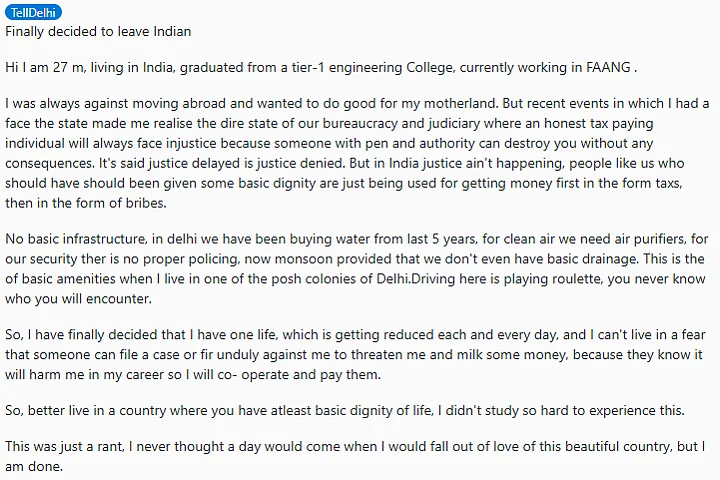
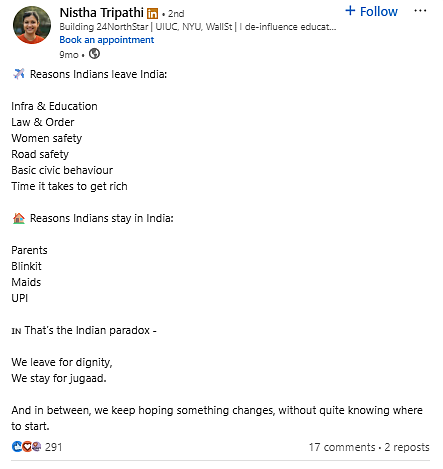
However, several social media threads on platforms like Reddit and LinkedIn reveal that issues such as civic infrastructure, corruption and lack of employment and education opportunities prompt Indians to leave the country and their citizenship, eventually.
Here is a preview of the post.
(Source: LinkedIn/Screenshot)

Speaking to Newslaundry, a friend of Yuvraj Mehta, the 27-year-old techie who drowned in a water-filled pit at a construction site in Noida’s Sector 150, said, “He used to say that India lacks safety measures and proper development. The roads are bad, the facilities are poor, and on top of that, we have to pay so much in taxes. That’s why he wanted to move to the US to be with his sister.” (sic.)
An Indian-origin individual who acquired German citizenship in 2025 told The Quint that systemic issues in India, including income inequality, corruption, poor infrastructure, declining quality of life and deteriorating air quality, drove their decision to leave. While they said life in Germany offers greater stability and better living standards, they added that they sometimes miss the relative ease of life in India, despite Germany being more structured and rule-bound.
Similarly, Overseas Citizen of India (OCI) cardholder Nipun Chopra, an Associate Professor of Neuroscience at DePauw University who has been living in the US for nearly 20 years, said that poor civic infrastructure and rising AQI levels were “partly” among the reasons that led him to settle abroad. He said:
“In Calcutta, where I grew up, the infrastructural limitations are plain to see.”Nipun Chopra, Associate Professor, DePauw University
Speaking to environmental activist Bhavreen Kandhari told The Quint, “Environmental stress in India is driving two sharply different migration patterns: those with means increasingly see poor air and water as the final push to settle abroad, while the underprivileged are forced to move or stop working altogether due to lost livelihoods and growing insecurity.”
Adding to the discussion on online frustration, Kandhari said that anger over poor AQI reflects class-based inequality in mobility rather than a mass exodus, with only those who can afford to leave having the option to do so.
Environmental factors may not be the primary driver, but they are emerging as a significant and growing influence in decisions to move abroad, permanently.
Speaking to The Quint earlier, Economist Sanjaya Baru said, “As Prime Minister Modi himself confessed in his Independence Day address in 2024, we have to improve the 'ease of living' here so as to reduce the 'push' factor. But there will always be a 'pull' factor enticing some to emigrate.”
(Data sourced: Ministry of External Affairs. [Data set]. Dataful.)