
As Manipur gears for a new "popular government", the streets of Imphal have been filled with a flurry of activities and celebrations.
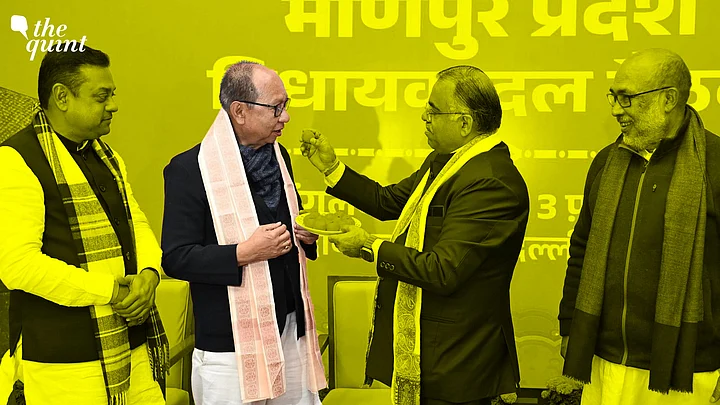
On 3 February, Tuesday, the Bharatiya Janata Party (BJP) named Yumnam Khemchand Singh, former Manipur Speaker and Rashtriya Swayamsevak Sangh (RSS) insider, as the Legislature Party Leader, set to be the next Chief Minister of the state.
And, in an apparent bid to appease the conflicting sides, a Kuki MLA, Nemcha Kipgen, and a Naga MLA, Losii Dikho, were named as the Deputy Chief Ministers, making them the first women to hold the post.
The very next day, President’s Rule has been revoked in Manipur, almost a year after it was imposed on 13 February 2025, paving the way for the government formation.
Incidentally, among the leaders who accompanied Khemchand on 4 February to the Governor's residence to stake claim to form a BJP-led National Democratic Alliance (NDA) government in the state, were BJP MLAs from the hills, LM Khaute and Ngursanglur Sanate. Their appearance marked the first time since the start of the conflict in the state that Kuki-Zo-Hmar legislators have returned to Imphal—and engaged in official government processes.
Insiders told The Quint that the decision to elect Khemchand as the Legislature Party Leader took place after a party leaders' meet at its Delhi headquarters on 3 February.
They added that the meeting was attended by 35 of the 37 BJP MLAs, along with the party's central observer Tarun Chugh, its northeast in-charge Sambit Patra, and BJP state president A Sharda Devi.
"Veteran leaders like Thongam Biswajit Singh, Govindas Konthoujam, and even new leaders like the BJP's lone Naga MLA Dipu Gangmei were being considered. But the party has reposed its faith in Khemchand, who has appeal among all communities," an insider told The Quint.
Within the BJP, the proposal for installing a popular government had emerged soon after the removal of N Biren Singh. Incidentally, Khemchand was among the senior leaders in BJP Manipur to have pushed for Biren's removal.
Even as the move is being projected by the Centre as an optimistic bid for political reconciliation between the two communities, skepticism persists.
On 2 February, ahead of the announcement, Paolienlal Haokip, the BJP's Saikot MLA and influential Kuki-Zo-Hmar leader, tweeted that "without justice for the ethnic cleansing of our (Kuki-Zo-Hmar) people, and sans a written commitment for political settlement, representatives of Kuki-Zo people cannot be party to election of Legislative Party Leader in Manipur."
Just days earlier, he had reiterated his people's stand for separate administration, under a union territory with legislature, in an interview to The Quint. "Since the conflict, the hills have become starved of all welfare and aid," adding:
"If we agree to form popular government without a separate administration, it would be seen as a betrayal to our people."
A 'Liberal Meitei' Image
Despite having saffron roots and RSS affiliations, Khemchand remains a bit of an outlier.
The senior leader and taekwondo champion had recently ruffled feathers on both sides after he visited a Kuki-Zo-Hmar IDP camp in December last year, sparking objections from armed groups in the hills. Phanjoubam feels the leader has the tacit support of the Kuki-Zo-Hmar people, as well as the Nagas, due to his somewhat "liberal Meitei image".
The Singjamei MLA had recently gone viral on social media for a dancing video on Christmas. Referring to the new CM as "the dancer", Naga leader Ajang Kashar, member of the Indigenous People’s Forum Manipur (IPFM), also agreed that Khemchand was a wise choice, saying:
"The Naga community does not have a problem with this."
Meanwhile, Congress leader Keisham Meghachandra Singh told the media that Khemchand's appointment will not affect the upcoming elections. "Despite the BJP government in the Centre as well as the state, they failed to govern the state. The Congress has always stood for the welfare of the people," he said.
Populist Move or Electoral Bid?
On ground, Khemchand's appointment evoked cautious reactions from both the hills and the valley, where the lines of separation between the Kuki-Zo-Hmar and the Meiteis remain sharp as ever.
Pressure on the Centre to act had been mounting not just politically but from the streets of Manipur as well. On 31 January, thousands, including hundreds of internally displaced persons (IDPs), took to the streets of Imphal and other valley areas with a call to "Save Manipur" against the Centre's alleged "complicity" in perpetuating targeted attacks. Many in the crowd alleged that the Centre had been indulging in a "proxy war".
As the decision was announced, the apex Meitei civil society body, the Coordinating Committee on Manipur Integrity (COCOMI), which organised the rally, voiced concerns.
"This has more to do with electoral optics than ground realities—and little to do with restoring peace and normalcy. It is primarily an attempt to rescue the BJP’s political fortunes in the state," Khuraijam Athouba, senior leader at COCOMI, told The Quint.
Recalling the time after the 18 June 2001 uprising, when the party had virtually disappeared from Manipur’s political landscape for nearly 17 years, Athouba said failure to restore the suspended BJP government in Manipur this time could lead to a near-complete uprooting of the BJP as a political party in the state.
"The real objective appears to be the reorganisation of BJP legislators and MLAs of the ruling NDA, pushing them back into their respective constituencies to restart groundwork for the upcoming state election due early next year".
The NDA allies include the National People's Party (NPP) and the Naga People's Front (NPF) with six and five MLAs each.
Imphal-based political analyst Pradip Phanjoubam agrees that the popular government has more to do with the BJP retaining power than restoring peace.
"This is a desperate bid to form the next government, not just for the MLAs here, but for the Central leadership as well. The BJP knows it will be at a disadvantage and may not even be voted into power if it's not already installed as the ruling party here at the time of polls."Pradip Phanjoubam
Blood Divides the Hills and Valley
The move, nevertheless, comes amid persisting communal divides between the hills and the valley, sharpened by recent incidents of violence and repeated failure of the justice system in ensuring safety and a sense of well-being for the affected people.
Since the May 2023 clashes, Kuki-Zo-Hmars and Meiteis have remained within their instituted zones—the former in the hills and the latter in the valley surrounding Imphal, with the buffer zones (secured by Central forces) emerging as battle frontlines.
"If we look back at the past few months, open defiance of the rule of law and acts of terrorism have become common in Manipur. A popular government is unlikely to solve the issue," COCOMI's Athouba told The Quint.
The persisting volatility of the border regions came to the spotlight on 22 January when 31-year-old Meitei migrant worker, Mayanglambam Rishikanta Singh, a resident of the Kakching district, was abducted and brutally murdered in Churachandpur while he was visiting his Kuki wife. A video of the execution was uploaded online with the ominous warning, "No peace, no popular government".
A relative told The Quint over the phone that political developments would not undo the harm Rishikanta's death had caused the family. "No matter who came to power, the loss his family had to bear would remain just as painful," they added.
As per media reports, the Kuki wife of the deceased had sought permission from the Kuki Nationalist Organisation (KNO), the umbrella body representing the armed Kuki groups that are part of the Suspension of Operations (SoO) agreement with the Central and Manipur governments, a claim that the KNO has refuted.
"No one was approached for permission. If they had asked us, we would have said, 'Don't come'. Kukis and Meiteis have not crossed into each others territories since 2023, and any incursion from either side is bound to be seen as breaking the unspoken code. That does not change, popular government or not," Seilen Haokip, KNO's official spokesperson, said.
In fact, days before the incident, Kuki-Zo-Hmar civil bodies, MLAs, and the SoO groups had met in Guwahati, and signed joint statements in which they emphasised their decision to not support any form of popular or re-elected government without first receiving a written assurance from the Centre. Nemcha Kipgen also attended the Guwahati Declaration.
KNO's Haokip highlighted the recent killing of the Meitei man in Churachandpur as an example of how bad things really were.
"We do not condemn the killing as doing that would be seen as a betrayal by our people. We also do not endorse it, and we don't want any untoward violence. Hence, the rules of separation must strictly be adhered to."Seilen Haokip
Ethnic Logjam: The Naga-Kuki Conundrum
While the Manipur conflict is often written off in binary terms, the political realities of the multi-ethnic state are far more complex.
The Nagas and the Kuki-Zo-Hmar together form 40 percent of Manipur's population and send 20 MLAs to the state Assembly. Of the 10 Kuki-Zo-Hmar MLAs, seven are from the BJP. The NPF is also an important BJP ally. In so far as the present conflict is concerned, the Nagas have remained more or less neutral to both Meiteis and Kukis.
But Phanjoubam warns that any attempt for a separate administration for Nagas and Kukis would bring the Nagas into the fight.
"Administrative separation cannot happen without territorial separation. And Kuki and Naga territories intersect—and even overlap in ways that cannot be separated without violent reparations."Pradip Phanjoubam, Political Analyst
According to observers, tensions have been flaring between Kukis and Nagas, especially in the Kangpokpi region.
In January 2026, the Zeliangrong United Front (ZUF), a Naga rebel group, destroyed poppy fields and houses in Kangpokpi district, targeting alleged illegal poppy cultivation on what they claim as ancestral Naga land. Before that, Naga groups had condemned an attack on a Naga village in Kangpokpi by suspected members of Kuki National Front (Presidential Faction) or KNF-P, one of the SoO groups under KNO.
Nevertheless, the question of separation hangs like the sword of Damascus over the state. For the Kukis, separate administration is the only way to right the wrongs of the past decades.
"It isn't just this conflict. Kuki-Zo-Hmar-populated areas have faced years of neglect and alienation. We have been called illegal interlopers, poppy cultivators, insurgents and what not... In reality, Manipur never really considered us as their equal part. Now, the separation has been sealed in blood," a Kuki CSO leader from Churachandpur said on condition of anonymity.
Activists mention incidents like the recent death of a Kuki gangrape victim, who died waiting for justice, as well as a score of similar cases still awaiting trial, or the Centre's decision to award the Shaurya Chakra to CRPF soldier Vipin Wilson, that have deepened people's anger against the Centre. Wilson had been widely accused of anti-Kuki violence in 2023.
"The hill districts have very little infrastructure. There are no jobs. In the absence of any police or State machinery to protect them from threats of violence, many in the hills have had to fall back on SoO groups and local bodies for security. These groups don't represent all the aspirations of people. And yet, they are sometimes the only bridge between people and governance as even elected representatives are powerless," a Kuki legislator told The Quint on condition of anonymity.
The evening of the announcement, shots were fired in Churachanpur district through the night, apparently in a show of discontent among the SoO groups in their designated camps in the hills.
"The Kuki-Zo-Hmar communities are not hopeful about the new government formation. We don’t trust any government led by the Meiteis anymore. After all the unspeakable atrocities that we have gone through, it’s separate administration that we are looking for," Ginza Vualzog of the Indigenous Tribal Leader Forum (ITLF) told The Quint.
All Eyes on Nemcha Kipgen
All eyes are now on Nemcha Kipgen, one of the few women in Manipur's politics, and known to have influence in the Kangpokpi region.
She is a two-time elected MLA from the region and has held the Social Welfare and Cooperation, and Commerce and Industry, Textiles and Cooperation portfolios in the previous Biren Singh governments.
Dr D (name withheld), a scholar of Kuki-Naga history and insider, told The Quint that one of Kipgen's compulsions (at least the one she would project) was to counter the Nagas.
"The Kuki-Zo people in Kangpokpi are landlocked on two sides—Nagas toward Senapati and on the route to Churachandpur, and the Meiteis toward Imphal. Tensions between the Kukis and Nagas had been growing in the region in recent months. Aligning with the BJP may have been the only way to bolster security in the region."Dr D
Incidentally, Kipgen's husband is a senior leader with the Kuki National Front (KNF), an armed group part of the SoO agreement, which has historic rivalries with Naga insurgency groups like the NSCN-IM.
In Churachandpur, however, the mood remains more adverse. "If any of the Churachandpur MLAs join popular government, they may face violence or threats at home. Even Kipgen must be prepared for some pushback," the Kuki scholar said.
Responding to Nemcha Kipgen being named as the Deputy Chief Minister, Vualzog said that Nemcha was "on her own":
"In the Guwahati Declaration which included SoO groups, Kuki-Zo Council and the Kuki-Zo MLAs, it was decided not to join the popular government until the state and Central government gives in writing its support for our demand of separate administration."Ginza Vualzog, ITLF
"If Nemcha Kipgen ignores the Resolution, then she is going on her own, at her own risk," he added.
