
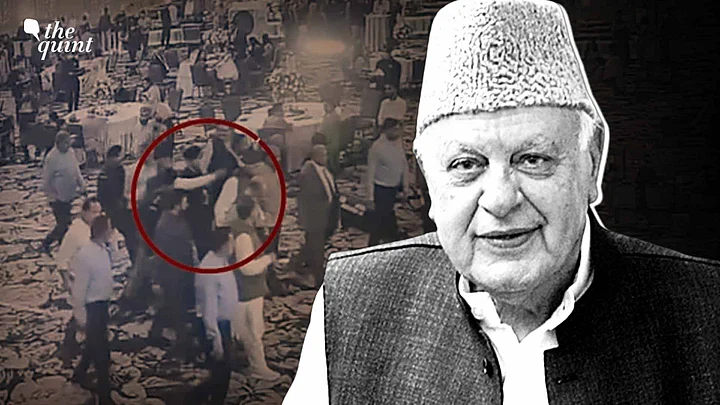
The attacker who attempted to assassinate Dr Farooq Abdullah was "driven by hatred", as he believed the three-time former J&K Chief Minister was responsible for the "destruction" of Jammu, senior police sources in J&K told The Quint.
They added that the assailant, 64-year-old Kamal Singh Jamwal, had no past history of crime but appeared to have been motivated by a “sense of grievance” against the “father-son duo”, which is to say both Farooq and his father, Sheikh Abdullah, who led the erstwhile state during the time of accession in 1947.
“Jamwal also served as a secretary to his local neighbourhood committee. When the police spoke to his neighbours, they described him as a 'normal' person who'd get along with everyone,” the sources said.
They further added that save for a short political stint during which he was associated with the Lok Janshakti Party, Jamwal didn't have any political association. The Quint, however, couldn’t independently verify the claim of him being associated with the said party in the past.
Sanjay Saraf, a leader of the Lok Janshakti Party faction led by Pashupati Kumar Paras, told The Quint,
“Personally, I have never known or seen this guy. All sorts of people come to our party events. When [Ram Vilas] Paswan sahab used to visit J&K, so many people would come to see him. But that doesn’t mean they are formally a part of the party. The assault on Dr Farooq Abdullah is unacceptable. We can never condone that. Despite our political differences, we have high regards for him, and we respect him.”
At the same time, a second official said Jamwal, who is a resident of Purani Mandi area of Jammu, may have specifically been aggrieved over the land reform policies of 1950 carried out under the aegis of Sheikh Abdullah. The land reforms saw the J&K administration ending the feudalism in the region by fixing a ceiling on individual land holdings across J&K, with the excess land going to the tiller.
Subsequently, this led to 9,000 proprietors, mostly in Jammu, being divested of their excess land, and 790,000 landless peasants, mostly Muslims, being conferred with proprietary titles, including 250,000 lower caste Hindus.
The episode triggered a massive wave of resentment against Sheikh in Jammu led by the Hindu landlords, galvanising a major right-wing upsurge which was pacified only after Sheikh’s arrest in 1953.
Not a Lapse?
“I have wanted to kill Dr Farooq Abdullah for the past 20 years,” Jamwal is seen telling the police in a video, adding that the weapon he used was his own licensed firearm.
The ruling National Conference has questioned how the armed assailant was able to get into a point-blank range with Farooq.
However, the police sources refused to describe the incident as a "lapse", arguing that it was not possible to frisk each and every guest attending the wedding because it wasn't a government event.
“At most, there would have been deployment. The former CM had 20-30 men with him already. That the attacker managed to get his .32 bore revolver inside [the venue] is subject to probe,” the sources added.
As a Z-plus-category protectee, Dr Farooq Abdullah is guarded by the National Security Guard (NSG), the country’s premier counter-terrorism force, and also by the Personal Security Officers assigned by the J&K Police.
Official sources told The Quint that the public movement of high value protectees such as him are governed by a mechanism of Advanced Security Liasoning, during which representatives from multiple agencies, who are in a correspondence loop, make various threat assessments. “Sometimes, they can even deny the clearance,” the official explained.
The National Conference on Friday, 13 March repeated the allegations that security arrangements at the venue were not up to the mark, including the metal detector that allegedly wasn’t functional.
“How is this not a lapse? There was a three-time former CM, deputy CM, and advisor at the venue. They are highly protected persons. How did a person enter the venue with a gun? Somebody has to be responsible...”Imran Nabi Dar, spokesperson, National Conference
The Widening Communal Chasm
A day earlier, on 12 March, Thursday, J&K Police said they had filed FIR 29 under Section 109 of the Bharatiya Nyaya Sanhita (BNS) and Sections 3/25 of the Arms Act against the accused who is currently under five days of police remand.
“We can say that J&K doesn’t see much of a violence that it once did,” another senior security source from Jammu said. “Normally, one wouldn’t even think of getting close to the 5-6 meters of someone like Dr Farooq Abdullah. But, in the case of wedding ceremonies, the situation is different. There’s only so much that can be filtered out.”
To many, the assault represents the climax to the rising tempo of polarisation with which the politics in the region had been gripped recently.
Two months ago, the National Medical Commission revoked the authorisation of Shri Mata Vaishno Devi Institute of Medical Excellence, a semi-private college in Reasi in Jammu, following protests by right-wing groups who complained that more Muslims students had been admitted by the college.
Later, the law students in Jammu led agitations demanding that the proposed National Law University be built there—and not in Kashmir.
The vocabulary of the protests carried a strong sense of victimhood, with student leaders claiming that the region had been subjected to discrimination, even as Kashmir received development projects and funding.
The protesters also raised a campaign that the Union government must cut off the Jammu region from Kashmir—and upgrade the former to the status of a state.
The Rising Hate in Jammu
The sense of animosity towards Kashmir and Kashmiris has become so pronounced in Jammu that even the Valley-based employees, who migrate to the city for the six months in winters as part of the official process called ‘Durbar Move’, are contending with what they describe as the "hardening of attitudes".
But while the Bharatiya Janata Party (BJP) may have tacitly encouraged the heightened sense of victimhood in Jammu, the party was also taken aback by the severity of Thursday's assault at Dr Farooq Abdullah.
The senior figures associated with the party in Jammu, which includes MLAs Sunil Sharma, Vikram Randhawa, and even former legislators like Ravinder Raina, have gone out of their way to express outrage over the incident.
In Kashmir, the prominent view is largely centered around the fact that anti-Muslim hatred has crescendoed to a whole new level in country of which Jammu had become a recipient, too.
“Dr Farooq Abdullah’s father defended India’s position on Kashmir at the United Nations in the past,” said Sheikh Showkat, a senior political analyst from Kashmir.
“He even took Kashmir out of the crisis in 1996 when he decided to fight elections in the middle of turmoil. And yet, a large number of his fellow countrymen want to see him as a traitor.”
The hatred, he said, has become so ingrained that it hardly matters to its purveyors who they are targeting.
“In Assam, they (BJP) dropped the former President’s name from the college because he was a Muslim. In Gujarat, a Mughal-era lodgehouse is now called Tapi Bhavan. All this has happened in the past 24 hours. Obviously, when the politics of exclusion escalates elsewhere, it will have its impact in J&K also,” he added.
Jammu-based editor Zaffar Choudhary said this was the third instance that Dr Farooq Abdullah has been assaulted by a detractor.
“And not just that. Even the convoy of his father [Sheikh Abdullah] would be subjected to stone-pelting when he travelled via Jammu in the 1970s. To ensure his safe passage, a circular road that bypasses Jammu city and connects directly to the secretariat was constructed during those years.”Zaffar Choudhary, editor and author
‘Here Lies an Indian’
Dr Farooq Abdullah remains a major anchor in J&K’s mainstream politics. He inherited the political mantle from Sheikh Abdullah in the early 1980s. His bid to power was endorsed by the then Prime Minister of India, Indira Gandhi, leading to his first stint as the CM of the erstwhile state, sworn as he was barely 90 minutes after his father’s demise in September 1982.
Two years later, however, Gandhi orchestrated a coup to dislodge him following the political reassertion that he had come to embody in the Muslim-dominated Kashmir. That act of dethronement made him famous initially.
But with the signing of a political accord between him and Indira’s son and successor Rajiv Gandhi in 1986, Dr Farooq Abdullah was accused of being a "sell-out" and came to be despised, a feeling that only deepened in wake of his alleged role in an episode of election rigging in 1987, that saw him becoming the CM for the second time.
He resigned quickly as Kashmir was engulfed by a rapidly ballooning insurgency. He moved to London to open a clinic where he planned to practice medicine.
By 1996, he returned to the Valley and fought the landmark state elections which he won comfortably, becoming the CM of J&K for the third and final time.
In their book Farooq of Kashmir, journalists Ashwini Bhatnagar and RC Ganjoo have written that following a threat by militants in the mid-1990s, Farooq Abdullah expressed the desire that upon his death, the epitaph on his grave should mention that, “Here lies an Indian.”
(Shakir Mir is an independent journalist whose work delves into the intersection of conflict, politics, history and memory in J&K. He tweets at @shakirmir.)
