
ADVERTISEMENTREMOVE AD

In Bengal's Hakimpur Border, Most 'Illegal' Bangladeshis Crossing Back are Hindu

Police state there is no government order for authorities to treat Hindus and Muslims differently while deporting.

Published
story-hero-img
i
Aa
Aa
Small
Aa
Medium
Aa
Large
Edited By :Rakhi Bose

Hossain Molla, 19, is returning to Bangladesh with his entire family—parents, grandparents and siblings. Though Hossain himself was born in India, his parents came from Bangladesh in 2002, initially seeking medical treatment for his grandfather in Kolkata. Repeated trips became expensive, and the family eventually stayed back as daily wage labourers.

“Without citizenship, we cannot stay here anymore,” Hossain told The Quint.

Hakimpur border in West Bengal’s North 24 Parganas district has suddenly become a focal point of national and regional media attention after the newly elected Bharatiya Janata Party (BJP) government in West Bengal announced a crackdown on undocumented Bangladeshi migrants.

Much of the media coverage, however, has focused almost exclusively on Muslim migrants. This has amplified a notion that “millions of Muslim infiltrators” are fleeing Bengal. Yet, Hindu undocumented migrants also present at the border, remain largely outside the camera frame.
ADVERTISEMENTREMOVE AD

The Migrants the Cameras Ignore

A popular narrative that has long been promoted in Bengal and beyond that when Hindus come from Bangladesh, they arrive because of religious persecution and do not wish to return. Muslims, meanwhile, are often portrayed as arriving with so called "jihadist" intent to “capture Bengal”.

But Hakimpur tells a far more complicated story.

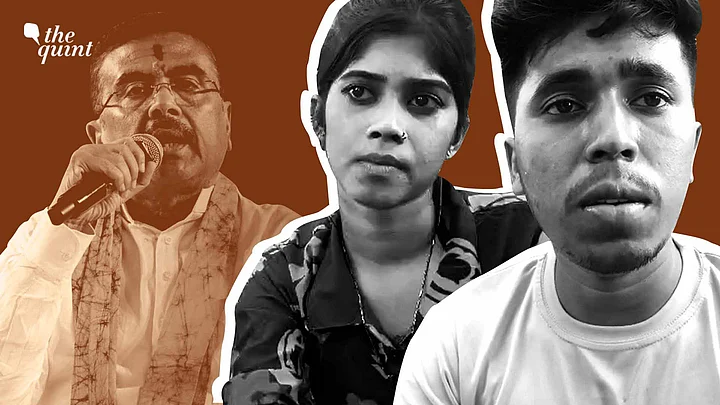
The Quint met Mitu Mondal at the Hakimpur border, where she sat silently with her three-year-old son, her face drained of hope. In her early 20s, Mitu had crossed into India from Gopalganj in Bangladesh in 2018 without a passport or visa, scaling the border fence in the name of love. Eight years later, she is returning to Bangladesh with her child.

Her husband, Nitai Das, also a Bangladeshi migrant settled in Bengal whom she had followed, remarried two months ago. She claims he threw her out of the house after that, along with their child.

“The man who married and brought me here has found new love now. I have nobody here anymore. So, I’m going back to Gopalganj. My parents and relatives are there. That is where my people are.”
Mitu Mondal

Mitu alleges that her husband—also originally from Bangladesh—managed to obtain forged Indian documents for himself through bribery.

“I am being punished because I am Bangladeshi,” she said bitterly. “But my husband is also Bangladeshi. He paid money and arranged fake documents. Why should he get to stay here? He should also be deported like me.”

Mitu was not actually arrested or deported by Indian authorities. But the news about new Chief Minister Suvendu Adhikari's annoucement to weed out illegal Bangladeshis and hand them over to the Border Security Force (BSF) has left many like Mitu in the lurch.

She says she is returning because, in the absence of legal docuements and no family in India, she would be sent back anyway or put in a detention camp if she stayed on.

Sujoy Roy, 20, originally from Khulna in Bangladesh, also crossed over to Bengal without a visa or passport in August 2025 to learn sweet-making. He states that many migrated in search of work, better job opportunities, or skilling. While some return, some stay back.

“I came to learn the art of sweet-making,” Sujoy explains. “Now that I’ve learned the work, I’m going back home.”

When asked how he had entered, Roy casually states, "in black", meaning through illegal backchannels.

Many anxious Hindus sitting at the border were reluctant to speak openly. After learning they were Hindu, a Hindi media journalist repeatedly asked them: “If you are Hindu, why aren’t you applying under the Citizenship Amendment Act (CAA)?”

Finally, visibly irritated, they replied pointing across the border, “Arrey, our home is over there".

Another undocumented migrant, Priya Mondal, wearing shakha on her wrists and sindoor on her forehead—traditional religious markers of a married Bengali Hindu woman—was detained along with her husband by Swarupnagar police station. The authorities informed them that they will be handed over to the BSF.

Originally from Barishal, Bangladesh, Priya, who had been brought to the border by police authorities to be handed over to the BSF, claimed that she had come to Kolkata on a medical visa for treatment, but did not return to Bangladesh even after her visa expired.

Now, she says, she does not know when or how she would be allowed to return home. “I don’t know what will happen to me now, or when I will be able to return home,” Priya said.

While several social media accounts in wake of CM Adhikari's announcements have been circulating videos from the World Ijtema congregation held from 2-5 January in Hooghly district, falsely claiming that the footage shows illegal Bangladeshi Muslims fleeing West Bengal (even news outlets have picked up such news), the cases at the border belie the popular narrative of a Muslim exodus of illegal Bangladeshis being underway.

A similar exodus narrative had emerged during the process of the Special Intensive Revision (SIR) of electoral rolls, when media outlets claimed that lakhs of Muslim infiltrators were returning to Bangladesh. However, 4 December 2025, BSF North Bengal Frontier IG Mukesh Tyagi stated at the BSF headquarters that the actual number over the previous three months was only 186.

This time too, the pattern appears similar. Claims about lakhs of illegal Muslim migrants fleeing to Bangladesh seem vastly exaggerated. West Bengal has a population exceeding 100 million; compared to that, the number of returning undocumented Bangladeshi Muslims remains statistically insignificant.
ADVERTISEMENTREMOVE AD

The Myth of Demographic Shift

On 28 May, Malda Superintendent of Police told Bengali news outlet Sangbandh Pratidin that they have nine suspected Bangladesh citizens in their "holding centre". Earlier, CM Adhikari had announced the same. This holding cell is the first one in West Bengal to come up as part of the BJP's "detect, delete, deport" policy to weed out alleged illegal immigrants from Bangladesh, followed by holding centres in Basirhat and Murshidabad, among others.

In the run up to the recently concluded Assembly polls, the party talked a lot about the demographic shift in West Bengal due to the allegedly high infiltration of Muslims from Bangladesh under the Mamata Banerjee government.

Sukriti Ranjan Biswas, president of the Joint Action Committee for Bengali Refugees, however, told The Quint that while there was truth in the "demographic shift" narrative, it wasn't the minority population causing the shift.

"It is true that demographics have changed in many border districts. But the people who primarily changed those demographics were Hindu migrants from Bangladesh. Muslim migration exists, but on a much smaller scale. Most Muslims who come here are extremely poor labourers. Their families and roots remain in Bangladesh. They come for work, not for permanent settlement or citizenship.”
Sukriti Ranjan Biswas

He adds, “If anyone can show me even one middle class undocumented Bengali Muslim living here permanently, I will quit activism altogether.”

Ashish Thakur, president of the Nikhil Bharat Bangali Udbastu Samiti, echoed similar sentiments.

“It is established that Muslims have crossed over,” he says. “But the overwhelming majority of migrants from Bangladesh have actually been lower-caste Hindus fleeing persecution and economic hardship.”

Police sources in Swarupnagar told The Quint that Bangladesh-bound undocumented migrants are first subjected to document verification to establish whether they are genuinely Bangladeshi nationals. After that, following CM Adhikari’s announcement, they are handed over to the BSF. The latter then keeps them in custody, assesses the situation, and later transfers them to Bangladeshi authorities.

On 27 May, around 30 undocumented migrants were reportedly waiting near the border at Swarupnagar to cross over. Many were buying large quantities of dry food from local shops because they did not know how long the BSF might detain them. Locals said that on average around 40 Bangladesh-bound undocumented migrants arrive every day.

Swarupnagar Police also clarified there is no government directive instructing authorities to treat Hindus and Muslims differently during deportation procedures.

ADVERTISEMENTREMOVE AD

Suvendu Adhikari’s Crackdown

On Wednesday, 20 May, the West Bengal government handed over 43 acres of purchased land and 31.9 acres of government-vested land to the BSF for the construction of border fencing and border outposts along the Bangladesh border. The transfer had reportedly been delayed due to complications during Mamata Banerjee’s tenure.

At the land transfer ceremony, Adhikari said, “On 14 May 2025, Under Secretary to the Government of India, Pratap Singh Rawat, sent a directive instructing that illegal Bangladeshi infiltrators should be directly handed over to the BSF. The previous government in West Bengal opposed granting CAA status to refugees while also failing to implement this important legal opportunity provided by the Union government. From today, we are implementing this law."

"Those not covered under the CAA are illegal infiltrators. State police will arrest them and hand them over to the BSF. The BSF will coordinate with BDR and arrange deportation. Detect, delete, deport—this law comes into force from today,” he added.

However, the CAA has officially been in force across India since 10 January 2020. Since citizenship constitutionally falls under the exclusive jurisdiction of the Union government, no state government has the authority either to block or independently implement citizenship law.

Refugee leaders, however, remain worried by Adhikari’s declaration.

Sukriti Ranjan Biswas said, “Since the word ‘infiltrator’ is usually used to refer to Muslims, many Hindus think nothing will happen to them. Police detaining people crossing the border is not new. That has always happened. But perhaps they are now referring to those who have been living here for a long time.”

Ashish Thakur pointed out, “According to the Constitution, anyone who entered India after 19 July 1948 without passport or visa is an illegal infiltrator. The 2019 law says those who came before 2014 and sought refuge from the government can apply for citizenship. But most people never did.”

ADVERTISEMENTREMOVE AD

Fear, Citizenship and Political Memory

During the nationwide anti-Bangladeshi drives in 2025, the Nikhil Bharat Bangali Samanway Samiti provided legal aid and rescue support to Hindu refugees detained in states such as Maharashtra and Odisha.

Its president, Subodh Biswas, told The Quint,

“Refugee Bengalis who came after facing persecution received patronage during the Left Front era. But people who were not supposed to receive it also received it. Perhaps Suvendu Babu is referring to them.”

So does that mean there is no danger in Suvendu’s declaration?

“Promises are one thing,” Biswas replied. “Implementing them is another.”

Earlier, at his first press conference as chief minister on 11 May, CM Adhikari had also said, “On 16 June 2025, the Office of the Registrar General of India sent a circular regarding the Census. The West Bengal government kept this file pending for almost a year. Today we are implementing the Registrar General’s circular.”

On 14 June 2025, the Registrar General issued the Gazette notification for the 2027 Census. Under the Census Act of 1948 and the Citizenship Rules of 2003, the same institution is responsible for both Census operations and the National Population Register (NPR) process linked to the National Register of Citizens (NRC).

The NPR was originally scheduled to begin on 1 April 2020 but was postponed due to the COVID-19 lockdown. Before that, on 16 December, West Bengal had officially suspended NPR through a government notice amid massive protests.

West Bengal’s anxiety over citizenship registers has deep historical roots. A large section of the state’s voters are Hindus who migrated from East Pakistan or Bangladesh but remain legally vulnerable due to bureaucratic complications. Even though the new CAA passed in 2019 promised citizenship, six years later only a tiny fraction have actually benefited.

The Joint Parliamentary Committee report made it clear that the law was effectively meant for only 31,313 people who had formally registered with Foreigners Registration Offices (FRO) after entering India and declared themselves victims of religious persecution. Very few Hindus who migrated to West Bengal ever registered themselves with the FRO after entering India.

In 2003, Mamata Banerjee, then leader of the Opposition, accused the ruling Left Front in Parliament of facilitating infiltration. Ironically, after becoming chief minister, she herself was accused by the BJP of enabling infiltration.

Under Article 256 of the Indian Constitution, state governments are bound to comply with Union laws. Failure to do so can trigger a constitutional crisis—and eventually President’s Rule.

Bengal’s Divided Response

Kaushik Maity, secretary of the Bengali nationalist organisation Bangla Pokkho, argued, “Bangladeshi Muslims who have entered India illegally should be thrown out. West Bengal should not be a place for any illegal infiltrators. Bengal has suffered since 1947. We are happy that illegal infiltrators are leaving Bengal."

"The Bangladesh border should be fenced properly. No infiltration should happen in future. We believe our brave BSF jawans will take care of it. Resources should belong only to the sons of the soil of West Bengal. Jobs should be reserved for permanent residents of Bengal.”

Siddhabrata Das of Bangla Jatiya Sammelan offered another perspective. “Even if Bangladeshis leave, Hindi-speaking migrants continue to arrive systematically. As a result, our demography is changing,” Das said.

Conflict between West Bengal’s public opinion and the Union government over border fencing and migration is not new. What is relatively new is the overt "anti-Bangladeshi" sentiment.

In the first week of 1964, the Government of India announced plans to “seal” the East Pakistan border to stop further refugee inflows. Bengali political leaders strongly opposed the move and took to the streets.

On 27 January 1964, a convention was held at Kolkata’s University Institute Hall attended by leaders including Revolutionary Socialist Party's Tridib Chowdhury, Jana Sangh leader Haripada Bharati, NC Chatterjee, Forward Bloc leader Hemanta Basu and Communist leader Jyoti Basu. They demanded the withdrawal of the “border seal” decision and insisted that all those who had come—or would come in future—from East Pakistan must be rehabilitated and granted citizenship.

Sensing the gravity of the situation, Union ministers Gulzarilal Nanda, TT Krishnamachari, and Mehr Chand Khanna issued a joint statement the very next day accepting the convention’s demands.

Perhaps, after decades of tension between West Bengal and the Union government over the border question, the BJP government’s rise to power has finally resolved that conflict—on the Union government’s terms.

(Soumo Mondal is an independent journalist covering news and politics in West Bengal.)

Edited By :Rakhi Bose
Speaking truth to power requires allies like you.
Become a Member
Monthly
6-Monthly
Annual
Check Member Benefits
×
×