
Your support helps keep independent voices alive on the ground. Become a member.
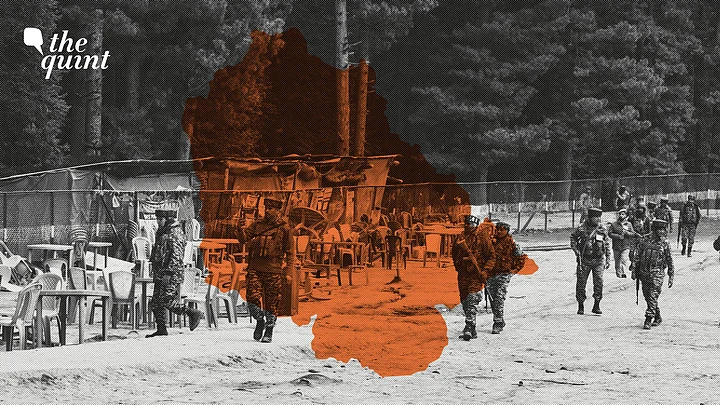
“We even see troop presence at places where we weren’t used to seeing them earlier,” Waseem Bhat, a local grocer in Srinagar, tells The Quint in the days leading up to the somber first anniversary of the deadly Pahalgam massacre.
On 22 April last year, the Baisaran Valley in Pahalgam echoed with the sounds of gunfire. What should have been an ordinary afternoon for tourists trying to relax and unwind in Kashmir turned into a day of carnage—one that the Valley, by its own grim records, hadn’t witnessed in at least 25 years.
The terror attack triggered a three-day aerial dogfight between Indian and Pakistani air defences, with both sides launching mortars. Shelling from across the Line of Control (LoC) killed dozens of civilians in border villages, including at least five documented cases involving children.
In the aftermath, the government heightened security measures and carried out a widespread crackdown, including at least a dozen demolition drives at the homes of local militant recruits, and the closure of popular tourist spots. The enforcement of some of these steps continues to this day.
“Even Mughal Gardens are heavily patrolled. A monastery in Harwan area of Srinagar, which is a popular tourist attraction, has continued to remain out of bounds for people.”Waseem Bhat
One Year On, Safety Still in Question
Despite the heightened security presence, uncertainty still hangs heavy over Kashmir. A year on from the attack, security officials from J&K Police, who spoke to The Quint on the condition of anonymity, admit that "Pakistan-based elements still remain capable of carrying out terrorist attacks."
To underscore how attempts to carry out such acts continue to surface every now and then, another official pointed out to the most recent arrests in Kashmir and across other parts of the country.
In early April 2026, J&K Police claimed to have busted an interstate Lashkar-e-Taiba (LeT) terror module, leading to the arrest of two alleged Pakistani terrorists—Abu Huraira and Usman—from Punjab. The two men, according to the official, had originally infiltrated in 2010, and were residing in Punjab using forged identities.
The arrests of the two Pakistani terrorists led investigators to 22 local accomplices, they added.
Despite these attempts by Pakistan, the official added, "our commitment to thwart their conspiracies hasn’t flagged either. This year, we have busted around 5-6 terrorist modules."
‘Zero Terrorism’ vs Ground Reality
Independent security experts, too, described the situation in Kashmir as inherently risky.
“In the last few years, their (Pakistan’s) hold on their ground has strengthened vis-à-vis us,” Ajai Sahni, who heads the Institute for Conflict Management in New Delhi, told The Quint. “They might have their own problems. But their intentions haven’t changed. The hostilities between the two countries are yet to cool down.”
Sahni criticised the government for its proclamations about "zero terrorism", referring to a frequent refrain voiced by the Union Home Minister Amit Shah.
“It is a wrong slogan to begin with. This is political rhetoric that has dangerous consequences for our national security. When we invoke something such as 'zero terrorism', that gives terrorists an incentive to do something to prove us wrong. After all, Kashmir is not a normal place. An occasional incident can always be orchestrated and, depending upon the moment, that incident can become a major incident.”Ajai Sahni
Tara Kartha, a senior security analyst who has previously served in the National Security Council Secretariat (NSCS), told The Quint that uncovering of a number of terrorist modules over the past few weeks suggests Pakistan is trying to leverage its present status as America’s hand-picked mediator for its war with Iran to foment serious attacks inside Kashmir.
“Pakistan most likely wants US President Donald Trump to talk about Kashmir. It serves Pakistan’s purpose if it is able to invite Trump’s attention to Kashmir after the Iran crisis is over. Then they will say, 'we did this for you and you do this for us'."Tara Kartha
In another recent operation led by the Special Cell of Delhi Police, 43-year-old Shabir Lone from Kashmir was arrested in New Delhi on 30 March for allegedly putting pro-terrorist posters. The police are linking Lone to a major terrorist module run by Pakistan and some extremist elements in Bangladesh, who were planning to orchestrate a major terrorist attack in India.
"Another attempt to perpetrate a Pahalgam-like attack cannot be ruled out."Tara Kartha
Security vs Stability
Political analysts argue that Kashmir's security vulnerabilities are compounded by the political resentment triggered by the decisions taken after the abrogation of Article 370 six years ago.
That includes altering the domicile rules to relax residency norms; changing land laws that permit the conversion of agricultural land for other purposes; delimitation that gerrymandered the Assembly constituencies to the disadvantage of Kashmir; and rescaling of the region’s reservation arrangement that has shrunk opportunities for applicants under the ‘merit’ category.
On top of that, the experts say the impression that the Centre was reneging on its promise to restore statehood has further deepened the estrangement.
Professor Radha Kumar, appointed by the Cabinet Committee on Security (CCS) as one of the three interlocutors on J&K in 2010, opined the government's failure to restore statehood was likely to prolong the turmoil in the region.
“After the Pahalgam attacks, Kashmiris had come out in unprecedented numbers to protest the killings,” Kumar told The Quint. “But where the Centre could have reciprocated was by fulfilling its promises regarding statehood. It did not.”
Kumar said that this deepening sense of alienation would only increase the security-related challenges in Kashmir.
“You have the opportunity to make peace only on the basis of democratic rights which must be available to all Indians. Even when you look at the recent Constitution Amendment Bill [for women’s reservation which failed to go through in the Lok Sabha], it includes a reference suggesting that the J&K will remain a Union Territory in perpetuity. That itself says a lot about the government's intentions.”Professor Radha Kumar
In spite of restrictions on civil actions and protests in the region, recent events have shown how subdued political anger can erupt in major protests on short notice, forcing the government into a clampdown mode.
Earlier this month, 28-year-old Rashid Ahmad Mughal was allegedly gunned down by the Indian Army during a gunfight in Ganderbal district. His family maintained Mughal, who was a commerce post-graduate from the Lar area, was innocent, denying the security forces' claim that he was a militant.
Over the weekend, the Ganderbal district was gripped by street protests, with locals demanding Mughal's body after he was buried 67 km away in Handwara as per a new protocol governing the burial process of a slain militant, which Mughal was reportedly not.
Jammu and Kashmir Lieutenant Governor Manoj Sinha had earlier ordered a thorough and impartial magisterial inquiry.
“There is a huge asymmetry between the people's capacity to protest and the government's response to contain them,” said Kapil Kak, Air Vice Marshal (Retd) and security analyst. “Yet, when the need arises, they can come out."
Kashmir also saw huge protests in the wake of the assassination of Iran’s Supreme Leader Ayotollah Khamenei.
Can Kashmir See 'Controlled Tourism'?
Kumar, the former interlocutor, suggests that security measures alone would not ease terrorism-related threats.
“We have noticed how patterns in Kashmir militancy have changed after 2019,” she said. “We saw the rise of attacks on civilians in Srinagar in 2021-2022 followed by devastating attacks in the Jammu region. Pahalgam, though rare on a horrifying scale, is not entirely isolated from the larger evolutionary arc of militant violence in Kashmir.”
So what can be done? Sahni suggests that the government must opt for 'controlled tourism' in Kashmir to ensure adequate security apportionment.
“Tourists must be allowed only to those places where the administration is certain it has a foolproof security presence. It should not open the floodgates of tourists as the government doesn't yet have a proper definition of normalcy. So, there will always be an inherent risk.”
On the heels of the one-year anniversary of the Pahalgam attack, Anantnag Police ramped up various security measures, including QR-based identification of local pony-ride operators, cab drivers, and members of the nomadic community. The QR codes enable them to access their personal details, including name, contact number, address, and biometric information.
Kumar also suggests that addressing local political concerns would also help plug other security vulnerabilities in the region.
“When you subjugate people in the most prolonged and harshest ways possible, you have to expect a backlash. When it will happen, how it will happen, we can never be certain of. The situation demands a major course correction,” she added.
(Shakir Mir is an independent journalist whose work delves into the intersection of conflict, politics, history and memory in J&K. He tweets at @shakirmir.)
