
ADVERTISEMENTREMOVE AD

'Are Our Children Still Indian?': Deleted Voters of Murshidabad Demand Answers

The high scale of deletions have led to accusations of politically driven religious profiling against the BJP.

Published
story-hero-img
i
Aa
Aa
Small
Aa
Medium
Aa
Large

Your support helps keep independent voices alive on the ground. Become a member.

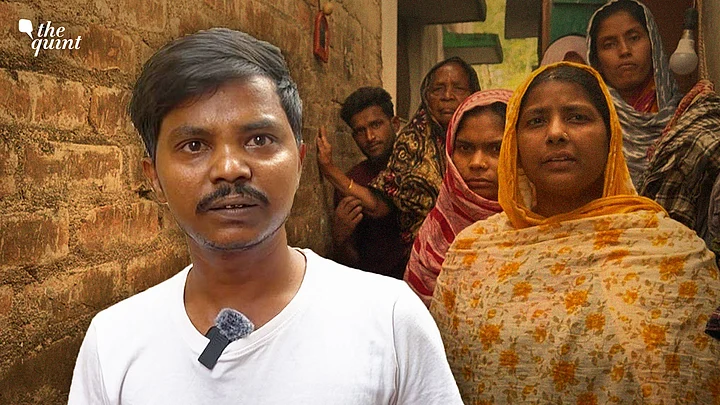
"It's happening to us because we are Muslims, and we are poor. It is all a big 'shodojontro' (ploy) to remove us from India," Ayesha Bibi, 28, tells The Quint as she rolls dried sal leaves into shiny bidis between her fingers.

Ayesha lives in one of the border villages of Samserganj, Murshidabad, where nearly 70 percent of the population is Muslim. She is among the 74,775 voters from Samserganj Assembly seat whose names have been deleted from the electoral roll for the upcoming first phase of the elections in West Bengal following the Special Intensive Revision (SIR) of electoral rolls.

The border seat, which was also the epicentre of frenzied communal violence last year following the Waqf Amendment Act, has the highest number of voter deletions across the state, followed by Lalgola.

The Supreme Court of India has allowed deleted voters of the first phase till 21 April to file their appeals in the 19 appellate tribunals.

Ayesha, whose husband is a migrant worker, has made an appeal at the appellate tribunal online, as have the thousands of other deleted voters in Samserganj. But they do not have much hope.

ADVERTISEMENTREMOVE AD

Targeted Deletions? 

In nearby Lalgola Assembly seat, with the second-highest number of deletions across the state, the mood is equally grim. Almost 65,000 voters in Lalgola have been deleted following the SIR. The list includes Ruksana Khatun, a resident of Pathanpara village, who has been pregnant for the last three months, about the same time as the length of her SIR trial.

Ruksana was deleted from the list after being put under adjudication following 'logical discrepancy'.

Worried about the future of her unborn child, Ruksana has become reticent and eats less, her mother informs.

"She is worried that she will be sent to a detention camp, or across the border to Bangladesh, and then have to raise her child alone. I also worry... if the child will be called Indian or not. You see, my name is on the SIR list, I voted in 2002. Her husband's name is on it. How is my daughter's name not on the list?" Ruksana's mother asks.

With 22 Assembly constituencies, Murshidabad is distinct due to its high Muslim population (67.7 percent as per the 2011 Census). It is often called the "kingmaker" in West Bengal's politics—usually in conjunction with the adjacent Maldah.

Traditionally, a Left and then a Congress bastion, the 2021 Assembly polls saw the Trinamool Congress (TMC) win 20 of the 22 seats in the region.

It is for this reason that the high scale of deletions in Murshidabad have sparked widespread accusations of politically driven religious profiling against the Bharatiya Janata Party (BJP), and the Election Commission of India (ECI), which locals allege is working with the BJP.

Critics back such suspicions with data.

In late December, the ECI published the ASDD (Absent, Shifted, Dead, Duplicate) list, in which the share of deletion of Muslim population was less than their total population proportion in almost every seat. However, among the 91 lakh or so voters whose names have been removed from voter rolls as of now, over 34 percent are Muslim. This exceeds their total statewide population of 27 percent, as per the 2011 Census. However, Hindus (mostly Scheduled Castes and Scheduled Tribes) exceed Muslims in overall deletions state-wide.

"Since the first list was based on mapping, regions like Murshidabad and Maldah saw the lowest deletions as Muslims were well-mapped with the 2002 list. It's only after the ECI introduced the illogical concept of 'logical discrepancy' that more Muslin names started getting removed," Shabir Ahmed, lead researcher at SABAR, tells The Quint.

Former Rajya Sabha MP from TMC, Jawhar Sircar, also believes the deletion data reveals the more sinister designs of the saffron brigade.

"Anti-Muslim sentiment is an integral block of the RSS-BJP's Hindutva politics. They refuse to admit the phenomenon of the Bengali Muslim population of India," Sircar told The Quint in a recent interview.

The former MP added that to the BJP, the 27 percent Muslim population is a "roadblock" because the party thinks "no Muslim in West Bengal would ever vote for the BJP."

The TMC won Samserganj last time by a margin of 26,111 votes. With nearly 75,000 voters deleted, will the party's fortunes be affected?

Migrant Workers Face the Brunt

While the SIR deletions have affected almost all sections of society, it is the migrant workers, Scheduled Caste Muslims, and women who make up a major chunk of slashed voters.

Oshidul Sheikh from Samserganj came home for the holy month of Ramadan from Kerala where he works as a carpenter. His name came under adjudication due to 'logical discrepancy' over an error in the spelling of his name in one of his documents.

He had appealed to local authorities and attended the "hearings" with local electoral officers.

Oshidul has remained in his village since—running from local administration to BLO to BDO offices in order to get his name back on the voter list. But, in the final supplementary list, his name was deleted.

"It has been about two months since I have been at home to sort this problem out. I have missed two months' wages trying to fix a clerical glitch. Who will bear the cost?"

Oshidul earns about Rs 30,000-35,000 per month in Kerala, which helps him and his family in Samserpur survive.

Sakim Sheikh of Sikderpur village in Samserganj, who also works in Kerala, had a similar story. "I have cancelled my return ticket twice due to hearings, after I was put under adjudication. But, despite all this, I have been deleted."

Many among the Bengali Muslim migrant workers, who had faced widespread abuse and deportation last year—amid the Ministry of Home Affairs (MHA)-led purge of "Bangladeshis" from other states—are also fighting for their right to vote.

Maldah resident Samaj Sheikh is among them. Samaj was forced to leave Gurugram last year out of for fear of getting illegally detained as a "Bangladeshi".

Samaj has found his name deleted from the voter roll. "First they drive us out of our workplace and back to our homes. Now they are saying we don't belong here, at home, either. So where will we go? How will we work?" Samaj tells The Quint.

According to researcher Dr Adil Hossain, caste is important when it comes to understanding why certain districts have higher deletions.

"Among Hindus, the Matua refugees belonging to the Namashudra Scheduled Caste, have the highest deletions. Similarly, Bengali Muslim migrant workers from Murshidabad, Maldah, and Dinajpur are all from the so-called 'lower-caste', their ancestors having converted to Islam to escape the oppression of the Hindutva-vadi caste system. These Muslims lack the social capital to acquire a 'job' or formal education by virtue of their caste... this caste marginality adds to overall disenfranchisement of the community," Dr Hossain states.

ADVERTISEMENTREMOVE AD

A Shift in Murshidabad's Political Mood?

Founded by Nawab Murshid Quli Khan in 1704, Murshidabad is no stranger to power and politics. Once the capital of Bengal, Bihar, and Orissa in the 18th century, the region served as a pivotal center of power before the British colonial rule until the Battle of Plassey.

In these parts, the historical character Mir Jafar, the traitorous kin of Bengal's last Nawad, Siraj ud-Daula, is well imprinted on popular public memory. The memory of the betrayal of Siraj and the subsequent coming of the crown in its stead remains an emotive issue. For locals, in this situation, the BJP is perhaps the East India Company or the imperial crown, and the TMC feels more like a Mir Jafar.

Lalgola-born Mohd Khairul Islam, for instance, had voted in the 2024 Lok Sabha elections. He voted in the 2021 Bengal Assembly polls, too, as well as the 2019 Lok Sabha elections.

He asserts that if he was not a legal voter all this time, how could his vote have counted in the past?

"This SIR mess is a problem created by the BJP, but the TMC also did not help anyone. The Chief Minister needed to have argued our case better in the Supreme Court," Khairul, whose sister and wife have been deleted from the voter rolls (his own name was reinstated from the under adjudication list following multiple hearings), tells The Quint. "It should never have come to this tribunal stage."

In the 2021 polls, Samserganj was won by the TMC's Amirul Islam, who won with 96,417 votes (51.13 percent), beating the Congress' Zaidur Rahman and the BJP's Milan Ghosh.

This time, the contenders include the TMC's Nur Alam after the incumbent Amirul Islam was shifted to neighbouring Farakka, a move that has confused many as Alam is a Samserganj local. Nazme Alam is contesting from the Congress, while the BJP has fielded Shashthi Charan Ghosh.

Meanwhile, in Lalgola, the Congress has fielded Tohidoor Rahaman Suman against the incumbent TMC's Abdul Aziz 'Doctor'. While the former is known to a be a "son of the soil" with a clean image, Aziz is powered by the money and influence of former TMC leader Enamul Haque, who happens to be Aziz's father-in-law.

"The Muslims in the region are tired of being treated as a vote bank," Kulera Bibi from Lalgola's Chowapada tells The Quint.

"Didi has increased the Lakkhir Bhandar amount from Rs 1,000 to Rs 1,500. But what will we do with subsidies if we are not considered legal voters ?Eight out of the 11 members of my family have been deleted. How can I rejoice and vote while my own family is not able to?"
Kulera Bibi

According to political analyst Zaad Mahmood, the "Muslim vote" seems to be cracking open, with many Muslim-populated seats seeing a three-way contest this time between the TMC, the Congress, and the Left.

Independent factors like Asaduddin Owaisi, Humayun Kabir's Babri pitch, the Left, and alternatives like the ISF, AUDF and others have been surfacing, and adding to the existing anti-incumbency woes of the TMC in Muslim-populated and dominated seats.

"The Muslims have also been disenchanted with Didi and the TMC's corruption. So far, we did not have an option. This time, we do," a Murshidabad local says.

Mahmood, however, feels that a split in the Muslim vote may end up benefiting the saffron party.

"There is a lot of polarisation, especially of the Hindu voters or Hindu refugee voters. The Muslims may not vote for the BJP. But if they vote for the Congress or the CPI(M), it is indeed the saffron party that could benefit from the split because the region also has a minority Hindu population and the Hindu vote is quite polarised," Mahmood opines.

Speaking truth to power requires allies like you.
Become a Member
Monthly
6-Monthly
Annual
Check Member Benefits
×
×