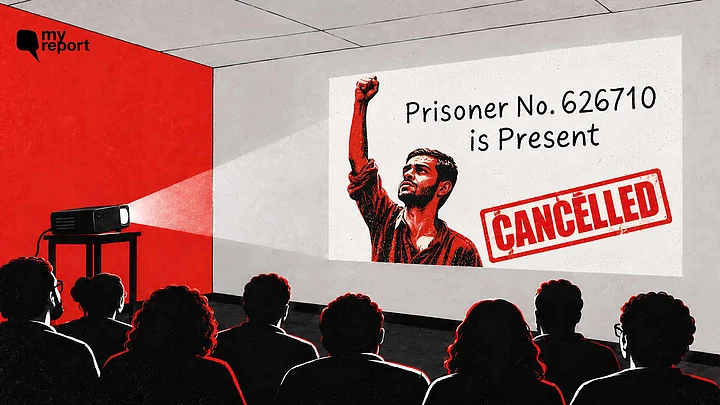
At around 6:30 pm on 18 September, we walked out of a venue in Mumbai with a sense of relief. We had just paid the advance and made the booking for the second screening of Prisoner No. 626710 Is Present, Lalit Vachani’s documentary on Umar Khalid. The screening was scheduled for the next day.
After spending much of the day frantically searching for a venue in the city, we could finally breathe.
This was going to be our second screening of the film—both of which were part of a larger nationwide campaign throughout September in solidarity with Umar Khalid, Sharjeel Imam, and other political prisoners.
For us, the point was also to gather people in Mumbai, where finding physical spaces for political organising and solidarity is increasingly difficult. We wanted to create a small pocket offline where people could sit together, talk about political prisoners, and find one another.
Umar and Sharjeel have now spent more than six years incarcerated without trial, while their bail hearings have been delayed repeatedly. But we should not have to remember political prisoners only when another bail hearing approaches.
We left that evening looking forward to creating that space again. The relief lasted barely half an hour. At around 7 pm, the manager of the said venue called us in panic.
“Bhaiya, jo aapki film hai, kis cheez ke baare mein hai?”
The sudden question could only mean something negative. Then he told us why he was asking: the police had come. According to the manager, people in civilian clothes had arrived shortly after we left and begun questioning him about the screening. By the time he called us, he was distressed and clear that he could no longer allow the screening to take place.
All we were trying to do was watch a film.
CBFC Notice, Fear, and Venues Galore
Our original venue had backed out because they were afraid of possible legal trouble and police pressure. By then, that fear around the documentary had become very real.
Just a day earlier, the Central Board of Film Certification (CBFC) had flagged an IIIT-Hyderabad screening, posting on X that the “public screening” of an uncertified documentary would violate the Cinematograph Act unless a specific exemption had been sought. The screening was cancelled. Another at NLSIU Bengaluru was also dropped amid the certification issue.
Our screening, however, was not a public screening. It was a closed, privately organised event at a paid venue, open only to registered participants. The Cinematograph Act's certification framework concerns films intended for “public exhibition”—and lawyers we consulted also pointed this out.
In theory, we had nothing to worry about, and there were valid grounds to pushback on because there wasn’t a violation of The Cinematograph Act. Our lawyer said we should have continued to screen the documentary. But it was hardly our decision to make. The damage was already done once the CBFC's post began circulating. Everyone seemed scared to touch the film.
We had spent the entire day going from one place to another, approaching around 11-12 venues across Mumbai. Some refused immediately; others came close to confirming and then backed out.
One was a large café owned by someone with considerable privilege and who had always appreciated our political work. When we reached out, she immediately asked us to come see the space. When we went, she enthusiastically showed us around, told us she did not want any money for the venue, and even offered to make tea and arrange things for everyone attending. Then she asked what the documentary was about.
We said Umar Khalid, and she froze for a moment.
But she continued reassuring us that she would host us. We got into an auto to leave, relieved, and almost immediately received her message: "It was too risky. She could not give us the space."
At another space that presents itself as “artists first, art first and political first,” we were told it was “90 percent done.” The person even patted my partner Prashant on the back: “We are artists, bro. We will fight.” Soon after we left, that too became a no. He had invested Rs 30 lakh into the space and could not risk it.
These were artists and spaces that spoke constantly about free expression, art and politics. Yet, when solidarity needed a room for a few hours, the doors kept closing.
We understand why people are afraid because we are afraid too, but at some point, some of us have to be willing to tangibly risk something—our comfort, our spaces, our resources—to stand behind people who have already lost years of their lives to incarceration.
At our first screening, a friend said something that stayed with us: “Log abhi jail bharne ke liye tayyar nahi hain.” Perhaps that is the difficult question we need to ask ourselves: what are we actually willing to risk when solidarity stops being contained in our screens?
We can scream “Free Umar Khalid” online as much as we want, but online discourse can disappear with the click of a story. Physically gathering is different. People meet, talk, learn about Umar and Sharjeel beyond accusations and headlines, and leave carrying that experience with them.
Movements require rooms. And access to those rooms is a class question. Not everyone owns a café, has a large home, money, lawyers, or institutional protection.
If those who do possess these resources retreat the moment it poses a material risk, where are those without any of them supposed to organise?
Screening Was Cancelled, Cops Still Showed Up
As soon as the second venue cancelled on us, we called off the screening publicly. We posted on our Instagram accounts about it, and dissolved the private group of registered participants.
Yet, the next morning, people in civilian clothes showed up at our original venue—the one that had already backed out before we had even found the second space. According to the manager, they asked whether screenings like this happened there and showed them an old message from our private group, announcing the event at that location. It's hard to tell how they got access to those messages. Hours later, plainclothes personnel were still seen surveilling around the venue.
What seemed almost absurd to us was the determination to ensure that a cancelled screening remained cancelled. It felt as though even the possibility that we might quietly organise had to be eliminated.
Those fears do not emerge from nowhere: in March 2025, workers from the Eknath Shinde-led Shiv Sena allegedly vandalised Mumbai's Habitat studio following Kunal Kamra's stand-up performance, after which the venue temporarily shut down.
It would not be far-fetched to say: fear is contagious. Once the police have appeared at your door because of one political screening, why would a small venue owner risk hosting the next one?
And for organisers, every gathering now comes with an additional burden: Will the police arrive? Will a right-wing group turn up? Could the venue be vandalised? Are we putting the people attending—or somebody else's livelihood and property—at risk?
State’s Most Powerful Censor is in Our Minds
This experience was not exceptional. It is precisely how easily our experience fits into a larger pattern that should scare us.
Just weeks before our screening, people who gathered in an Ahmedabad garden to read I Am Malala, The Diary of a Young Girl and other books were allegedly assaulted. Around the same time as us, a member of the Indian People in Solidarity with Palestine in Mumbai was purportedly raided over a Gaza kite-flying solidarity event.
Cinema, literature, and art are how people encounter ideas, exchange them and find one another.
It is chilling when you begin wondering whether you should read a book publicly, hold a placard, screen a film or let people gather in your space—when certain forms of visible solidarity begin to feel as though they carry consequences simply for being visible.
The most disturbing thing we took away from those two days was how quickly we began to question ourselves.
We spent the next two days speaking to our lawyer, going over what had happened repeatedly, worrying about whether the police might come to our homes or call us for questioning, and trying to understand what legal consequences could possibly follow.
Somewhere in all that anxiety, we had to keep reminding ourselves: this was not a crime. We had tried to organise a private screening of a documentary, followed by a discussion. We wanted to talk about political prisoners. We wanted people to gather, watch a film, and exchange ideas.
Freedom of speech and expression and the right to peaceful assembly are fundamental rights under the Constitution. And yet, intimidation is precisely when constitutional freedoms begin to feel illegal. That fear cannot become normal.
(Shrishti Khanna is a political activist, writer, and former mental health worker based in Mumbai. Prashant Pundir is a political activist and published poet based in Mumbai.)
Mumbai Police's Response
The authors have written to the Mumbai Police Commissioner "seeking scrutiny" of what happened. "The Police Commissioner’s office has acknowledged our representation and forwarded it to the Joint Commissioner of Police (Law & Order) for further action," they noted.
The Quint has also reached out to Versova Police Station on call and emailed them a detailed questionnaire. Their response was awaited at the time of publishing. This article will be updated as and when they respond.)
(All 'My Report' branded stories are submitted by citizen journalists to The Quint. Though The Quint inquires into the claims/allegations from all parties before publishing, the report and the views expressed above are the citizen journalist's own. The Quint neither endorses nor is responsible for the same.)