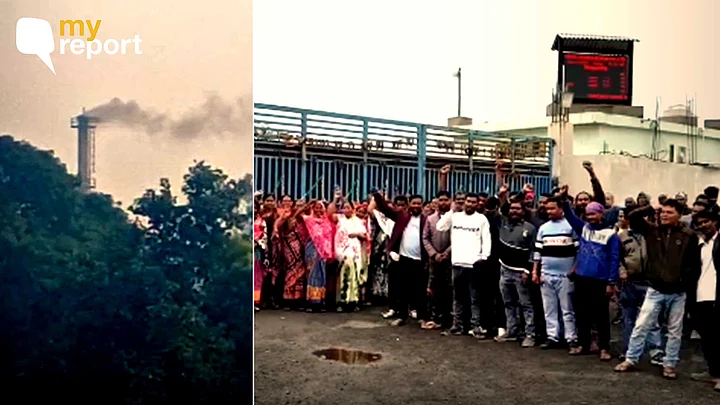
Try something tonight. Tie a handkerchief over your nose, lie down, and try to sleep. Or simply imagine your child sitting in a classroom, with their face covered, every single day. That is what life has become in Siriapali, a village in Odisha's Jharsuguda district. It is also my village.
A coal tar plant stands just a few hundred metres from our homes. For almost a year now, a strong, unpleasant smell from the plant has become part of the villagers' everyday lives.
"We were told this would be a zero-pollution factory. Now we are choking," one resident tells me.
'Our Lives Have Become Hard'
The said plant is operated by Kolkata-based Utkal Hydrocarbon Pvt Ltd. It processes coal tar, a byproduct of steelmaking, to manufacture products used in industries such as aluminium production.
"At the time of setting up the plant, we were told that the smell would last only a few days. It has been a year. It comes every day, sometimes in the evening too. Living here has become very hard," Biro Baba, a 55-year-old farmer, says.
Another farmer, Rameswar Pradhan, 46, says his family struggles to have dinner because of the constant smell. "Sometimes it gets so strong that you can't swallow even one bite," he says.
One of our biggest concerns is the school located around 400 metres from the plant. More than 200 children study there. Parents are worried about what prolonged exposure to the fumes could mean for their children's health.
For many of us, the problem is no longer just the smell. Villagers also complain of burning eyes and difficulty staying outdoors when the odour becomes particularly strong.
Laxman, a 49-year-old grocery shop owner, says villagers have tried approaching the plant management several times but have not received any satisfactory response.
Villagers have also staged multiple protests outside the plant gates. The most recent protest took place on 20 November.
Despite repeated complaints and protests, little seems to have changed.
We are not against industries coming to our district. Jharsuguda has several industries, and many families depend on them for their livelihoods. We understand the importance of development and employment.
But does development have to come at the cost of our everyday lives?
'What Does Coal Tar Mean for Our Health?'
There is another reason why villagers are worried.
The International Agency for Research on Cancer (IARC) classifies coal tar pitch, a product derived from coal tar processing, as a Group 1 carcinogen. This means there is sufficient scientific evidence that it causes cancer in humans.
Studies have linked exposure to coal tar substances, particularly among workers, to lung and skin cancers.
I am not claiming that the substances coming out of the factory are cancerous, but we do not even have an independent study establishing what the villagers are being exposed to or what the long-term health consequences could be.
That is precisely what worries us. We want to know what is in the air we breathe and whether our children and families are safe.
'We Want Answers, Not Promises'
I wanted to understand more about the plant and what had been told to the authorities before it was set up. So, I filed a Right to Information (RTI) plea. On 11 May 2026, the Odisha State Pollution Control Board sent me 702 pages of documents, including the company's draft environmental impact report from November 2021.
The RTI response was lengthy, but it failed to satisfactorily address our concerns about air quality, wastewater management, the Bheden-Hirakud river system, and the limited budget allocated for environmental protection. Several questions on these issues remain unanswered, and despite repeatedly raising them with the Odisha State Pollution Control Board, we have yet to receive clear answers.
There is another concern. A much larger coal tar complex is also coming up at Sripura in Jharsuguda district. If one plant is already causing so much anxiety among villagers, what will happen when another such facility begins operating?
'Who Is Listening to Siriapali?'
Siriapali is a predominantly tribal region. According to the 2011 Census, Jharsuguda district had 1,76,758 Scheduled Tribe residents, accounting for around 30 percent of its population.
Many families in and around Siriapali depend on farming and groundwater. Their homes, farms, and livelihoods are tied to this land.
Moving away is not a simple option. We are not asking industries to shut down. We only want the company and the authorities to take our complaints seriously.
We want the air around our homes and school to be tested, and the findings to be made public. We also want the company to sit down with the villagers and address our concerns.
We were promised a factory that would not pollute our surroundings. Today, we are struggling to breathe. Is asking for clean air and a safe place to raise our children too much?
(The Quint has reached out to Utkal Hydrocarbon Pvt Ltd and the Odisha State Pollution Control Board regarding the issues raised. The story will be updated if and when they respond.)
(All 'My Report' branded stories are submitted by citizen journalists to The Quint. Though The Quint inquires into the claims/allegations from all parties before publishing, the report and the views expressed above are the citizen journalist's own. The Quint neither endorses nor is responsible for the same.)