The Quint has consistently been reporting on the working conditions, wages, and woes of gig workers under Naukri Crisis. Become a member to support our work.
Has your firm received a memo from the Union Labour Ministry to stop promoting 10-minute deliveries? “No comment.”
Has your firm decided to remove any branding or advertisements that claim to promise deliveries in 10 minutes? “No comment.”
Starting when will your firm implement this order? “No comment.”
This is the response from Blinkit, Zepto, and BigBasket, while calls to Swiggy Instamart were unanswered, when asked about the Union Labour Ministry’s reported memo to rethink 10-minute delivery limit days after gig workers staged mass protests to highlight the immense pressure in the quick commerce ecosystem.
On Tuesday, 13 January, several media outlets reported that Union Labour Minister Mansukh Mandaviya has urged quick commerce platforms to rethink the 10-minute delivery model, citing sources.
During a closed-door meeting with their representatives on Saturday, the Labour Ministry directed Blinkit, Swiggy Instamart, and Zepto to stop promoting their grocery deliveries as a “10-minute service,” news agency Reuters reported.
However, 48 hours after the reported announcement, official communication regarding the same is conspicuous by its absence.
Neither the Union Labour Ministry nor any of the said quick commerce platforms has issued a public statement on the said memo, shrouding it in ambiguity. When asked a delivery person engaged with Blinkit about any communication on the possible changes to the app, he too said, “There is no word from our reporting manager or the company yet. Jo bhi hai, news se hi pata chala (whatever I learnt was from the news).”
The question is if the Labour Ministry has urged discontinuing the promotion of 10-minute deliveries for rider safety, why hasn’t it made the directive public—and why are the said platforms unwilling to openly announce phasing out the model?
On the face of it, the Centre’s intervention is welcome, however the absence of an official communique regarding the same raises the following questions:
Will the platforms impose a new time limit on riders to deliver orders, which were earlier promised within 10 minutes?
Is the memo meant only for Blinkit, Swiggy Instamart, and Zepto, or has it been sent to others like BigBasket, Flipkart, Jiomart, Amazon etc which have separate quick commerce verticals?
Is rethinking the 10-minute model limited to stopping promotion of such claims on the customer-facing app?
What will change for delivery workers?
What does this directive aim to achieve?
Let’s try to answer these questions one by one.
'Change in Branding But No Change in Business Model'
In the absence of a response or a press statement or even so much as a social media post from the quick commerce platforms, there is no clarity on how they plan to phase out 10-minute deliveries.
According to a report by ET Brand Equity, Blinkit's principal tagline has been revised from '10,000+ products delivered in 10 minutes' to '30,000+ goods delivered at your doorstep'. Zepto's tagline now says 'Groceries in minutes', and Swiggy Instamart shows 'Groceries and More' on Android and iOS app stores. But Tata Group's BigBasket continues to show '10 min grocery app.'
Nirmal Gorana, National Coordinator for Gig & Platform Service Workers Union (GIPSWU), told The Quint,
“An oral order is not sufficient. An official document, that states the provisions of the directive is, needed to ensure proper implementation as well as punitive action in case the platforms are found violating norms.”
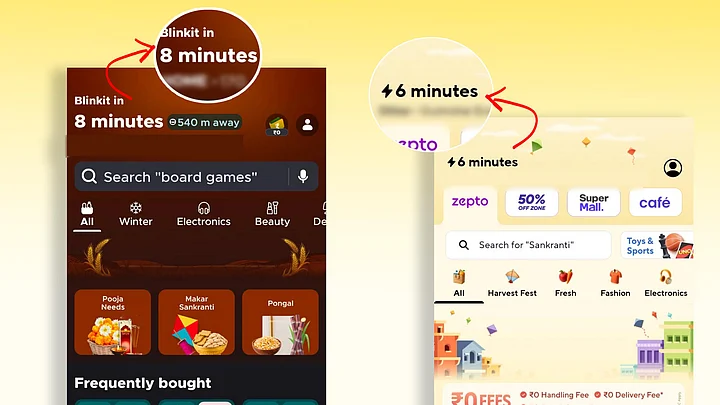
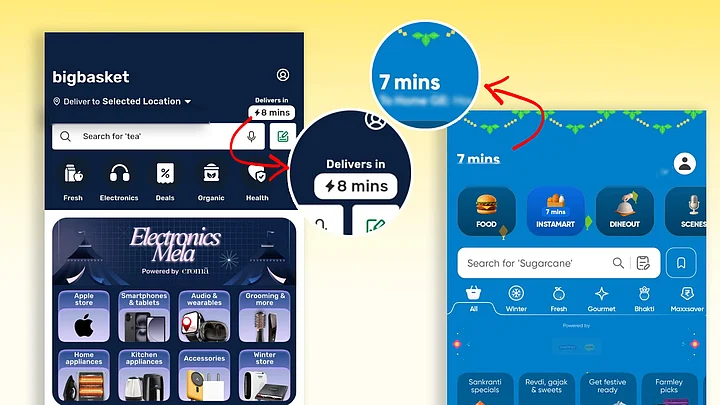
When The Quint checked the customer-facing side of the said apps, deliveries were still being promised under 10 minutes.
Which brings us to the next question: is removing the claim of 10-minute deliveries from the apps’ branding an effective strategy to ensure rider safety?
But before we answer this, let’s recall what Deepinder Goyal—the founder of Eternal (which includes Blinkit, Zomato, District, etc)—wrote while defending the 10-minute delivery model, in light of mass protests by gig workers on Christmas and New Year’s Eve last year.
In a series of posts on X, Goyal wrote, “The most common concern is that faster delivery promises translate into pressure on delivery partners to drive unsafely. That isn’t how the system operates. Firstly, delivery partners are not shown customer-facing time promises. There is no ’10-minute timer’ or countdown in the delivery app. 10 mins or faster deliveries are primarily due to our stores being closer to customers and not by higher speeds on the road.”
If Goyal’s claims are true and delivery partners are not shown the 10-minute timer on their side of the apps, then what purpose does removing the ’10-minute-delivery’ claim from the platforms’ branding serve?
The move will presumably sensitise customers about the pressures of delivery persons, and hopefully reduce instances of harassment faced by riders if they are late by say, 5-10 minutes. However, if the customer while placing an order is still being promised delivery of their products under 10 minutes (as in the screenshots attached above), they will expectedly raise complaints against the riders for late deliveries.
News reports of discontinuing the 10-minute delivery model reportedly led to Eternal and Swiggy’s stock moving sharply in the afternoon trade on Tuesday, 13 January. Denying “any sharp movement" in Eternal share prices, and responding to a notice from stock exchanges, Eternal in a regulatory filing stated,
“Specifically with respect to our quick commerce business Blinkit, there is no change in business model that could have any material impact on the company.”
What Changes for the Riders?
Various gig workers’ unions have welcomed the move, seeing the Centre’s intervention as an acknowledgment of the harsh working conditions endured by delivery persons, particularly those engaged with quick commerce apps. But not having seen the government directive (and not being privy to the closed-door meeting despite being stakeholders in the matter), they too are cautious of this victory.
"Yes, the rollback is good news, but many things will remain the same. Delivery partners are still expected to work fast, handle multiple orders at the same time, and stay logged in for long hours to earn incentives. Until that changes, the stress of the job will continue,” Nitesh Kumar Das, Organising Secretary of the Gig Workers Association, told The Quint.
He added that though there is no visible countdown clock forcing riders to speed yet, ratings, incentives, and non-transparent penalties ensure that workers feel constant urgency.
It is important to note here that delivery persons are paid wages per order, and on completing a certain number of orders they are eligible for an incentive. For instance, if they deliver 15 orders, they unlock an incentive of Rs 150. But their wage per order and incentives change daily, even by the hour depending on demand.
So, a delivery partner who logs in early morning or late evening may have to deliver 10 orders to unlock an incentive, while those working during the day may have to deliver 20 orders to unlock the same incentive. And while average wage in wee hours is Rs 55, that during the day is Rs 35 per order.
It is this algorithmically determined dynamic pay that places undue pressure on delivery persons, and pushes them towards precarity. Delivery workers are compelled to ride for 12-16 hours daily, come hell or high water, to be able to earn Rs 1,000, not accounting for cost of fuel, repair, or health issues.
So what changes on ground for delivery workers?
“The removal of the 10-minute delivery catchline is largely optics-driven rather than business-altering,” Karan Taurani, executive Vice President at Elara Capital, told Reuters. “The proposition of quick commerce continues to be anchored in speed, convenience, and proximity-led fulfilment, which remains structurally superior to horizontal e-commerce timelines.”
Besides, Shaik Salauddin, President of the Telangana Gig and Platform Workers Union, told The Quint, “The quick commerce apps must ensure that the cost of rebranding should not fall onto the workers. Currently, the delivery partners are required to purchase with their own money jackets, raincoats, T-shirts from these platforms. But the re-branded apparel should be made available to them for free.”
With gig workers’ social security already uncertain, and regulation of quick commerce platforms largely absent, the non-disclosure of the 10-minute delivery circular only deepens the ambiguity surrounding the gig work ecosystem.
The Quint has reached out to the Union Labour Ministry as well as Union Labour Minister Mansukh Mandaviya's office. The story will be updated once they respond.