
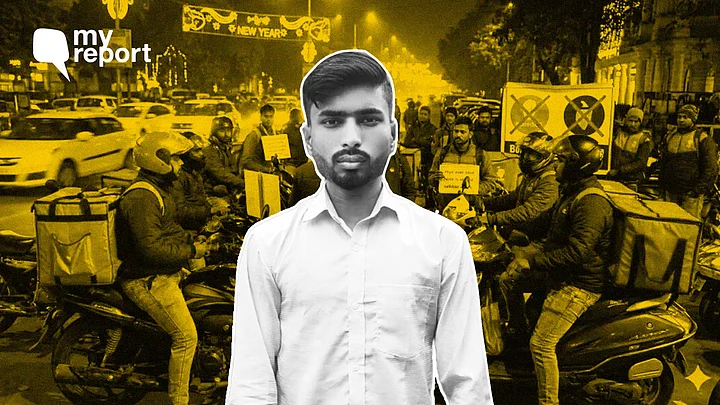
I am a gig worker. I deliver food and groceries in Delhi, helping companies reach customers at the last mile. Every order I deliver keeps their business running. And yet, these companies refuse to acknowledge us as their own. We are kept at a distance, labelled only as 'gig workers.'
Over time, that word has begun to hurt. Sometimes, it feels less like a classification and more like an insult that strips us of dignity, security, and recognition, even though we carry the entire system on our backs.
For years, we have been demanding fair and transparent pay, reasonable working hours, workplace safety, and security and government regulations that govern labour laws. Yet, our voices go unheard.
Left with no option, we have decided to suspend our services on 31 December. This is going to hurt our pockets, yet we are doing this to make our voices heard.
Here are the major issues we deal with in our everyday work.
'Flawed Payout System'
Both the payout system and assignment of app-based companies are deeply flawed.
We are paid only for the distance from the store or restaurant to the delivery location. The distance we travel to reach the restaurant, and the distance we cover while returning after a delivery, is not covered.
Second, every delivery rider is assigned a specific delivery zone, and if we step out of that zone—even by mistake, due to a road diversion, getting lost, or a sudden road closure—we stop receiving orders. Until we make our way back into the assigned zone, work simply stops. This costs us fuel and time, but we are not compensated for either.
For instance, I usually work around Sector 7, Rohini. When I am doing grocery deliveries, I sometimes get orders that require me to travel as far as Mangolpuri. That is a distance of about seven to eight kilometres. I am paid for going from the store to Mangolpuri, but I receive nothing for the journey back to the store.
The situation is no different in food delivery. We are required to travel to different restaurants to pick up orders, but the distance covered to reach those restaurants is unpaid.
Even after completing a delivery, the travel required to reach the next restaurant is not counted for payment. This is one of the biggest reasons our earnings remain so low despite long working hours.
'10-Minute Delivery Is Putting Our Lives At Risk'
Almost every app-based company, in a race to outdo each other, has introduced 10-minute deliveries. What has that done to the lives of riders like me is not something they seem to have considered.
I work in Delhi, and the city’s traffic needs no explanation. The same is true for any major metro—whether it is Delhi, Mumbai, Bengaluru, Chennai, or Hyderabad. Traffic congestion is a daily reality. Even a single traffic signal can easily consume two to three minutes. In such conditions, how are we expected to complete a delivery in just 10 minutes?
Beyond traffic, some delays are completely beyond our control. Often, customers do not answer phone calls. Sometimes, the location shared is incorrect, or it cannot be tracked properly on the map. Many buildings are poorly numbered, forcing us to search lane after lane, wasting valuable time.
In gated housing societies, the process is even longer. We are required to register with the security guard, after which the guard seeks permission from the resident. Only then are we allowed to enter. Even after that, we are expected to deliver the order to the customer’s floor, regardless of how high it is. Every step takes time.
To cope with these pressures, riders often jump traffic signals or ride on the wrong side of the road. This is not recklessness—it is pressure. If we fail to meet the 10-minute target, we begin receiving repeated calls from managers and team leaders and are harassed for delays.
In the process, we are forced to put our lives at risk. If such delays are escalated repeatedly, we are removed from our shifts and our IDs are blocked. This constant threat is why riders are always in a hurry. Accidents happen—sometimes they make it to the news, and many times they don’t.
Instead of the 10-minute delivery gimmick, companies should instead provide riders with reasonable delivery timelines that prioritise safety over speed.
'Lack Of Government Regulations Hurt Us'
Despite being the main link between app-based companies and their customers, we are protected by neither government labour laws nor by the companies themselves. Our IDs can be blocked at any time, without explanation or accountability.
I work for nearly 12 hours a day, yet there is no certainty about how much I will earn. There is no guarantee that targets will be met, and if I fall sick even for a day and cannot work, I simply do not get paid.
It is extremely cold these days, but whether it is day or night, we continue delivering orders. Many times, the cold affects my health, but falling sick only means a loss of income. We are expected to risk our lives on the road, yet there is no protection and no compensation.
Because companies do not recognise us as employees, we receive none of the benefits that regular workers are entitled to—no provident fund, no gratuity, and no employment security. We have been placed in the category of 'gig workers,' a category where labour laws do not apply and where there is no guaranteed minimum wage.
It is to highlight these very demands that we are protesting once again—so that companies are forced to acknowledge our problems, and the government brings us under a regulatory framework that protects us from exploitation.
(The Quint has reached out to the Office of the Labour Commissioner, Government of NCT of Delhi for their response on the gig workers' protest. The story would be updated as and when they respond.)
(All 'My Report' branded stories are submitted by citizen journalists to The Quint. Though The Quint inquires into the claims/allegations from all parties before publishing, the report and the views expressed above are the citizen journalist's own. The Quint neither endorses, nor is responsible for the same.)
