
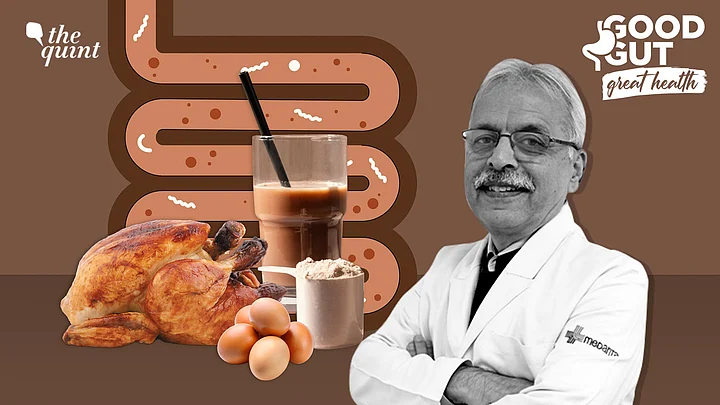
(This is the second article in a series by gastroenterologist Dr Ashwini Setya, in which he unpacks how lifestyle, environment, diet, and hidden exposures affect your gut health. Read the first one here.)
Protein is widely known as the muscle-building macronutrient. What is less well known is that proteins are the essential building blocks of various enzymes and many hormones.
Lately, however, protein has caught the fancy of 'health-conscious' people and is trending thanks to social media influencers. But what needs to be realised is that what is trending is not necessarily good for health.
The gut should not be seen simply as a conduit for food with two ends, but an active regulator of how much dietary protein is needed and metabolised.
Is there such a thing as too much protein?
Should you prioritise protein over carbohydrates in your diet?
Is powdered protein powder bad for your gut?
Let's break it down.
Protein, Digestion, and the Gut: Common Myths Debunked
Let’s get the basics out of the way first. Protein digestion begins in the stomach, where gastric acid prepares proteins for enzyme action, breaking them down into smaller fragments called peptides. Further digestion and absorption take place in the small intestine.
However, not all ingested protein is fully digested. Some escapes this process and reaches the colon, where it is acted upon by gut microbes.
This is where things get complicated. Beyond the basic biology, discussions around protein are clouded by misinformation, oversimplification, and persistent myths, making it harder to understand what the gut actually needs.
Myth: More protein always equals better muscle growth
Fact: Most adults can only absorb and utilise about 20-25 grams of protein in a single meal for muscle synthesis. Surplus protein doesn’t magically convert to more muscle—it’s often used for energy or excreted.
Myth: All protein is same and equally digestible and bioavailable
Fact: Digestibility depends on the source. Animal proteins (meat, eggs, dairy) are typically easier for the gut to break down than some plant proteins due to amino acid (the building blocks of proteins) profiles and anti-nutritional factors like phytates.
Yet, if fibre is insufficient, or the gut is unhealthy, even premium quality protein can go partially unused, impacting both the host and the microbiome.
High-protein diets, especially when not balanced with adequate fibre, change gut microbiota composition which can increase colonic as well as overall inflammation, and even irritate the bowel by producing chemicals that harm gut lining and may contribute to disease states like leaky gut and inflammatory bowel disease.
Myth: Protein is much better than carbs
Fact: While a higher protein-to-carb ratio can be beneficial for metabolism, it carries specific risks for your digestive system if not managed carefully.
When your carbohydrate intake is currently "balanced," reducing it further to add more protein can negatively impact the gut environment by increasing protein fermentation which causes toxic metabolite accumulation like ammonia and hydrogen sulphide, leading to low-grade gut inflammation.
Myth: The more the protein in the diet, the better it is
Fact: There are several gut factors that affect protein digestion and absorption.
Protein source, meal composition, digestive enzyme adequacy, and gut permeability largely determine how the protein is digested and utilised by the body for its various functions.
Microbiome composition and its diversity determine how much protein is assimilated after digestion, and how much is presented to the gut microflora for fermentation.
Importantly, people low in stomach acid or pancreatic enzymes extract relatively less protein from the diet, and thus, may need additional or different protein sources to compensate.
It is extremely important to understand that acid is not only the first step in digestion, but also our first line of defence. Acid kills the germs that we ingest along with food; it also initiates digestion by breaking down protein into smaller moieties.
Further, it is an important chemical that stimulates a hormone which causes the release of bile and the pancreatic digestive enzymes through a complex interaction, to complete the digestion.
In India, where people consume anti-acid medication (pantoprazole and related drugs) as a routine for years on end, to treat ‘gas’, the result is actually the contrary. Because these drugs have reduced the acid to nil, the partially digested food is presented to the gut bacteria to be fermented upon resulting in more gas production.
A balanced diet of protein and healthy fats with fibre slows digestion, promoting more thorough absorption and less protein fermentation in the large intestine.
Dietary Protein vs Powdered Protein Supplements
One of the most common trends—particularly in gym and fitness circles—is the daily use of protein powders. Alongside their rise in popularity, there has been a flood of debate about whether they are good or bad for health, much of it driven by misinformation.
The truth is, there is no simple yes or no answer.
Protein powders themselves are not inherently harmful and can be a convenient way to meet protein needs. However, their impact on the gut depends on how much you consume, the form of protein used, and what else your diet includes alongside it.
Whole food proteins are naturally packaged with other vital nutrients (vitamins, minerals, fibre). Whole food sources of protein (legumes, eggs, fish, dairy, lean meats, etc) promote a balanced gut environment and stable digestion. The presence of fibre, in particular, helps by doing that.
Protein powders, which have whey, casein, and other isolates, are highly concentrated protein sources and are often bereft of other nutrients and sometimes combined with artificial sweeteners, emulsifiers, and preservatives.
For some, especially those with lactose intolerance, these powders can cause bloating, gas, and discomfort since the gut microbiome is less equipped to process them.
Studies indicate chronic consumption may suppress beneficial microbes (like Bifidobacterium) and, with high doses, may add inflammatory load on the gut.
Moreover, research suggests that beyond 20 grams, additional intake post exercise does not help muscle recovery commensurate with higher intake, yet can disrupt the gut balance.
Medical, Ayurvedic, and Naturopathic Perspectives: Where They Diverge
Modern medicine (Allopathy) recommends protein intake based on age, gender, activity, and state of health.
In Ayurveda, on the other hand, protein and overall diet are customised to the individual’s dominant dosha (body constitution). It warns against excessive animal protein for most types, suspecting it can cause imbalance and toxin buildup.
Plant proteins are often preferred, complemented with herbs, all with mindful eating.
Naturopathy focuses on natural, whole foods, and is cautious about both extreme protein intake and excessive supplement use.
Both Ayurveda and naturopathy stress digestive robustness, mind-body connection, and prevention, while modern medicine often is inclined towards symptom relief and biomarker management of the deranged body function. The watchword, as always, is balance.
(Dr (Prof) Ashwini Kumar Setya, MD DM PGDMLE, is a Senior Consultant at Medanta Institute of Digestive & Hepatobiliary Sciences and Holy Family Hospital, New Delhi. This is an opinion piece and the views expressed above are the author’s own. The Quint neither endorses nor is responsible for the same.)