
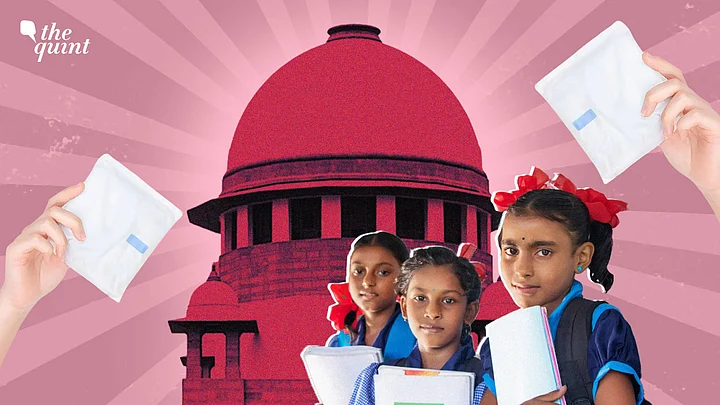
The recent Supreme Court judgment declaring menstrual health as a fundamental right under Article 21 is a cause for celebration. But, as experts caution, this is just the first of many steps ahead.
On 30 January, the top court in its order issued a slew of mandatory directions for states to ensure menstrual hygiene, including the distribution of free sanitary pads and gender-segregated toilets in all schools.
Failure to implement the Centre’s national policy—'Menstrual Hygiene Policy for School Going Girls'—will invite punitive action, the court added.
Welcoming the judgment, Arundati Muralidharan, public health professional and co-founder of think tank Menstrual Health Action for Impact (MHAi), says there is scope to build on what the Centre and the state governments have done over the past few years. But, as experts put it, the difference now is that “we can hold the state responsible.”
SC Judgment Brings Menstruation to the Public Sphere
Speaking to The Quint, advocate Tahini Bhushan says the judgment, in a way, “is a start of sorts”.
"This verdict will impact how policies are now going to be implemented.”
Bhushan adds till now policies were voluntary, pushed by some states at the local level, or by development sectors and private companies as part of CSR (corporate social responsibility) exercises. The Supreme Court judgment changes that.
“So you can expect to see some amendments in laws, especially by-laws, with respect to schools and educational institutions."
Mumbai-based psychotherapist Ahla Matra explains the judgment from a psycho-social lens, saying it takes menstruation from a private “women’s issue” to one of a fundamental right and dignity.
“Just a change in the law is not enough to change deep-rooted cultural stigma and tradition, but it is definitely a step towards it—and definitely cracks a wall,” she tells The Quint.
In its judgment, the Supreme Court said menstruation should not be "a source of shame or stigma", calling for a discourse where men and boys are sensitised to the issue.
Men have a “multifaceted role” in menstrual hygiene and awareness for schoolgoing adolescent girls, the court said, adding that “male teachers can integrate accurate, stigma-free information into lessons”.
Dilip Pattubala, founder of Uninhibited, a Bengaluru-based non-profit, believes the Supreme Court order gives legitimacy to their work. “Until now, the country did not acknowledge menstrual health as a fundamental right, so all of us who work in this space would have to keep proving the importance of the work we do,” Pattubala notes.
The current policies did not address the shame and stigma around menstruation, he says.
“Psychologically, shame thrives when there is no discussion or discourse around one’s experience. The hope is that this judgment will bring menstruation from the private life to the public sphere—and reframe it as a public responsibility at schools, workplaces, and other institutions.”Ahla Matra
The Message For Young Menstruators
Menstruation is often treated as something to be spoken of in hushed tones. According to the experts, the shame and stigma aren't natural, but manufactured at the intersection of religion, patriarchy, and capitalism.
“As a culture, when we see menstruation as a maturing of the body, we respond to it by surveillance, control, and moral policing of the menstruators’ bodies,” Matra explains.
“Suddenly there is overemphasis on how women’s bodies should exist in the public and in the private world. And this is deeply entangled with this caste-based idea of purity and pollution as well, which sort of places menstruating people in exile during that period.”
Matra adds that menstruation is so steeped in "shame-based instructions" that it extends to how you discreetly dispose of pads, discreetly purchase them, and ensure you don’t stain yourself. “And that’s really sending a message to the mind of a young menstruator."
Even capitalism exploited this shame commercially by pushing menstrual concealment products that are leak-proof and smell-proof, she adds. “The hope is that this judgment can begin to delegitimise traditions of control and surveillance and reframe it as a violantion of rights,” the psychotherapist says.
Pattubala adds that real change can happen when decision-makers at every level of the process shift their perspective. “If they also carry the stigma and are not comfortable talking about it to one other, then it will dictate how the policy will be implemented on the ground,” he adds.
"For example, the government school teachers skip the chapter on reproduction entirely, even though it is included in the NCERT textbooks. Even the examination committee have stopped asking questions on the topic, because they know the chapter isn't being taught.”
The Distribution Dilemma
Yet, as Lakshmi Murthy, president of Rajasthan-based Jana Sansthan, points out, India has come a long way in the last couple of decades. For one, the Indian market has expanded in terms of choices beyond sanitary pads.
However, as the Supreme Court exhorted the use of oxo-biodegradable sanitary pads, experts argued that treating pads as the 'holy grail'—despite an ecosystem that has evolved to include other products—takes the choice away from them.
Muralidharan says the top court could have referred to the Bureau of Indian Standards for menstrual products—both single-use sanitary pads and menstrual underwear.
Pattubala, for examples, says that his non-profit saw greater success with menstrual cups in Karnataka, and they plan to scale its distribution with the help of the state government.
"There are alternate products available, so we should give them a choice to choose what suits them."Dilip Pattubala
Moreover, experts raised concerns over the judgment "translating to poor distribution issues” as well as reinforcing the challenges of the disposal system. For instance, oxo-biodegradable sanitary pads aren't truly bio-degradable and environment friendly. When the garbage collection isn't organised, they eventually get dumped in a landfill.
Further, disposal in the rural areas is unlike the system in big cities, they say. “Even if you have incinerators, you have electricity issues. And if you have small incinerators, then you have to deal with acrid smell,” Murthy says.
Lack of Facility Not Key Reason of Absenteeism, Dropouts
Pronouncing the verdict, the Supreme Court bench comprising Justices JB Pardiwala and R Mahadevan quoted American social activist Melissa Burton: “A period should end a sentence—not a girl’s education.”
Speaking further on education, they said the verdict was aimed to close the gap where the “absence of sanitary napkins and a hygienic mechanism to dispose it, results in absenteeism, or dropout of girls from school”.
However, Dr Muralidharan says absenteeism and dropouts are complex issues. Although enabling access to sanitary products and gender-segregated toilets are important steps, the fact remains that girls don’t only stay away because of this, she adds.
One of the top reasons for absenteeism is period pain, and for some, excessive bleeding. Fatigue, stigma, and discrimination also contribute to it.
“When a girl attains menarche, enters adolescence, some parents may withdraw their daughters from school to marry them off, she said.
So, alongside logistics, addressing shame and stigma around menstrual health are as important.
(Ritika Jain is a New Delhi-based independent journalist covering stories that intersect with law, governance, society, and human rights issues.)