(This piece contains some spoilers.)
Set in Punjab’s fictional town of Dalerpura, Kohrra Season 2 returns to render mystery and violence—but this time, not only through spectacle or gore. Violence is ambient. It lingers.
A mother stares endlessly at the road and the motorcycle on which her son died; women flinch at raised voices; a migrant boy searching for his long-lost father is rebuked at every turn; a labourer’s body instinctively recoils in fear after encountering his master. Nothing erupts into melodrama, and yet brutality saturates every frame.
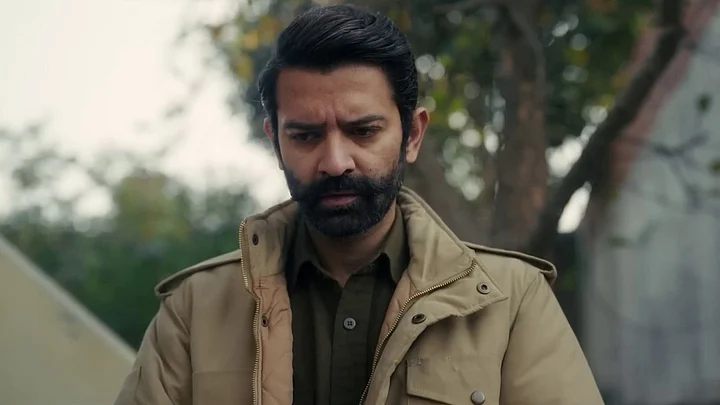
The central murder investigation, led by Dhanwant Kaur (Mona Singh) and Amarpal Garundi (Barun Sobti), gradually reveals that the most haunting figure in the story is not a conventional villain, but a former bonded labourer (Rakesh Kumar) whose subjectivity has been hollowed out by years of captivity.
The chilling cattle-barn scene in the final episode is unforgettable. Preet (Pooja Bhamrrah), the woman whose murder anchors the plot, discovers Rakesh inside the barn and asks him to leave. Rakesh refuses to leave because that space of confinement has become legible to him as his “home." Freedom feels unfamiliar.
What unfolds then is not an outburst of cinematic aggression but something far more unsettling: a man who, even when unchained, returns blankly to the barn as though it were the only space he recognises as his own. The violence he commits in rage is not spontaneous, but a condition cemented in him over years of subjugation.
These moments are devastating because they expose a truth India has never fully confronted: bondage does not end when chains are removed. It mutates, migrates, and internalises.
Yet, as soon as one begins to praise Kohrra for addressing the persistence of bonded labour, an uncomfortable question surfaces: why do Indian crime dramas so frequently mobilise Punjab as the site of social crisis? Drugs. Migration. Neo-noir violence. And now bandhua mazdoori. Why does the nation’s fracture so often unfold in this border state?
Perhaps the answer lies not in Punjab alone but in the geography of Indian capitalism.
Bonded Labour Is Not a Feudal Relic
Following a 1975 ordinance, bonded labour was abolished in 1976 under the Bonded Labour System (Abolition) Act. In Bandhua Mukti Morcha vs Union of India, the Supreme Court recognised debt bondage as a violation of Article 23, after horrific conditions were exposed in Haryana’s stone quarries, where many SC and ST labourers worked amid disease, unsafe blasting, and withheld wages.
Yet, abolition did not end bondage; it reconfigured it. Late-1970s surveys estimated millions still trapped, with the Gandhi Peace Foundation (1978) placing the figure at 2.62 million. Subsequent reports found bonded labour across agriculture, brick kilns, quarries, plantations, fisheries, carpet weaving, construction, and migrant work—overwhelmingly affecting Dalits and Adivasis. What changed was not coercion itself, but its form.
Traditional bondage operated through feudal patronage: lifelong attachment to a landlord (malik), payment in kind, and intergenerational obligation. Contemporary “neo-bondage” is more mobile and contractual, often mediated by labour contractors. Advances precede migration, wages are withheld, and debt rolls over; a worker may change employers only by transferring debt to another creditor. As Tom Brass (2008) argues, unfree labour is not opposed to capitalism but can serve it. Today, bondage persists in agribusiness, construction, and brick kilns feeding India’s urban expansion.
Gyan Prakash’s Bonded Histories: Genealogies of Labour Servitude in Colonial India (1990) deepens this view. Tracing kamias in southern Bihar, he shows that colonial “debt-bondage” was not merely a feudal leftover but reshaped by changing political economy. Embedded in caste hierarchies, these unequal ties were recast under colonial rule through the language of debt and individual freedom, rendering the labourer legible as an “unfree” subject trapped by loans.
Bonded labour, therefore, is not a leftover from the past, but a reworked relation of power that links colonial land reforms to contemporary regimes of migrant debt.
Punjab as a Cinematic Safe Zone
Punjab occupies a peculiar place in the national imagination: once hailed as the Green Revolution’s success story, it is now framed through agrarian crisis and drug panic. Yet, it is also a major destination for migrant labour. The National Commission on Rural Labour has documented Bihari and Odia workers in Punjab’s fields and brick kilns, while civil society groups have filed thousands of bonded labour complaints, particularly involving SC agricultural workers known as Siri. Their families often perform unpaid labour, and attempts to leave have reportedly been met with violence and social boycott.
Hence, Punjab is not uniquely exploitative. It is where India’s internal labour migrations converge, where workers from Bihar, Jharkhand, Odisha, and Chhattisgarh enter agrarian and construction economies that depend on seasonal, indebted, low-cost labour. It is a ‘receiving state’.
By situating bonded labour in Punjab, Kohrra stages exploitation into a recognisable site; a wealthy agrarian household, a sizeable barn, and labourers who are both indispensable and invisible. Yet, the risk, I argue, is regionalisation.
When crisis is repeatedly narrated through Punjab, the rest of the Hindi belt, where recruitment usually originates, slips from view.
In states like Bihar, eastern Uttar Pradesh, Jharkhand, family pressures and agrarian distress push people to migrate long before a labourer ever reaches Punjab.
In this sense, the story begins elsewhere.
The Politics of Visibility: Borders as National Mirrors
Why, then, do OTT crime series keep returning to Punjab?
Partly because it offers a ready visual grammar—mustard fields, crumbling havelis, border anxieties, post-Green Revolution decline—that urban streaming audiences instantly recognise. But there is also a political calculus. In an era of tighter OTT regulation and scrutiny of political content, critiquing structural exploitation in electorally crucial Hindi heartland states may carry greater risk. Punjab, shaped by shifting regional formations, becomes a comparatively safer canvas for staging systemic decay — a pattern visible in Udta Punjab and Paatal Lok.
Kohrra does take risks: its portrayal of bonded labour is restrained and humane, showing how prolonged subjugation erodes agency rather than producing monstrosity. Yet, representation is never neutral.
By situating bonded labour primarily in Punjab, the series risks narrowing what is, in reality, a nationwide condition.
In other words, the geography of the narrative shapes how audiences comprehend responsibility and scale, turning exploitation into 'someone else’s problem.'
Bondage as Condition, Not Incident
What Kohrra captures with precision is the psychology of internalised captivity. Scholars note that bonded labour is sustained not only by overt force, but by survival debts (marriage, illness, subsistence), caste hierarchies that normalise servitude, and the threat of violence or social boycott. In the barn scene, the labourer does not need to be ordered back; years of dependence have so structured his world that freedom itself is unintelligible.
In another moment, when Rakesh accepts a toffee from a schoolchild and gently holds his hand—perhaps recalling his own son—a quiet dread settles in. Viewers anticipate harm. Even in this fleeting tenderness, Rakesh is rebuked and beaten by the police.
At another point, the house where the migrant labourers had lived for years catches fire due to a short circuit. Their bodies are recovered alongside the memory of unpaid labour, their lives rendered expendable. No one comes looking for them—except Arun, searching for Rakesh—a fate they had no power to determine.
The series suggests that freedom requires more than mere release; it demands dismantling the conditions that made bondage rational in the first place. Bondage reproduces itself because poverty does.
Beyond Punjab: What the Show Leaves Unsaid
By the time Kohrra concludes, it leaves us with an uncomfortable question: does bonded labour still exist? The answer is undeniable—it does, and across India. From stone quarries in Haryana and brick kilns in Tamil Nadu to sugarcane farms in Gujarat, plantations in Assam, forest zones in Chhattisgarh, carpet looms in Uttar Pradesh, and agricultural fields in Punjab.
These flows are circular, because regional migration in India has never ceased.
The starkest example came during the COVID-19 lockdown, when internal migrants died walking back to their villages after the nationwide shutdown was announced in March 2020.
Perhaps a more radical reading of Kohrra is not that it burdens Punjab with the nation’s sins, but that it exposes a form of internal neo-colonialism—labour extracted from marginalised communities to fuel agrarian and urban growth elsewhere. Punjab becomes the stage, but the story is written across uneven terrains.
There is, however, a notable absence. While the series traces the labourer’s psychic damage, it barely explores the recruitment chain—the contractors, advances, and mechanisms that make bondage possible.
We glimpse Rakesh’s past only through his son, Arun Kumar (Prayrak Mehta), who arrives with a 23-year-old wedding photograph, and a brief flashback of Rakesh reaching Dalerpura with three other workers decades earlier. Starkly, his only line in the entire series is telling a contractor he is from Chhattisgarh. We are not shown how he travelled such a long distance, nor the violence and torment they all endured over two decades.
Even if this absence is an aesthetic choice, it also reflects a broader pattern in Indian media—the endpoint exploitation is visible but its origins are left open-ended.
Sitting With Discomfort
What makes Kohrra Season 2 powerful is its refusal of neat resolution. There is no triumphant rescue, because there is nothing left to rescue.
The final scenes insist on a harder truth: some forms of violence are so deeply embedded in everyday life that they cease to register as violence at all. In the closing frame, the grandmother berates Rakesh before Dhanwant and Garundi, sobbing as she calls him “a dog” for betraying the family that “fed” and “cared” for him. In that moment, he is recast as inherently violent—an ironic reflection of how society demonises those it has systemically dehumanised. He is tragic, and that tragedy implicates more than a single household in Dalerpura, or even Punjab.
It implicates a nation that abolished bonded labour on paper while allowing indebtedness, socio-political hierarchies and migratory vulnerability to reproduce it in new forms. If Punjab keeps appearing in crime dramas as the site of decay, perhaps it is because it sits ‘too well’ at the intersection of India’s labour migrations, where the nation’s structural inequalities become (easily) visible enough to be (easily) narrated.
But bonded labour does not belong to Punjab alone. It belongs to India’s ever-shifting economic order and until that order changes, freedom will continue to feel unfamiliar.
(Shirin Bismillah is a PhD scholar in Media and Cultural Studies at the University of Roehampton, London. Her poems and translations have appeared in several magazines. This is an opinion piece and views expressed are the author's own. The Quint neither endorses not is responsible for it.)