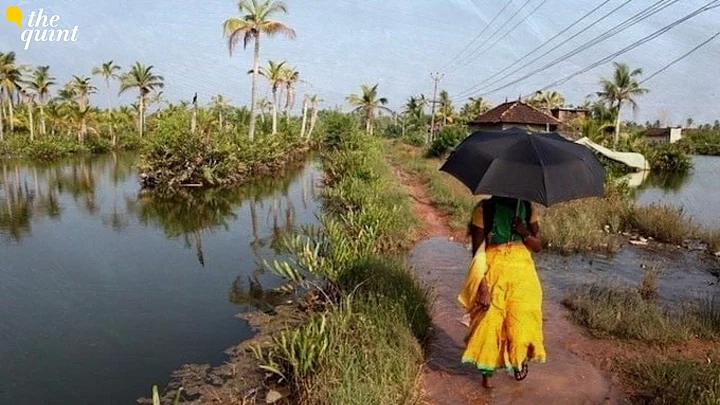
For decades, migration in India has largely followed a one-way path, from villages to cities, from farms to factories, from uncertainty to opportunity. Yet recent years have disrupted this familiar pattern.
But climate stress, rising urban costs, and fragile informal employment are pushing millions back to rural India, challenging long-held assumptions about where economic security truly lies.
Reverse migration is often framed as a temporary setback. In reality, it is a structural signal.
Whether it becomes a cycle of distress or a foundation for resilience depends on how deliberately rural economies are rebuilt.
The Widening Rural–Urban Imbalance Under Climate Strain
India’s development trajectory is at a critical inflexion point. The Economic Survey projects that more than 40 percent of India’s population will live in urban areas by 2030, even as a majority continues to rely on rural and semi-rural economies for livelihoods. Yet rural India supports nearly 70 percent of the population while contributing only about 48 percent to net domestic product, a long-standing imbalance that limits income growth and upward mobility.
Climate change is intensifying these structural pressures. Erratic rainfall, rising heat stress, and resource depletion are reshaping migration patterns across agrarian regions, driving both distress-led and aspirational movement.
Migration is no longer only about seeking opportunity; it is increasingly a strategy for managing risk in an uncertain climate future.
The post-pandemic wave of reverse migration exposed the fragility of rural systems. Returning workers encountered limited job opportunities, overstretched infrastructure, and weak safety nets. Agriculture absorbed many by default, resulting in widespread underemployment rather than durable livelihood recovery. In this context, strengthening rural economies has become urgent.
Income Data Reveals What's Hiding Beneath the Surface
Data from recent rural income surveys, on the surface, suggest improvement. By September 2025, only around 18 percent of rural households reported a decline in income over the previous year. Tural unemployment has also remained relatively low, at about 4.2 percent.
However, a deeper look reveals a more complex reality. Nearly 45 percent of rural households reported no change in income, the highest level of stagnation observed across multiple survey rounds.
In effect, fewer families are falling backwards, but nearly half are not moving forward either.
Consumption trends underline this vulnerability. More than three-quarters of rural households reported higher consumption in 2025.
When consumption growth outpaces income growth, it rarely reflects prosperity. Instead, it often signals households drawing down savings, increasing borrowing, or postponing essential investments in health, education, and productivity.
Stabilisation, in this context, masks a lack of resilience. The data points to a clear conclusion: rural India is surviving, but not yet strengthening.
Time to Reimagine Rural Development Beyond Agriculture
This is where Climate-Smart Villages become central to the conversation. These are not isolated pilot projects or short-term interventions. They represent a system's approach to rural development, one that integrates climate adaptation with livelihood creation.
Climate-smart villages combine sustainable agriculture, water stewardship, resilient infrastructure, skills development, and local enterprise.
They reduce dependence on a single income source and create diversified livelihood pathways that can withstand climate and economic shocks.
For returning migrants, this shift is critical. Farmers become producers and processors, not just cultivators. Youth find local opportunities as technicians, entrepreneurs, and service providers rather than being forced to migrate for precarious work.
Women gain access to income-generating roles closer to home, strengthening household and community stability. In such ecosystems, reverse migration becomes a choice supported by opportunity, not a response to crisis.
Why Decentralised Clean Energy Is Foundational for 'Energy Swaraj'
None of this transformation is possible without reliable, affordable energy. Decentralised clean energy systems such as solar microgrids and community-owned power solutions do far more than electrify homes.
They power irrigation, cold storage, agro-processing units, workshops, schools, health centres, and digital services.
They extend productive hours beyond daylight and reduce dependence on unreliable grid supply or expensive fossil fuels.
Energy access determines whether rural livelihoods can move beyond subsistence. Local power enables value addition, supports small enterprises, and keeps economic value circulating within the community. It also creates jobs in installation, maintenance, and operations, addressing underemployment in regions where work is often seasonal and insecure.
At the heart of this approach is a growing vision of 'Energy Swaraj', where villages generate, manage, and benefit from their own renewable power systems.
When energy is locally owned and democratically governed, communities shift from passive consumers to active decision-makers in their development journey.
Rebuilding Rural Economies by Design
Reverse migration is not an anomaly. It reflects deeper economic, climatic, and demographic shifts.
The question is not whether people will return to villages, many already have, but whether rural India can offer livelihoods that are productive, dignified, and future-ready.
Income and consumption data make one reality clear, stabilisation without growth is not enough.
Rural economies must be rebuilt around diversification, productivity, and climate resilience. This is no longer only a welfare concern. It is a macroeconomic priority.
If villages are designed as integrated, climate-smart ecosystems powered by decentralised clean energy and grounded in local ownership, reverse migration can rebalance growth, restore dignity to rural livelihoods, and build resilience from the ground up.
Done right, reverse migration is not a step backward. It is an opportunity to redefine development itself, where prosperity is measured not by leaving home, but by the ability to thrive where one belongs.
(Harsh Tiwari is a social entrepreneur and engineer-MBA working at the intersection of clean energy, education, and livelihoods. He leads Bindi International, where his work on solar electrification, women’s skilling, and digital schools has impacted thousands across rural India. This is an opinion article and the views expressed above are the author’s own. The Quint neither endorses nor is responsible for them.)