Home Sports Cricket The Fire & Ice of Gautam Gambhir & Suryakumar Yadav — Hated, Yet Undefeated
The Fire & Ice of Gautam Gambhir & Suryakumar Yadav — Hated, Yet Undefeated
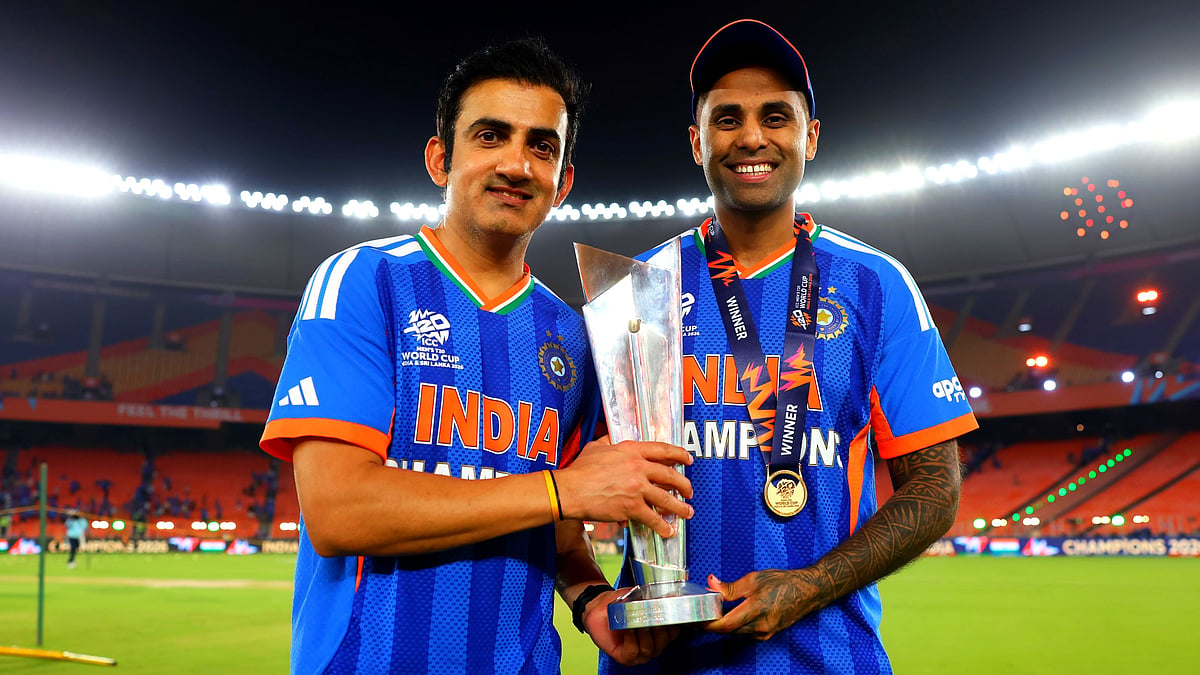
T20 World Cup: Two men who polarise opinion — Gautam Gambhir & Suryakumar Yadav — are now architects of history.
Shuvaditya Bose
Cricket
Published:
i
T20 World Cup 2026: Gautam Gambhir and Suryakumar Yadav have scripted history for India.
(Photo: BCCI)
✕
advertisement
“Ab haste thodi rahenge har jagah?”
Suryakumar Yadav asks it with a grin — the grin that has barely left his face in the hour since India won the ICC Men’s T20 World Cup by 96 runs over New Zealand. A journalist has just asked him about the contrast between his own disposition and that of his head coach.
Yadav deflects it with warmth, insisting the two men are more alike than people suppose.
They are not.
Suryakumar Yadav smiles at everything. Gautam Gambhir smiles at almost nothing. Yadav answers questions as though he’s having the conversation over dinner. Gambhir answers them as though they are being taken in evidence.
They cannot be any farther apart than they already are. The point being — the duo is different. Distinctively different. Yet, fate has them walking the same wire. Both divide opinion in a way hardly any Indian captain and coach has in the recent years. Yet, both are winners. Undisputed champions.
Gautam Gambhir’s appointment as the head coach of the Indian cricket team did not sit well with a section of the fans. Some of the resentment had a political tinge — Gambhir had, after all, been a Member of Parliament — but the cricketing objection was straightforward: he had no head coaching experience. At the press conference yesterday, Gambhir even expressed his gratitude towards Jay Shah, former secretary of the BCCI, and currently heading ICC, for giving him the responsibility when his only experience was a mentorship role with the Kolkata Knight Riders.
I want to thank Jay bhai for trusting me with this job, because I very well remember this, that when I was given this job, I had no experience of being the head coach of any franchise or any team.
Gautam Gambhir
In only his first tour on the job, India lost an ODI series to Sri Lanka. It was India’s first ODI series defeat to Sri Lanka in 27 years. A news portal even opined that Gambhir could become Greg Chappell 2.0.
The year darkened further: a 3-0 home whitewash at the hands of New Zealand, which was an unprecedented abomination. Soon, his team would lose 3-1 to Australia. And here, Gambhir would make an announcement. Not hushed — in front of the press.
If an Indian cricketer has red-ball aspirations, he has to play domestic cricket. Non-negotiable.
Soon, both Virat Kohli and Rohit Sharma were seen playing Ranji Trophy matches. Briefly after, they both mysteriously announced his retirement from the longest format of the game, with fans of both cricketers turning on the coach.
There is a particular kind of pressure that accumulates when a public figure has been wrong about enough things in a row. Gambhir was now carrying it all: the series defeats, the Kohli and Sharma retirements, the scepticism of former greats including Sunil Gavaskar. He needed to win something. He needed to win it soon.
In his maiden ICC assignment — the 2025 Champions Trophy — Gambhir was victorious without any considerable challenge whatsoever. A few months later, the same feat was replicated at the Asia Cup, where India not only won the trophy, but defeated Pakistan on three consecutive occasions.
The biggest challenge, though, was always going to be the T20 World Cup. The Champions Trophy is a five-game tournament, and Asia barely has a decent cricketing nation at the moment. But at the T20 World Cup, India would be faced with multifarious challenges, including, but not limited to — the first World Cup after eons with no superstar in the team, and the massive weight of expectations from the home crowd.
A few difficult calls were made. Vice-captain Shubman Gill was dropped entirely from the team. The batting order was altered mid-tournament. Gambhir did all he could to ensure India become the first team to win three T20 World Cup titles.
India won.
ADVERTISEMENT
ADVERTISEMENT
How Gambhir Changed the Mentality of the Team
The most consequential of Gambhir’s decisions — more consequential, perhaps, than any tactical call or selection — was philosophical. He set out, methodically, to dismantle Indian cricket’s most enduring cultural obsession: the personal milestone.
It is for this reason that a Sanju Samson can attempt a six, despite batting on 89 and his team’s score being 203 with five overs to spare. He could have decelerated for an over, but he did not.
For too long in Indian cricket, we've spoken about milestones. And I hope, till I'm there, we're not going to talk about milestones. You can see it very easily as well. You can see it in the last three games, what Sanju did. 97 not out, 89, 88. Imagine if you would have been playing for a milestone, probably we wouldn't have got 250. So I think this is for you guys as well. Stop celebrating milestones, celebrate trophies. That is going to be important, because the bigger purpose of a team sport is to be winning trophies, not scoring individual runs. It has never mattered to me, and it will never matter to me.
Gautam Gambhir
He further elaborates:
The only thing we spoke about was that how can we give ourselves the best chance to win this World Cup. And the best chance to give ourselves to win this World Cup was that how we react when someone like a batter is close to 100. If someone is batting on 94, does he have the courage to go and get 100 next ball, rather than thinking about getting 100 for three or four balls. So I think guys have done that brilliantly. So I feel I think sometimes it's very difficult to change that mindset. But all of them in the dressing room bought into that mindset. And that is where the result is.
Gautam Gambhir
Suryakumar Yadav: Blooming Late, Deflecting Hate, Tryst With Fate
Suryakumar Yadav’s path to this captaincy was not a straight line. For the entirety of his twenties, he had not played a single match for India. In an interview with ESPNCricinfo, he once said:
My father always checks all the websites any time an India A team is announced. He calls me as soon as he sees it, and tells me 'your name is not there'. I tell him 'that's not a problem'.
Suryakumar Yadav
When Rohit Sharma announced his retirement from this format, Yadav was not the first in line to replace him. In fact, he was not in the queue at all. The vice-captain of the team was Hardik Pandya, who also was leading Mumbai Indians in the Indian Premier League, and had already won a title with Gujarat Titans. An established leader.
Gambhir chose Yadav. It was not a universally popular decision. It has now been vindicated entirely. What the coach understood — and what the subsequent two years bore out — was that Yadav’s philosophy and his own were not contradictory but complementary.
Look I have said this before – I think Surya has made my life a lot easier in this format. I think he's a phenomenal leader. The most important thing in this T20 format was that we didn't want to be afraid of losing. Because if you are afraid of losing, you never win. I always believe that high risk, high reward is very important in this format. Because many times it happens that you play in a conservative way. I would have been happier if we had been out at 110-120. But our target was always to make 250 runs. But we didn’t want to play the 160 – 180 runs cricket. I think for too long, we played cricket with 160-170 runs. But for the last two years, it was the captain's philosophy, the captain's ideology – obviously, if the captain and coach are not on the same page, it can never be possible. The captain himself wanted to play high risk, high reward. And I think the credit needs to go to the captain as well.
Gautam Gambhir
Yadav echoed:
I think I have played cricket with Gauti bhai for four years. I knew from the beginning what our expectations would be from each other. Many times we have talked about the team, about the playing 11 or 15, who we have to choose, and14 players have always been the same. So if the success rate is this high, so we don't need to discuss it so much. Because we were always on the same page, since we started working together, from the Sri Lanka series, when we went to Sri Lanka, from then till now, I don't remember any time we had an argument over a player. Whether we should play a particular player or not. We both were always interested in making the team win. How we can put a player in a position that can benefit the team. Our goal was to achieve something good together. That's why we were comfortable with any selection call. Whether it's playing XI, XV or even off the field. Because we already had that camaraderie. I have played with him and I knew what he thinks. He will take two steps, I will take two steps and we will meet somewhere in the middle. So many times it has happened that we didn't even need to discuss much. So this is a special thing, which is very important. Coming to a big tournament. If you want to win the World Cup, it is very important for both to be on the same page.
Suryakumar Yadav
Two men who polarise opinion — one grinning, one grimacing, both entirely sure of themselves — are now the architects of a nation’s third T20 World Cup. In a few minutes, Suryakumar Yadav will go back to smiling at everything. Gautam Gambhir will go back to smiling at almost nothing. They have, between them, nothing left to prove.