T20 World Cup: For Those Who Believe, There’s an 8 March After Every 19 November
T20 World Cup 2026 Final: After every heartbreak, there is joy. Only, you have to refuse to give up.
advertisement
It has been 840 days since a lakh supporters at the stadium, and a billion spread across the nation, were left deflated, dejected and disillusioned when the Australian team defeated India in the final of the 2023 ICC ODI World Cup.
The Difference Was Evident
Prior to the toss, teams are mandated to duly fill a Team Nomination Form, wherein the batting order and substitutes are listed. Copies of this form are circulated in the press box to aid journalists in their work.
When the form arrived in the press box at the Narendra Modi Stadium today, there was a noticeable contrast between the two teams — striking, at least to those with an eye for detail.
New Zealand's Team Nomination Form.
(Photo: The Quint)
India's Team Nomination Form
(Photo: The Quint)
What is the point of mentioning this?
Simply that the contrast on paper seemed to mirror the difference in how the two teams carried themselves on the field. In the Indian camp, there was clarity of thought. The players appeared certain of their process — and trusted it with unwavering conviction.
Abhishek Sharma Mirrors India’s Clarity of Thought
For instance, the crowd at the Narendra Modi Stadium gasped when Abhishek Sharma offered an orthodox, pristine front-foot defence to Glenn Phillips in the third ball of the second over. But Sharma knew what he was doing. Against off-spin — a discipline that has repeatedly exposed his Achilles’ heel — restraint was perhaps the wiser course. He understood that his moment would arrive.
And arrive it did. In the next couple of overs, bowled by pacers, Sharma unfurled his range, striking three fours and a six.
Despite Matt Henry generating movement in the first over, and almost trapping Sanju Samson leg before wicket, he was not offered a second over on the bounce. Instead, Santner went to Duffy for the third over, and that is precisely where the tonality of the innings was established.
Notably, Jacob Duffy and Lockie Ferguson have been two of New Zealand’s top three most expensive bowlers in the powerplay of this T20 World Cup. Yet, they were given the third and fourth overs respectively. Together, they yielded a combined 39 runs, as India’s score soared from 12/0 after two overs to 51/0 after four.
Despite conceding 15 in his first over, Duffy was given another over in the powerplay, as if hoping for a magic. The only magic that ensued, however, was from the bat of Sharma. The southpaw struck three fours and a six in that very over, recording an 18-ball half-century, which happens to be the fastest ever in a knockout match of the T20 World Cup, and the joint third-fastest overall.
Fastest 50 in a T20 World Cup Match:
1. Yuvraj Singh — 12 Balls
2. Stephen Myburgh & Marcus Stoinis — 17 Balls
3. Glenn Maxwell, KL Rahul, Shoaib Malik & Abhishek Sharma — 18 Balls
Sanju Samson Breaks Virat Kohli’s Record
Prior to this match, Sharma had scored only 89 runs in the entire competition, and had become only the third batter in history to be dismissed on three consecutive ducks in the first three innings of his T20 World Cup career. But when the stakes were at their highest, Sharma rose farthest.
It took India 44 deliveries to record a three-figure score. And we could have had a three-figure score on an individual level as well, which would have been the first century in the final of a T20 World Cup. Except, this team of Gautam Gambhir has very little regard for personal milestones.
With the team’s score reading 203, and with his own score reading 89 with five overs to spare, Samson could have decelerated to ensure his century. Yet, he tried to smash James Neesham for a six, and lost his wicket in the 16th over.
Samson's 89 also happens to be the highest score in the final of a T20 World Cup.
Highest score in a T20 World Cup Final
1. Sanju Samson — 89 (2026)
2. Marlon Samuels — 85* (2016)
3. Kane Williamson — 85 (2021)
4. Marlon Samuels — 78 (2012)
5. Mitchell Marsh — 77* (2021)
But once again, the team showed that the whole is greater than the sum of its parts. New batter Shivam Dube bettered everyone else in terms of strike rate, scoring 26 runs in just eight deliveries. Ishan Kishan also got a half-century, scoring 54 runs in 25 deliveries. Courtesy of the combined efforts from almost everyone, India scored 255/5, which is by far the highest total in a T20 World Cup final.
Highest Scores in Final of a T20 World Cup
1. India — 255/5 (2026)
2. India — 176/7 (2024)
3. Australia — 173/2 (2021)
4. New Zealand — 172/4 (2021)
5. South Africa — 169/8 (2024)
New Zealand Only Win Hearts. Again.
New Zealand are not a deep batting line-up like the English team. Always the bridesmaid and never the bride, they were not expected to disrupt the status quo. Unlike Australia, they are not the bad guys who break a billion hearts — despite what Mitchell Santner told The Quint in the pre-match press conference.
A lot more, though, can be said about Axar Patel than what he usually gets. Yet again, he was the man for the crucial moments, be it while dismissing the dangerous Finn Allen, or India’s nemesis, Daryl Mitchell.
New Zealand are left nursing shattered dreams yet again — for the fifth time in 11 years. But such is the unforgiving nature of sport that for every winner, there must also be a vanquished.
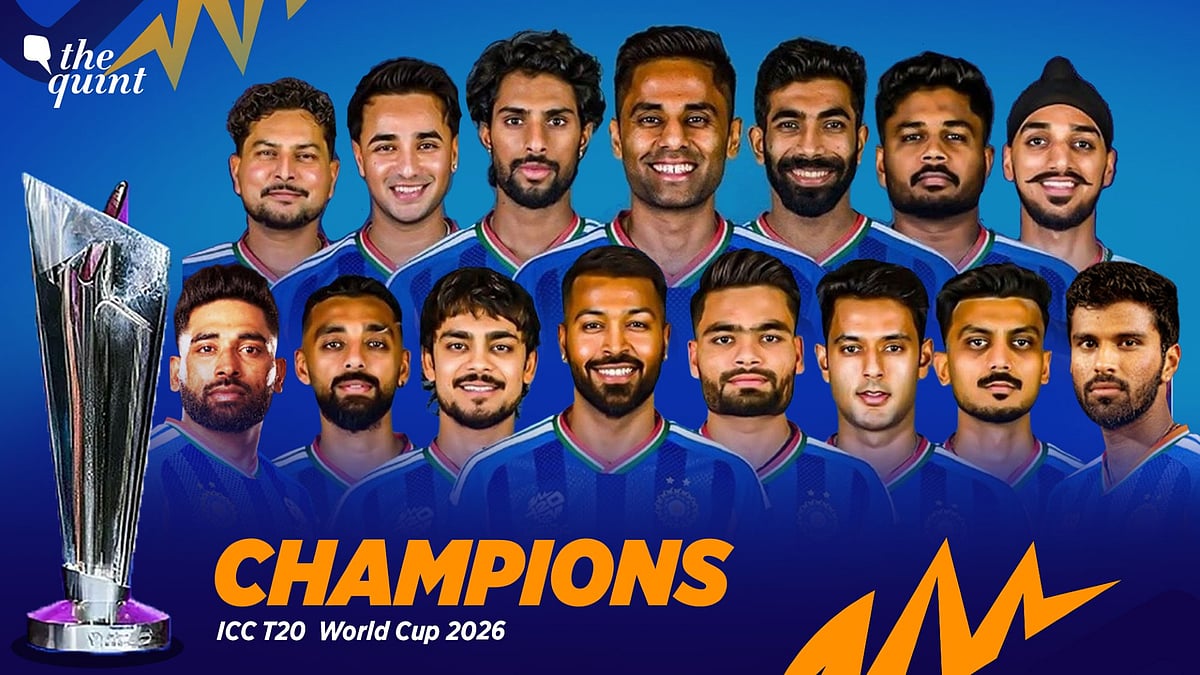
And the Indian cricket team, simply, cannot be that loser. For, they are champions. All 15 of them. And beyond. Rejoice.