
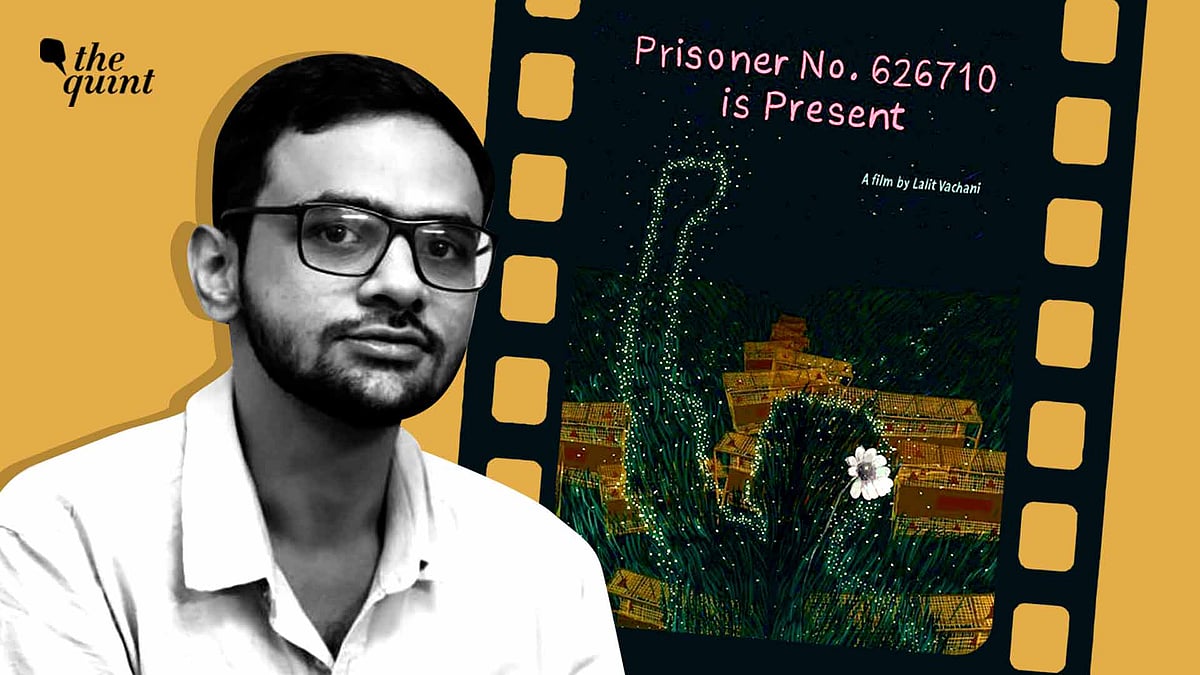
'Prisoner No. 626710 Is Present': The Umar Khalid Behind the Symbol of Dissent
The documentary asks us to recognise the humanity of the person who must live inside narrow descriptions.
advertisement
(We can tell the stories of India's political prisoners because we are editorially independent. This comes with risks and threats. Become a member and support us.)
What does it mean to be “present” when the State has made you disappear from public life? Lalit Vachani’s documentary Prisoner No. 626710 is Present explores that question through Umar Khalid, a charismatic student leader arrested on 13 September 2020 in connection with the alleged larger conspiracy behind the 2020 Delhi riots.
Its title holds two descriptions of him together: one, a prison number assigned by the State; and two, an insistence that Khalid remains “present”—in his words, in the lives of those who continue to visit him, and in the hearts of many of us who stand in solidarity with him and other political prisoners.
Since the film premiered on 29 July 2024 at the International Documentary and Short Film Festival of Kerala, it has screened across India and the world. I watched it at Birkbeck, University of London.
Much of the case it recounts was familiar to me and has been widely documented. Yet, cinema can make even familiar facts register differently: scholars like Walter Benjamin, for instance, have written of film’s ability to produce a more immediate, sensory and collective mode of reception.
What stayed with me, then, was the way Vachani moves between examining the allegations against Khalid and showing what his imprisonment has done to his friendships.
How a Terror Case Is Made
Prisoner No. 626710 is Present begins by tracing a change in the character of the State’s case against him. FIR 59, concerning the alleged conspiracy behind the Delhi riots, began with conventional criminal charges. But during the investigation, provisions of the UAPA [Unlawful Activities (Prevention) Act] were added, fundamentally altering the nature of the proceedings, and the legal framework around bail. What began as an ordinary FIR, the film tells us, became a “terror FIR”.
One speaker asks viewers to notice who exactly was arrested in the case. With two exceptions, they say, those arrested were Muslim, while people who were not arrested largely did not bear Muslim names. Vachani places that observation alongside its account of how a movement against the discriminatory Citizenship Amendment Act (CAA) of 2019 came to be narrated as a conspiracy.
The circulation of Khalid’s speech in Amravati on 17 February 2020, and the discourse around it, reflect a clear example of this bigoted characterisation in the mainstream media. He spoke about Donald Trump’s forthcoming visit to India one week later and the opportunity it presented for protesters: with the world’s attention on Delhi, they could make their opposition to the citizenship law meaningfully heard.
The documentary contrasts that fuller address—including its repeated calls for non-violence and love—with a 40-second excerpt circulated by the then Bharatiya Janata Party (BJP) IT cell head Amit Malviya in which Khalid calls on people to “come out on the streets” when Trump visits India. Stripped of the speech around it, the appeal was presented as evidence of a plan for confrontation.
A still from the documentary Prisoner No. 626710 is Present.
(Photo Courtsey: YouTube)
The discrepancy between his original, complete speech and the frenzy around the clips is not simply a question of missing context. Words such as “gang” and “disturbance” told millions of Indians, who were unlikely ever to watch the actual complete address, what kind of person they were watching: a terrorist and potential threat to the nation.
Vachani slows this process of distortion and asks us to look again—at what Khalid said, at the fragment that was so widely circulated, and at the meaning attached to it by the media.
Prisoner No. 626710 is Present also places this scrutiny of Khalid’s words alongside speeches by BJP leaders that were themselves brought before the courts, including Kapil Mishra’s ultimatum to anti-CAA protesters and Anurag Thakur’s “goli maaro” slogan.
What the Case File Cannot Show
Vachani’s film is not primarily an investigative documentary, however. In addition to examining speeches, media clips, and charges, it spends much of its 60-minute runtime with Khalid’s friends Banojyotsna Lahiri and Shuddhabrata Sengupta, and the routines they maintain to stay close to him.
The conversations are short. Lahiri describes trying to keep them light, to laugh and make jokes rather than spend their limited time together dwelling on how difficult things are.
There is something devastating about this decision. It highlights how imprisonment continues to shadow even those moments meant to offer relief from it.
Prisoner No. 626710 is Present also returns to books. Lahiri and Sengupta describe how Khalid reads across genres, from murder mysteries and philosophy to books about cricket. Lahiri shows a bookshelf of volumes he has read that have come back from Tihar. Friends and well-wishers have sent him so many books that she has sometimes asked them to pause. At the time of recording, she says he had likely read around 200 books in jail.
The bookshelf speaks to his curiosity and resilience, but it also records time passing under confinement. Each returned book marks another stretch of life spent apart. Reading has given those years some shape, but it cannot give them an end.
Photographs from Khalid’s brief interim bail for his sister’s wedding carry a similar tension. Friends gather on a rooftop near the family home in Okhla. They remember joking together and being happy during the seven days he was out. Yet one friend says they do not want the photographs on the wall all the time; they want to choose when to see them. A happy memory can also make his absence harder to bear.
Prisoner No. 626710 is Present reminds us that there is a person behind these larger symbols, with favourite books, friends who tease him, intellectual interests and conversations that cannot simply be resumed where they left off.
Meanwhile, Sengupta’s testimony locates Khalid within his rich political and intellectual life that long preceded his arrest. Sengupta speaks with admiration about Khalid’s intellect, humour and commitment to an open society, recalling conversations about faith and citizenship, and about the possibilities opened by young Muslim women’s participation in the Shaheen Bagh protests.
This is a testimony shaped by intimacy. The film gives Sengupta and Lahiri room to describe things a charge sheet cannot: why a prison visit can leave a friend feeling stronger, or why the uncertainty of waiting is different when there is no sentence to count down. One of them asks what the purpose is of speculating when Khalid might come out. A sentence would at least provide a date; here, they do not know how long the case will go on.
What Remains of a Protest?
The legal battle over Khalid’s Amravati speech matters beyond his own case. A movement against bigoted legislation and a Hindu nationalist regime was speaking to the country and trying to make itself heard by the wider world. If its speeches are later remembered chiefly as evidence of a conspiracy, the movement’s demands become harder to recall on their own terms.
This documentary asks viewers to return to Khalid’s words and sit with his ideas before confronting the subsequent story built around them.
This January, the Supreme Court denied Khalid bail yet again while granting bail to five other accused in the larger conspiracy case, finding that the allegations against them were not on the same footing.
A still from the documentary Prisoner No. 626710 is Present.
(Photo Courtsey: YouTube)
Prisoner No. 626710 is Present is a testament to the power of Khalid’s spirit, one that cannot be caged by incarceration. This September, a proposed screening at NLSIU in Bengaluru was cancelled after opposition from the ABVP; at IIIT-Hyderabad, the CBFC warned that publicly exhibiting an uncertified film would violate the Cinematograph Act unless an exemption was obtained, after which the proposed screening was cancelled. IIIT-Hyderabad subsequently stressed that the event had not been authorised by the institute.
The film was nevertheless screened elsewhere. NALSAR students organised a private screening in Hyderabad days after the IIIT-H cancellation, while a private Delhi screening later took place under unusually cautious conditions, with checkpoints and lawyers present.
These incidents merely highlight how afraid the state is of Khalid and his ideas, reinforcing the questions raised by the case against him in the first place: what kinds of political speech are permitted to circulate? What is amplified and what is censored?
There is an FIR, a prison number, television footage, and a speech clipped to 40 seconds. There is also a man who reads books, makes jokes through a glass partition, and briefly gathers with his friends on a rooftop. The state has a number for him; the film insists that he is still present.
(Kaashif Hajee is a writer, researcher, and educator based in London. He is Assistant Editor at The Polis Project and a film critic for The Quint, with bylines in The Caravan, Screen Rant, and SAAG Anthology. A graduate of NYU Abu Dhabi and SOAS, his work spans culture, politics, and media. He also mentors students worldwide as a college admissions counsellor at Crimson Education.)
- Access to all paywalled content on site
- Ad-free experience across The Quint
- Early previews of our Special Projects
Published: undefined