
What Samajwadi Party's 'PDA' Formula Can Learn from TMC's Bengal Debacle
For all its thoughtful and inclusive politics, the PDA is substantially tethered to the male population.
advertisement
Just after a day of Trinamool Congress’ defeat in the politically charged elections of 2026, Samajwadi Party’s chief Akhilesh Yadav called on the central government to implement the Women Reservation Act (2023) that provides one third quota for women in Parliament, State, and Delhi assembly. He further stated that they would raise this issue every week till the ruling party does not abide by the said Act.
Coming in the immediate aftermath of opposition’s humiliating defeat in West Bengal, and in the wake of incoming Uttar Pradesh legislative assembly elections, the statement signifies more than what is apparently visible.
It is a direct attempt to sediment the women voters, that are said to be increasingly driven to the ruling party. Especially as the Prime Minister, addressing the party’s supporters after conquering Bengal, roped in the Samajwadi Party for betraying the women by opposing the reservation Bill, the stake for Akhilesh vis-à-vis the women's reservation issue is significant.
The party cannot afford to be in perceptory disadvantage which could seamlessly turn into electoral disadvantage, given the ruling party’s near-perfect PR machinery.
Even during the Parliamentary debates on the Bill, the Samajwadi Party was quick to point that their disapproval is not tantamount to denying the Women reservation, since that has already been provided for in the Women Reservation Act 2023, which was passed unanimously.
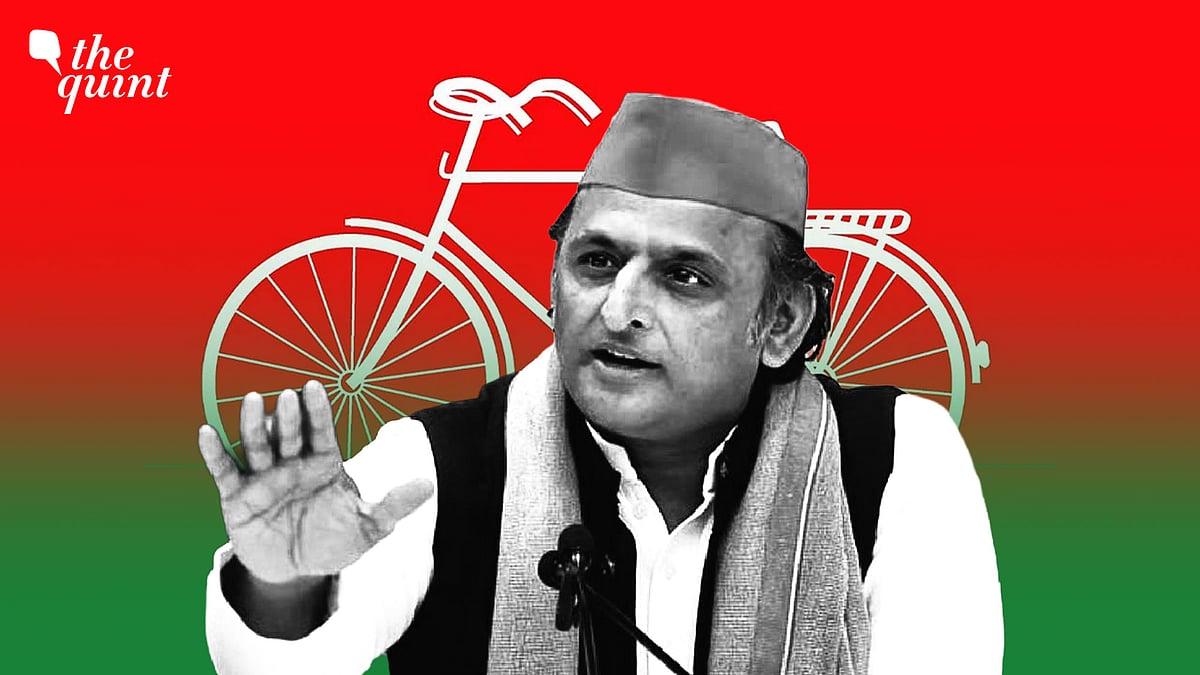
Rather, their contention was with regard to the non-consideration of the ongoing caste census, without which the SP argued, the reservation would miss the social justice benchmark—one that the party espouses through its trademark PDA (Pichda, Dalit, Alpsankhyak) formula.
In other words, it pressed that the application of Women reservation must be sensitive to the depressed sections of the society, which are represented by the PDA formula.
What is PDA and What Does it (Not) Do?
PDA, as mentioned above, is an acronym standing for Pichda, Dalit, and Alpsankhyak. Widely perceived as the weapon leading to the astonishing 2024 Lok Sabha performance of Samajwadi Party, it is set to be the party’s anthem in the Uttar Pradesh Vidhan Sabha elections of 2027.
The acronym does clever political work. It projects the SP as a party of the oppressed across every section of north Indian society that sits outside the upper-caste order, and it does so without alienating its Yadav–Muslim base.
It is, at its best, an intersectional move—one that acknowledges how caste, class, and community oppression overlap in Uttar Pradesh—that remains steadfast to the emblematic Lohia socialism.
The party has, nevertheless, felt unease in fending off the anti-women allegations that have befallen it since the downing of the Women Reservation Bill 2026. Dubbed by the ruling alliance as a mere casteist arithmetic draped in a social justice banner, Samajwadi Party has not been able to silence critics with the PDA plank.
The Bug
For all its thoughtful and inclusive politics, the PDA is substantially tethered to the male population and omits the very population that it claimed to vouch for in the parliamentary debate on the downed reservation Bill, that is, women. While indeed it can be said, and somewhat safely, that the categories under PDA (Pichda means 'backward', Dalit refers to the Scheduled Castes while Alpsankhyak means 'minority') encapsulate their female section, as in fact, they are not outside the mentioned folds, the point is not so subtle.
As such, whenever the word of Pichda, Dalit, or Alpsankhyak, is mentioned, our masculine instincts are trained to imagine a men who is being bogged down by the oppressive system—at most, or sometimes usually, we imagine a man with his family, the family being abstract and invisible. Implicit in this imagery is the node that the rectification of Pichda, Dalit, and Alpsankhyak, would percolate down to the community as a whole. Indeed, some of it is true.
But women's grievances outgrow these frames. Malnutrition, safety, access to schooling, employment, dowry [deaths]—these are not simply caste or community problems that resolve once the specified depressed group is uplifted.
They are forms of suffering that operate within and across those categories, and a non-PDA woman may still be more privileged than a PDA man on several of these axes.
A simple redressal of Pichda, Dalit, and Alpsankhyak problems, therefore, would not do, as the prime beneficiaries of such an amelioration would primarily and indiscriminately be men.
The better formula for the Samajwadi Party—or for that matter any social justice-oriented party—then, is to explicitly include women in its strategy, of course, with the caste-specific calculations within the folds of women itself that are subject to specific discussion suited and sensitive to the demands of the depressed sections.
It impresses upon more as an attempt to produce interpretations by stretching language, similar to how a defensive (and perhaps deluded) religious individual tries to read scientific achievements into religious texts in the face of challenge to its authority. It does not come upon as a realisation that the earlier conceptualisation has a blind spot or, at best, exists simply as geared towards different aims than the ones its projects.
What Can [Not] be Done
If Samajwadi Party is truly honest about its concern for women, what it needs is to reformulate, or even expand the PDA acronym into something that explicitly caters to the women, and not a juggling of sorts that is easily muddled—just like how it vociferously asserts Pichda, Dalit and Alpsankhyak.
There is no platform or event better for such reforms than electoral politics, where even people who do not believe in women's equality must tune themselves in a manner most suited to their winning agenda. This performance may instil some of that gender empowerment they speak into the heart of the electoral process.
(Shahzar Raza Khan is a PhD Student in Religion, Vanderbilt University. This is an opinion piece and the views expressed are the authors's own. The Quint does not endorse or is responsible for them.)
- Access to all paywalled content on site
- Ad-free experience across The Quint
- Early previews of our Special Projects
Published: undefined