
A Veteran at Ram Mandir's Helm: Why the Uniform Must Stay Above Politics
The uniform belongs to the Constitution. It does not belong to a temple, mosque, church, or a gurudwara.
advertisement
There is nothing inherently controversial about appointing a military veteran to administer a major public institution. Quite the contrary. Veterans are among the country's most under-utilised repositories of institutional capability. Decades of service teach them something increasingly rare in public life, i.e., discipline without drama, accountability without evasion, hierarchy without personal aggrandisement, and the ability to take decisions under pressure.
A distinguished military officer carries with them more than a résumé. He/she carries institutionalised experience, administrative rigour, constitutional bearing and, ideally, a deeply ingrained sense of service to the nation. When such experience is deployed in civilian institutions where it is genuinely needed, society benefits.
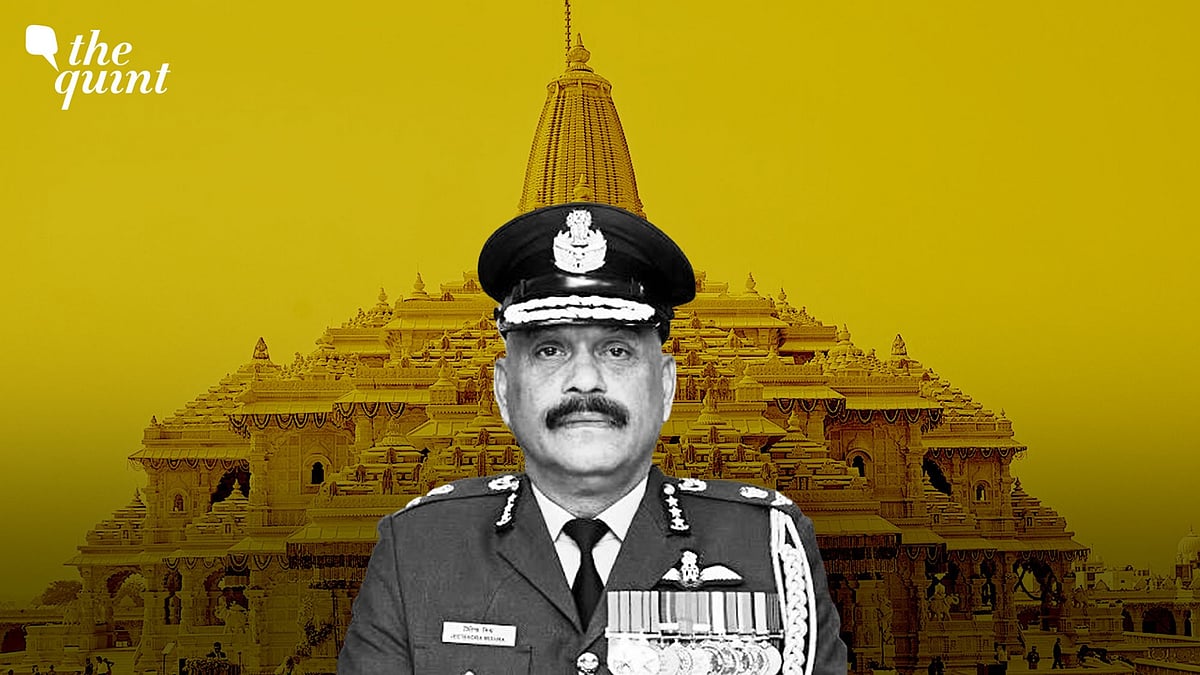
That is why the appointment of Air Marshal (retd) Jeetendra Mishra as the first full-time CEO of the Shri Ram Janmabhoomi Teerth Kshetra Trust should not be criticised merely because he is a veteran. The veteran is not the problem. Indeed, his professional experience may prove precisely what an institution undergoing administrative scrutiny requires.
The Uniform Matters
The Indian military uniform occupies a singular place in our national imagination. It is proudly secular. It is constitutionally anchored. It belongs to no party, no ideology, no caste and no religion.
Which is why there is a subliminal danger when the enormous moral capital of the uniform is transported into a religiously and politically charged institution. The danger is not that the veteran suddenly becomes less secular. The danger is that religiosity may begin to attach itself, however subliminally, to the symbolism of the secular uniform. That is a line worth guarding carefully.
To pretend that the Ram Mandir is entirely bereft of political angularity would itself be naive. The temple is an enormously consequential religious institution, but its construction and public meaning are inseparable from one of the most politically transformative movements in contemporary India. That reality need not diminish the religious significance of the temple. It simply means that anyone administering it operates within a landscape that is simultaneously religious, social and political.
Into that landscape now comes a former Air Marshal. The optics, therefore, matter. A decorated military officer at the helm of the Ram Mandir may, entirely unintentionally, create an association between two sources of extraordinary public reverence ie, the sanctity of the temple and the sanctity of the uniform.
That association is precisely what a secular republic should be cautious about manufacturing. The armed forces should remain above religious proprietorship. Their institutional identity must never acquire a denominational hue by association, however innocent or administratively motivated. The uniform belongs to the Constitution. It does not belong to a temple, mosque, church, or a gurudwara.
Credibility as Cover
Then there is another, more uncomfortable dimension. Politicians understand the power of institutional credibility. They also understand that placing an individual of unquestioned personal stature into a controversial or politically sensitive institution can alter the terms of public scrutiny. This is where the veteran can become something he never intended to be—political “cover fire”.
The point is not to allege that the former Air Marshal has been appointed for that purpose. There is no basis for imputing such a motive to him. The point is that political actors can benefit from the optics, regardless of the appointee's intentions.
A veteran's reputation should strengthen accountability, not substitute for it. Indeed, this is particularly relevant when the institution has been under scrutiny over allegations concerning donation management and administrative lapses. The appropriate response to such controversy is not merely to put a highly credible individual at the top. It is to build systems that make credibility irrelevant to accountability. No institution should require the public to trust a person's résumé in order to trust its accounts.
The Secularism Question Cannot be Wished Away
There is also a broader principle here that deserves to be defended without embarrassment. India's secularism does not require the state or its institutions to be hostile to religion. It requires constitutional institutions to resist being captured by religious identity. The military's secularism is particularly precious because it represents India at its most elemental - citizens of different faiths standing in the same uniform under the same flag.
That uniform should, therefore, be deployed in civilian life with some sensitivity to the symbolic terrain into which it is being placed.
There is nothing wrong with a veteran serving a religious institution. Veterans are citizens, and they have every right to serve wherever their abilities are useful. But the distinction between the veteran as an individual citizen and the uniform as a national institution must remain unmistakable.
The distinguished former Air Marshal has every right to take up a civilian role. The country has every right to insist that his military legacy is not appropriated to sanctify the institution, its politics or its administration. And the government has a responsibility to ensure that it is not.
Value Veterans, Don't Use Them
Veterans deserve better than tokenism and politicians deserve scrutiny. This is ultimately an argument for veterans, not against them. If governments genuinely believe that military veterans possess extraordinary administrative capability, then India should systematically employ them in public administration, infrastructure, disaster management, public-sector reform and institutional governance.
But they should be appointed for competence, given genuine operational autonomy and judged by measurable outcomes. They should not be used as human credibility certificates. A former military commander should never become the answer to a question that remains unanswered.
But do not allow his uniform to become either a religious symbol or a political shield. That would be a disservice to the very institution from which he comes. The Indian military uniform is powerful precisely because it transcends the divisions of Indian society. It represents a constitutional India in which the soldier's faith is private but his oath is public; his identity may be particular, but his allegiance is indivisible.
That distinction must survive every civilian appointment. The Ram Mandir deserves competent administration. The public deserves accountability. Veterans deserve to be valued for their capability rather than appropriated for their credibility. And the uniform deserves something even more important ie, to remain above the politics of the temple, just as it remains above the politics of the ballot box.
(Bhopinder Singh is the former Lieutenant Governor of The Andaman and Nicobar Islands and Pondicherry. This is an opinion piece and the views expressed are the author’s own. The Quint neither endorses nor is responsible for them.)
- Access to all paywalled content on site
- Ad-free experience across The Quint
- Early previews of our Special Projects
Published: undefined