
How Jeetendra Mishra Beat 5,585 Applicants to Become Ram Mandir Trust CEO
Jeetendra Mishra has been well known to PM Narendra Modi, informed sources told The Quint.
advertisement
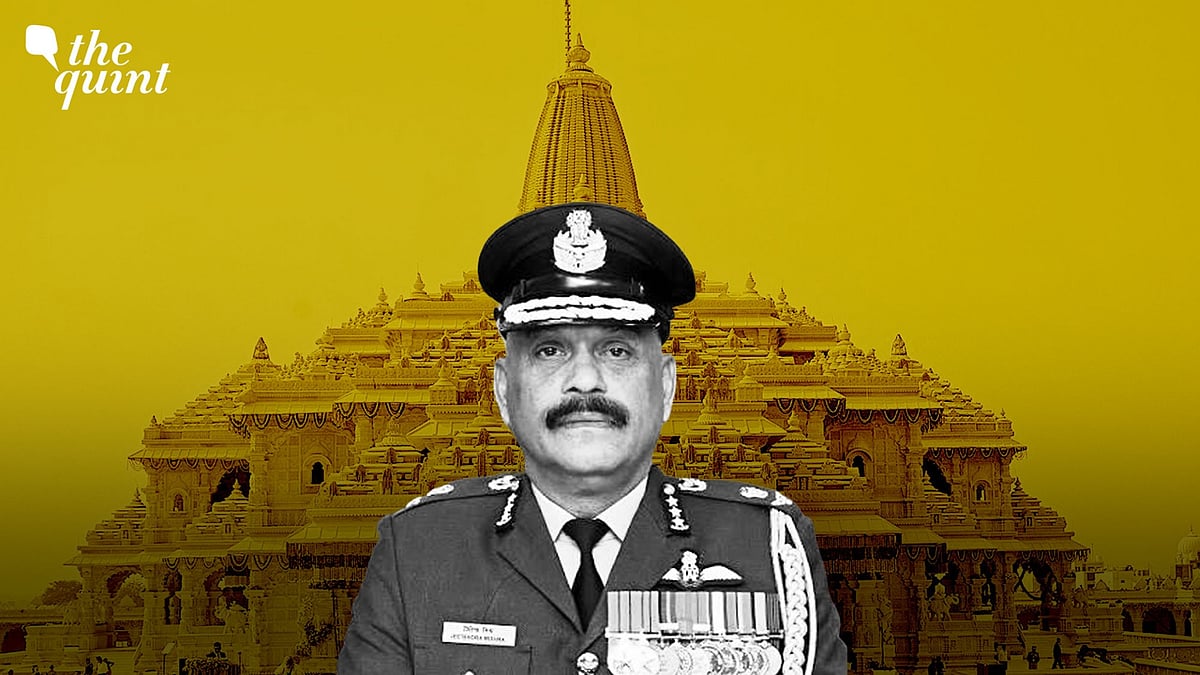
Air Marshal (retired) Jeetendra Mishra takes over the role of the first Chief Executive Officer (CEO) of the Ram Temple in Ayodhya with a principal mandate: Restore and regain the trust of the Hindus. After three months of the temple being mired in the donation theft row, Shri Ram Janmabhoomi Teerth Kshetra Trust announced Mishra as the CEO, and the chorus in Ayodhya—from saints to netas—struck the note of a nationalist icon stepping into the role of the executive head of the Ram Temple, projected as the ultimate cultural symbol of Hindu revival.
The selection of Mishra, per the saffron narrative, symbolises the best of cultural nationalism—a soldier who led India from the front in the most recent war with Pakistan returns to the roots to serve Ram Lalla.
The Rashtriya Swayamsevak Sangh (RSS) joint general secretary Dattatreya Hosbole, amid the raging controversy surrounding the donation row, had issued a video statement in which among others he had stressed that the Trust will work to regain the faith of the Hindus.
Sensing that the donation theft row had caused emotional anguish among the Hindus, the RSS' message to the Trust was to work on regaining the faith of the followers in an expeditious manner.
The RSS is learnt to have closely followed the response of the temple Trust to manage the crisis, while also being in the loop on the selection of the CEO, as well as a rejig of the Trust itself.
Jeetendra Mishra Beat Over 5k Applications
Shri Ram Janmabhoomi Teerth Khestra issued two press statements recently. First, released on 1 September, dealt with the search panel completing the evaluation process to finally recommend three names, which were not disclosed.
The second press statement came a day later, in which Jeetendra Mishra was announced as the first CEO of the temple.
The Trust had announced that as many as 5,585 applications had been received for the post of CEO. Detailed eligibility criteria had already been given out at the time of announcement of the CEO recruitment process. Since Ram is an avatar of the Hindu deity Vishnu, per belief among the followers, the desired candidate had to be a devout Vaishnavite.
Subsequent screening by the search panel—elimination on skill sets, online interviews, meetings in Delhi NCR, Pune, and Sambalpur—brought down the final list to 16 candidates. These applicants came to Ayodhya for extensive interviews held on 11-12 August. After zeroing in on three, the search panel finally submitted the report to the Trust.
“Besides obvious skill sets to justify the responsibility of a CEO, the candidate had also to satisfy the Trust members that he was satvik (a vegetarian) in his lifestyle,” a Vishwa Hindu Parishad (VHP) functionary associated with key members of the Trust told The Quint.
Who Made the Final Call?
Insiders stressed that the RSS was in the lead role to recast the Ram Temple Trust, including the selection of the CEO. Officially, the RSS maintains that it has nothing to do with the management of the affairs of the temple, run by the Trust, which has been constituted per an Act of Parliament. But the members of the Trust hold umbilical cords with the RSS, as they have long been associated with the VHP.
That Mishra hailed from Deoria in eastern Uttar Pradesh made him a suitable candidate, said sources, who added that the final decision didn’t just weigh the competency for the job of the CEO but also the political messaging ahead of the Assembly elections in the state, due in February next year.
The packaging of the Operation Sindoor hero as the chief of the Trust's command offered a compelling case to swing the defensive posture on the temple donation row to an offensive narrative by scripting a pitch that the crisis has been dealt firmly to not only recast the Trust but also bring a war veteran in the service of the cultural icon of the Hindus.
For such a decision, it should be apparent that the Prime Minister and RSS chief Mohan Bhagwat must have consulted each other and finally concurred on the eventual choice, said a senior BJP functionary.
Trust Rejig an Attempt to Close Donation Row Chapter
Champat Rai, general secretary of the Trust; Anil Mishra, a member; and Nripendra Mishra, former principal secretary in the PMO and the Ram temple construction committee chairman, figured in the donation row in some or the other ways.
As the row erupted, Nripendra Mishra seemed to have acted lone wolf to appear in TV studios to argue what should be done as a course correction. After the SIT, constituted by the Uttar Pradesh government, exonerated Trust members of any wrongdoing, Champat Rai charged Nripendra Mishra of solely executing big projects in an open letter.
Now Rai and Anil Mishra have exited the Trust.
“The remaining construction works of the Ram Temple will be completed in another one month, and that will bring to an end to the role of Nripendra Mishra in Ayodhya. The chapter will be fully closed on the controversy,” said a senior VHP functionary.
(The author is a senior New Delhi-based journalist, who for over two decades has covered the BJP and the RSS for India’s leading English dailies.)
- Access to all paywalled content on site
- Ad-free experience across The Quint
- Early previews of our Special Projects
Published: undefined