
PM Modi's Praise for Indian Workers Building Gulf Cities Ignores the Human Cost
The men who poured the concrete for those skylines are also dying under them, writes Rejimon Kuttappan.
advertisement
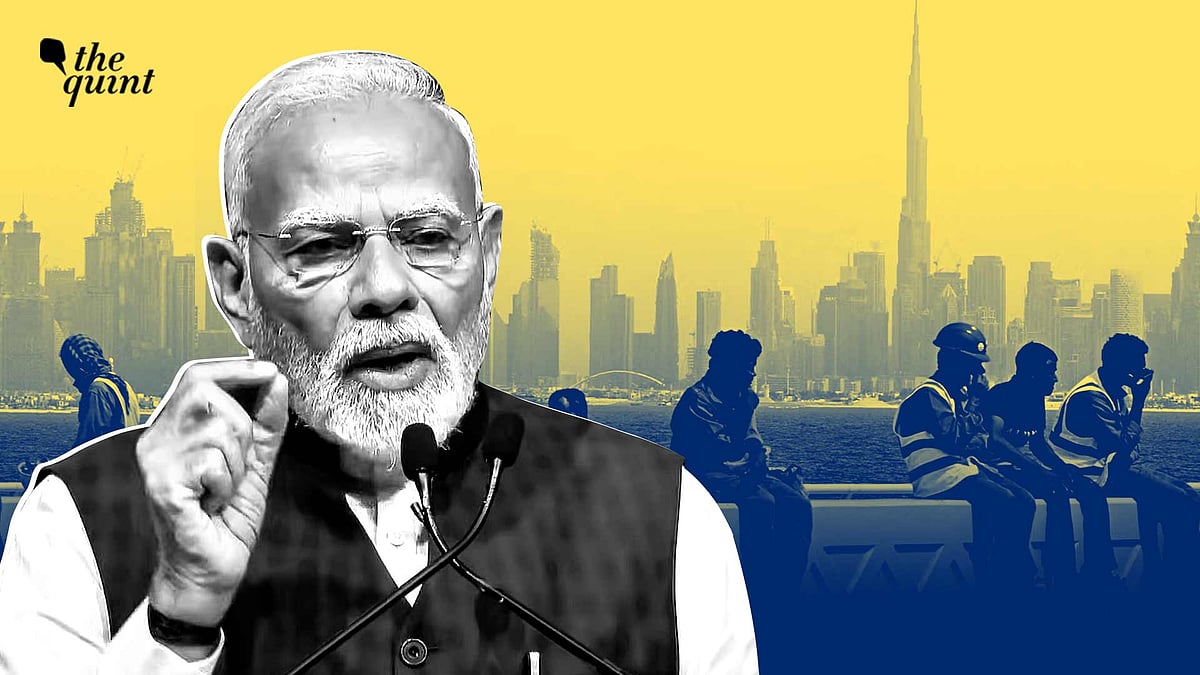
On 21 November, speaking at the fifth Kaushal Deekshant Samaroh in Lucknow, Prime Minister Narendra Modi told a hall of Industrial Training Institute (ITI) graduates a story he clearly enjoys. Whenever he visits Saudi Arabia, Dubai, Abu Dhabi, Qatar or Kuwait, he said, members of the royal families tell him the same thing: their magnificent modern cities were built not by their money but by the hard work of India’s artisans.
I don’t doubt that Gulf rulers say this. It is a gracious line, and it costs them nothing. That is exactly the problem.
The Count No One Wants to Read Aloud
On 29 January 2026, Minister of State for External Affairs Kirti Vardhan Singh told the Rajya Sabha that 37,740 Indian workers died abroad between 2021 and 2025. That is more than 20 deaths a day, every day, for five years.
Of them, 32,608 died in the Gulf:
12,380 in the UAE
11,757 in Saudi Arabia
3,890 in Kuwait
2,821 in Oman, and
1,760 in Qatar
Bahrain’s figures were simply absent from the reply. Even without them, the Gulf sends home close to 18 Indian bodies a day.
Set that beside an older count. Working from RTI replies and parliamentary records, the Commonwealth Human Rights Initiative found that roughly 10 Indian workers died each day in the Gulf between 2012 and mid-2018.
The daily toll has nearly doubled. Nor is the latest period improving: after dipping to 6,614 in 2022, deaths rose every year, to 7,854 in 2025.
Then comes the line that should stop anyone who takes pride in these workers. The ministry’s reply offered no cause-wise breakup for any of those deaths. Not one.
In my own reporting, the paperwork families receive most often reads “natural causes” or “cardiac arrest”. Young, medically screened men do not die of natural causes in these numbers. A certificate that says the heart stopped is not a cause of death. It is a description of death itself, and the state has been content to accept it.
The Living Fare Only a Little Better
Between March 2021 and December 2023, Indian missions in the six Gulf states logged 33,252 complaints from Indian workers, including women. Kuwait alone accounted for 16,436.
The government’s own list of the most frequent grievances, delayed or unpaid salaries and withheld end-of-service benefits, alongside confiscated passports, reads like my notebooks from the last 20 years. Across all Indian missions worldwide, worker complaints nearly doubled, from 11,632 in 2021 to 22,479 in 2025.
None of this is the work of a few bad employers. It is what the kafala system is designed to produce.
Gulf governments have announced sponsorship reforms in recent years. In the camps, the employer still holds the passport.
I know how little patience Gulf states have for anyone who counts these things in public. In 2017, after nearly a decade in Muscat, I was deported from Oman following a front-page investigation that mapped the routes used to traffic domestic workers. The story carried responses from the police and the ministries. It did not matter. Counting, it turned out, was the offence. That is exactly why India cannot leave the counting to host governments. It has to do it itself, through its own missions, and publish what it finds.
Why They Keep Going
So why do young Indians keep boarding these flights? Because home gives them less. The International Labour Organisation (ILO) and Institute for Human Development’s India Employment Report 2024 found that youth made up 82.9 percent of India’s unemployed in 2022. Add household debt, and farms that no longer feed families as erratic weather wrecks harvests, and the Gulf stops being a choice. It becomes an exit. The ITI graduates the Prime Minister addressed in Lucknow are precisely the young men recruiters will court next.
India made them a promise. In December 2018, it endorsed the Global Compact for Safe, Orderly and Regular Migration, which commits states to collect accurate, disaggregated migration data and to ensure fair recruitment and decent work.
In October 2025, the Ministry of External Affairs published a draft Overseas Mobility (Facilitation and Welfare) Bill to replace it. As late as July 2026, a Rajya Sabha reply still described it as a proposed bill.
Sadly, the war that began on 28 February, when the US and Israel struck Iran and the fighting spread to attacks on Gulf states, has shown how little protects these workers. Missiles and drones have targeted Gulf countries multiple times, and on 13 March, two Indian nationals were killed and ten injured in a drone strike in Sohar, Oman.
As airspace shut, Gulf workers home on leave were stranded at Indian airports. One feared his company would cut his pay if he did not get back on time; others waiting to fly out for new jobs were stuck at home, sliding into debt.
For those already there, the routes out were choked: Indians in Bahrain had to be routed through Saudi Arabia. At sea, Indian seafarers stranded near Iranian ports reported wages delayed or suspended altogether. One told Al Jazeera that many colleagues stayed on because they were still waiting to be paid.
What Honouring Them Would Actually Take
First, make cause-of-death reporting mandatory. Every death of an Indian worker abroad should be recorded by the mission with cause, employer, sector, age and home district, and published every quarter. Where a host country’s certificate is vague, families should have a legal right to an independent, state-funded post-mortem in India.
Second, pass a law that puts welfare before facilitation. The replacement for the 1983 Act must make protection enforceable, not aspirational: joint liability of recruiters and employers for unpaid wages, a statutory right to compensation, a wage-protection fund drawn from the Indian Community Welfare Fund, worker and trade union seats on the proposed council, and time-bound grievance redress with consequences for missions that sit on complaints.
As New Delhi deepens trade and investment ties with Gulf capitals, those deals should carry enforceable clauses on wage floors, a ban on passport retention, heat-stress protections and access to justice, with a dispute mechanism that bites.
None of this is radical. Each step follows from commitments India has already signed, and each could be in place before the next Pravasi Bharatiya Divas, the annual gathering where the government celebrates its diaspora. If ministers can make time for that celebration every January, they can make time to tell Parliament why more than 20 citizens die abroad every day, and what they intend to do about it.
PM Modi is right that Indian hands built the Gulf. But pride is not policy. A government that wants to honour those hands should count its dead, recover their stolen wages and give them a law fit for 2026. Until then, the compliment from the royal palaces remains just that: praise paid in words, to men who were too often not paid at all.
(The author is a labour migration specialist, workers rights activist, forced labour consultant and author of five books. This is an opinion piece and the views expressed are the author's own. The Quint does not endorse or is responsible for them.)
- Access to all paywalled content on site
- Ad-free experience across The Quint
- Early previews of our Special Projects
Published: undefined