For Migrant Workers With HIV, Staying on Treatment Takes More Than Just Medicine
A ground report from the Ganjam-Surat corridor, where migrants with HIV navigate long shifts, travel, and stigma.
advertisement
Jyotesh* knows the cost of a missed dose.
When he travelled from Surat back to his village in Odisha’s Ganjam district five years ago for some work, he carried a month’s stock of his daily HIV medicines. But the visit stretched longer than expected. The medicines ran out.
At the time, he did not think much of it. But when he returned to Surat three months later, where he worked in the textile industry, filling and replacing thread bobbins for weaving machines, his body began weakening again.
The work was difficult even otherwise: 12-hour daily shifts inside a room with barely any fans or ventilations, just heat and the constant roar of machines. With a weakened immunity, he couldn't keep up. Soon, he got jaundice too. It's not like medicines weren't available in Odisha. But the hospital was around 80 kilometres away from his house, and Jyotesh had not carried his transfer papers.
“We’re all going to Ganjam for a wedding next week. This time, I have carried medicines worth two months," he says in late April this year, placing the medicine bottle on the orange-and-blue chattai in his rented house in Surat. Next to it lies a stack of green medical documents carrying his treatment history since his diagnosis. One of the corners has been chewed through—"a rat bit it", he says with a smile.
Jyotesh with his medicines and medical documents
The 41-year-old discovered he and his wife were HIV positive in 2010, when she was pregnant with her first child. By then, he had already spent two decades moving between Ganjam and Surat. His three children don’t have HIV but their lives are still shaped by it: Jyotesh and his wife make sure they don’t eat on the same plate as their kids or share food, and are careful around cuts and wounds. “I know it doesn’t spread that way,” he says. “But in my head, I just want to be careful.”
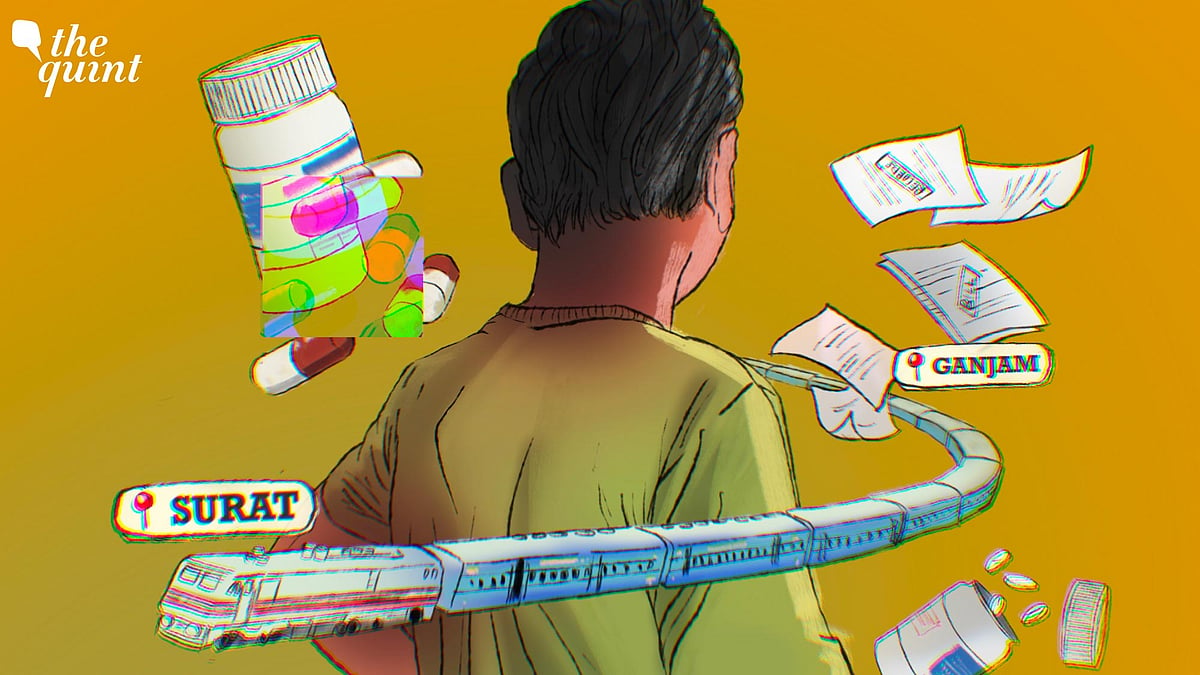
Nowhere is that challenge more visible than in the Ganjam-Surat migration corridor, which sees large-scale movement to the city’s textile hubs.
The National AIDS Control Organisation (NACO) identifies interstate migrant workers as "bridge population” for HIV, due to the social and work environment that increases their vulnerability to infection. The term refers to the role migration can play in linking different communities. Studies cited by NACO have found that in high-migration districts like Ganjam, migrant men were up to four times more likely to be living with HIV than non-migrant men in the same districts.
The Quint tracked migrant workers living with HIV on the Ganjam to Surat corridor to investigate how they live with the constant risk of becoming “lost to follow up.”
Between the Loom and the Pill
The sound of the loom never really leaves you in Surat.
A few lanes away from where Jyotesh rents his room, Ranjan*, a textile worker from Ganjam, who has been living with HIV for the past three years, rides his cycle towards the noise after his lunch break on a blazing April afternoon. He stops his cycle in a lane where every building looks like the other. If the sound of the loom sounded like a distant train earlier, now it feels like he is at the railway station.
Ranjan cycling to work
Three floors up, inside the weaving unit, he starts the 12 machines, one by one. As soon as he is done starting all, the first one shuts again. The process repeats itself for 12 hours, every day. Thread becomes fabric and sweat becomes a hard day’s money.
He is used to it all, now. The noise, the hours, even, to an extent, the heat. What he is not used to is the HIV pill he must take at 9 pm every night, which, he says, makes him sleepy. So for 14 days a month, when his shift changes from day to night, he faces a dilemma: to skip the HIV medicine or to risk the chance of falling asleep at work.
It is medically recommended to have the medicines every day at the same time — generally after a meal — to ensure that the virus stays suppressed. Repeated interruptions can risk increasing the viral load and weakening immunity. Healthcare workers generally prescribe it for night time after dinner, so that it doesn't interrupt work day and the minimal side effects can be managed. They encourage patients to discuss the schedules with them before changing the timing on their own, but Ranjan has not had the time to do that yet.
Inside a textile factory
He was asymptomatic when he was diagnosed five years ago along with his wife, during her pregnancy. His family lives in Ganjam; he moves between the two places whenever he can. He has just returned from a few months in Tamil Nadu, where he was trying to work in the fibre industry.
“I did not understand the language or culture there, so I came back here. Surat has so many people from my village now that it has become another Ganjam only,” he says. “But the heat has become so bad these days, the hot air from the machine blows like fire.”
He says he will ask the doctor in the next visit if he can eat his medicines in the morning instead of at night. “I know I should be eating them regularly, but what can I do? I can’t risk it. I'm here to earn.”
Inside the ART Centre
For people living with HIV, the ART centre is their lifeline. It’s where they get their medicines every month, consult with doctors and counsellors, monitor their viral load, and, crucially for migrants, get their transfer letters issued to access medicines from another ART centre, whenever they move.
When The Quint visited one such centre in Surat, the two doctors' desks were stacked with transfer letters to sign: transfer-ins and transfer-outs.
“We have around 30-40 transfers per centre every month. It’s a bit more in Surat than other cities as there are more migrants here,” said one of the doctors. There are three ART centres in Surat, which means roughly a hundred transfers moving through the city's system every month.
“The main problem is adherence,” says Laxmi Parmar, one of the counsellors in the centre, while making notes in her file.
India’s HIV programme now allows multi-month dispensing for stable patients, meaning medicines can be provided for more than one month at a time. Counsellors routinely ask workers about upcoming travel plans before deciding how much medication to dispense.
Medicines used for HIV treatment in India
“For us, the main difference between migrants and locals is that migrants don't usually stay in one place,” said the doctor, who did not want to be named. “They keep moving, so for them to continue this life long treatment is more difficult. They require a lot more counselling. If they go back to the village for a long time, they have to be transferred there so they can get medicines from there.”
In the last two months, migrant workers across states in India, including Surat, have moved back to their villages in large numbers due to the ongoing gas crisis in India, driven by the West Asia conflict. Prices for cooking gas have risen sharply and it has hit migrant workers hardest, who very often don't have documents for residence proof in the cities they work in, and cannot access subsidised supplies.
HIV awareness posters inside an ART centre in Surat
Migration as Tradition
For over a century, migration has shaped life in Odisha’s Ganjam district.
It was initially limited to the northern states, like Uttar Pradesh and Jammu & Kashmir, but shifted to West Bengal after Independence due to the language, food, and cultural similarities and conveniences. Majority of Ganjam’s migrants worked in the jute mills here, and some in coal mines in present-day Jharkhand. Since they could not go to Southern states due to the language barriers, they began going to Mumbai and the industrial areas of Gujarat. Mumbai’s labour politics made the city less accessible and Surat became the destination.
Over time, farmers became textile workers, and it became a skill that was inherited by generations.
“Migration first became a livelihood for survival and then tradition for the people of Odisha and the rural infrastructure completely changed because of it,”said Lokanath Mishra, co-founder of Association for Rural Upliftment and National Allegiance (ARUNA) NGO, which was started in Odisha in the 1990s to prevent HIV transmission among migrant populations.
“There are trains that are filled with migrant workers everyday, mostly to work in the textile industry," he said.
Ganjam features among the 17 districts with the highest male out-migration across state borders in India, according to the Working Group on Migration report, published by the then Ministry of Housing and Urban Poverty Alleviation in 2017. While there is no official data available, experts and field workers estimate that there are at least fifteen lakh migrants from Ganjam in Surat, forming a bulk of the labourers for the textile industries.
The same migration corridor also, over decades, has shaped the district's HIV epidemic. Ganjam currently ranks eighth among India’s AIDS-prone districts, and has consistently figured in the top ten list.
Mishra estimates that of roughly 19,000 people believed to be living with HIV in Ganjam, only around 7,000 are currently under treatment.
A study by the Population Council in 2011, conducted in collaboration with NACO and the United Nations Development Programme (UNDP), made some relevant findings:
In Odisha, 43 percent of all HIV-infected persons in Odisha were from Ganjam alone.
HIV prevalence was four times higher among migrants than non-migrant men, even after controlling for age, education, source of referral and other possible confounding factors.
The likelihood of being HIV-positive for returned migrants compared to non-migrants was over sevenfold.
Migrant men were up to eight times more likely to be living with HIV than non-migrant men in Ganjam district.
Selected indicators of socioeconomic vulnerability such as literacy, agricultural land/property ownership and employment were associated with HIV infection.
The latest data from Odisha's National AIDS Control Programme shows that a cumulative 66,121 HIV-positive cases have been identified in the state.
A senior official from the Odisha State AIDS Control Society told The Quint that the overall HIV caseload in the state had remained relatively stable in recent years.
"Even if the numbers appear high, that is partly because more people are getting tested and diagnosed earlier, instead of remaining undetected for long periods," the official said, requesting anonymity. "Ganjam remains a priority district because of its long history and scale of out-migration. We conduct awareness and testing activities around festive seasons when many workers return home. There are outreach camps, nukkad nataks (street plays), messages at billboards and behind tickets. But because people keep moving states and change phone numbers, preventing patients from becoming lost to follow up remains a big challenge."
Lost to Follow Up
Inside ART centres, NGOs, and healthcare systems, there’s a term routinely used: 'LTFU', which stands for Lost to Follow Up. It is used in medical forms and discussions to describe patients who stop returning for treatment.
"Sometimes, migrants say they are going to their villages for two months but if they don't come back for medicine refills by then, we contact them,” said a doctor at the ART centre. "If we manage to speak with them, we remind them to visit the nearest ART centre. If we can't get in touch, we contact the NGOs in the village to reach them."
But a lot of times, ‘LTFU’ happens simply because people living with HIV— migrants or not—have a hard time to accept the diagnosis, or to manage medicines alongside work, or to keep it hidden. Sometimes, especially when asymptomatic, they believe they can simply outlast it without treatment. Outreach workers are tasked with tracing them.
The Quint accompanied Bhadraben, an outreach worker with the Gujarat State Network of People Living with HIV/AIDS (GSNP+), a community organisation supporting people living with HIV, on one such follow-up visit. As we walked through narrow lanes towards a colony where several clients lived, she said to put away the notebook and pen so as not to alert anyone to the nature of the visit.
A Surat neighbourhood where many migrant workers from Odisha live
Some patients, she says, give wrong phone numbers and addresses altogether.
Dr V Sam Prasad, Country Programme Director at AHF-AIDS Healthcare Foundation, acknowledged that one of the biggest challenges in HIV care among migrant populations is retention.
“The first challenge is that we tend to lose people after identifying them,” he says. “People are not keen on getting treatment in unfamiliar cities. The current system requires manually getting a transfer letter to access medicines in another city. That needs to change. Even if someone has no art centre in the vicinity, if they want to access meds, local medical stores should be able to get it. The behavioural change will be immediate.”
Stigma, Disclosure, and What Cities Offer
Ever since he was diagnosed less than six months ago, Ashok* has been consumed with anxieties and fears. What if someone finds out in my village? What if someone finds out here? Will my condition get better? What vegetables can I eat? What if the one ASHA didi who knows tells someone? Will my child eventually get it too? Will my life ever be the same?
The anxieties of the diagnosis sit visibly on him, along with exhaustion of the night shift.
“Only my wife, me, and the ASHA didi know. Parents don't keep well and don't want to worry them more. I used to feel weak and uneasy but since I have started taking medicines it's better. I just can’t stop overthinking,” he says, speaking softly so as to not be overheard in the temple compound where we sit.
Ashok was diagnosed less than six months ago
He started his treatment in Ganjam and is now in Surat for two months, where he has worked as a textile worker for the last 10 years.
“The centre closest to my village is 50 kilometres away in Bharampur. I go by bus or bike but it takes almost the whole day to get medicines. There is also always a huge line. I prefer it here, the centre is a fifteen-minute walk from my house,” he says, turning his bicycle keys over in his hands.
The calculations that he has just begun to make have been Pooja’s* reality for over a decade, accompanied by something else: guilt.
A migrant from Odisha, she found out she was HIV positive during her second pregnancy, tested at a government hospital in Surat. She had been married once before when she was very young; she suspects her first husband had the virus though she never knew for certain and he died soon after. Her second husband was diagnosed alongside her, followed by her daughter and son.
Her daughter, she says, used to blame her for it and ask her why she hadn’t killed her rather than giving her this. Her husband initially blamed her too. For about twelve years, she balanced HIV treatment, an abusive household, and work – sticking diamond stones onto sarees.
“If I didn't find time to finish it in the day, I would complete it at night,” she says.
“I usually go once every few months to collect medicines for my full family. Our vitals are good so they give for a few months,” she says. “It’s so much better to do that here rather than in Ganjam. Even though the hospital is far away and I go secretly, people come to know. They wonder, Kiski bahu hai? Kiske liye dawai le rahi hai? (Whose daughter-in-law is she? Who is she taking these medicines for?) So I don’t go to get medicines when I’m there, I have to make sure I come back before my medicines get over. No one knows where you’re coming from and where you’re going, here.”
Beyond Medicines
“HIV is complex and when you add migration to it, it's another challenge,” says Daxa Patel, co-founder and Project Director of GSNP+.
Patel says that one of the initial challenges is disclosure, especially when the partner is staying away. Government guidelines mandate that once you are diagnosed, your partner should be tested too.
“We try to get the testing done when they go back to their villages but it doesn't always happen as they often don’t disclose it to their families. If they are unmarried, then even index 2 testing should happen, which means all their sexual partners, which is yet another challenge,” she says.
According to her, conversations around condoms or safe sex can themselves trigger suspicion inside marriages where the diagnosis has not been disclosed.
NACO continues to list migrant workers as a bridge population who are vulnerable to HIV and require Targeted Interventions (TI) for HIV prevention and care. Jogendra Upadhyay, at the Gujarat AIDS awareness and Prevention (GAP) unit, has held HIV awareness sessions and testing drives and camps in Gujarat in collaboration with NACO and International Labour Organisation.
Between 2021 and 2025, they ran testing camps across 48 workplaces in eight districts of Gujarat, reaching 48,000 workers. 138 people were found positive.
“93 percent of whom were being tested for HIV for the first time in their lives. What’s interesting is that over 90 percent of them were asymptomatic. After their test results, we link them to the nearest government centre,” he tells The Quint. “It's such a big, unorganised sector that reaching everyone is difficult.”
Learning to Live With it
Some of the Ganjam migrants who arrived decades ago have figured out how to live, and work, with HIV in a different city; the alarm clock on their phone is their best friend.
Akka has been in Surat for 40 years and has watched it transform from a small town to an industrial hub. She is part of the transgender community, that NACO recognises as high risk, and among roughly a thousand hijras from Ganjam now living in Surat.
Akka does not hide her HIV status from anyone
“I used to take medicines from a private practice for the first 6-7 years after diagnosis, before switching to the government. For a few years, I used to keep going back to Odisha to collect my medicines every two-three years before I finally transferred to Surat.”
She is different from most of the people who spoke to The Quint in one significant way. "I don’t hide that I have HIV," she says. "I tell people. Why should I lie?"
“I could lift 100 kilos earlier and now I struggle with 20. I don’t have too much strength anymore and my legs give me trouble. I think I will return back to my village soon” he says, sitting in his one-room apartment with his wife Laxmi, whose yellow saree matches the bandhani cloth hanging in the room.
Through the walls, you can hear the loom from the mill next door. They have lived here for fifteen years, yet, nobody knows about their positive status. During the lockdown, he was stranded in his village without medicines and documents. Now, he carries stock whenever he goes.
But he wishes he didn't have to.
“I heard injections are coming now instead of daily tablets,” he says, speaking of Lenacapavir, the world’s first twice-yearly HIV injection that has recently launched and has sparked questions and hope among many living with HIV. “When will that happen? Will I be allowed to take it? I’m tired of carrying medicines and documents everywhere.”
*All names of people living with HIV have been changed to protect privacy.
(This content received support from the Thomson Reuters Foundation as part of its global programme aiming to strengthen free, fair and informed societies. Any financial assistance or support provided to the journalist has no editorial influence. The content of this article belongs solely to the author and is not endorsed by or associated with the Thomson Reuters Foundation, Thomson Reuters, Reuters, nor any other affiliates)