
Why Modi's Latest UAE Stopover Could Be His Most Consequential Gulf Visit Ever
The most significant is the new framework agreement on a Strategic Defence Partnership between India and the UAE.
advertisement
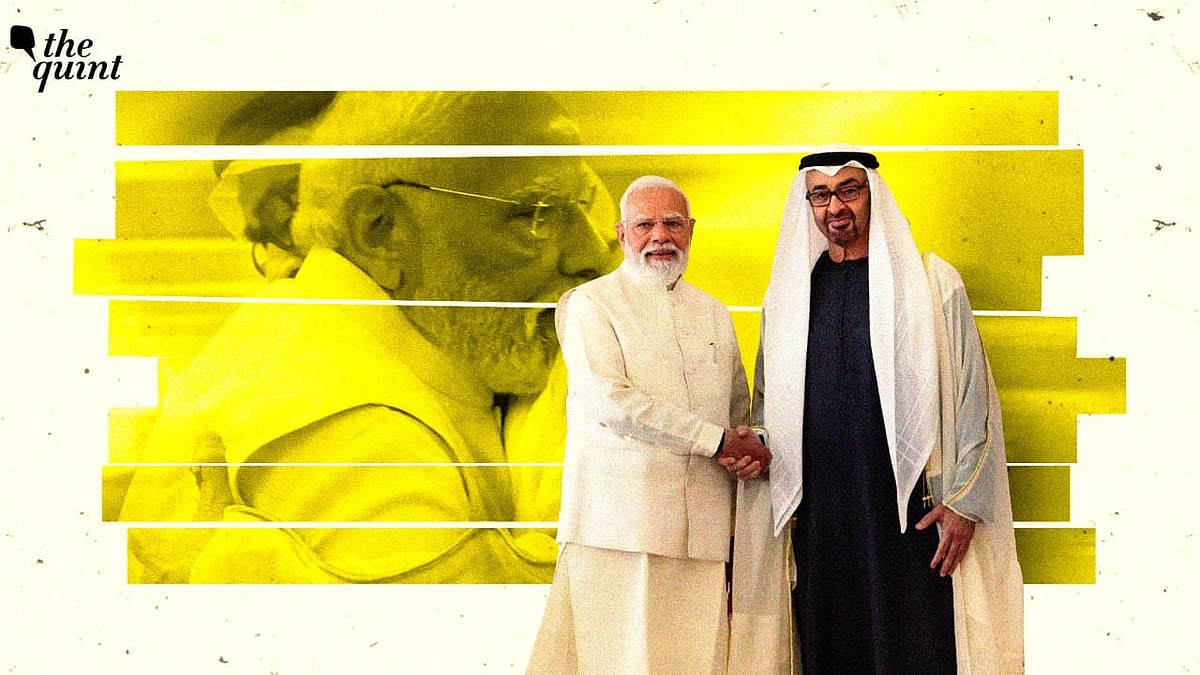
Prime Minister Narendra Modi 's visit to the UAE on Friday, 15 May—though lasting only a few hours—has perhaps been the most consequential of all his visits to the Gulf. Much of this derives from the timing of the visit.
The region is in the throes of the Iran war, and the ceasefire in place, according to US President Donald Trump, is on "massive life support". The Strait of Hormuz, through which one-fifth of the world's oil passes, too, has been closed for two months, shaking energy markets, sending oil prices soaring skyhigh, and stoking global inflation.
Indira Reels Amid Energy Shortage
India has not been immune from this fallout—dependent as it is on this waterway for at least 60 percent of its energy imports. Union Petroleum Minister Hardeep Singh Puri recently disclosed that oil marketing companies were losing Rs 16,000 crore daily, something the recent fuel price hike aims to somewhat address.
The rupee has fallen to a historical low to touch 95 to the dollar, and Prime Minister Narendra Modi has appealed to the people to take measures to save fuel.
Enormous damage has been wrought to energy supplies not only with the closure of vital transport arteries, but also by damage to energy facilities and infrastructure in the region. Thus, even if the strait reopens now, it will still take a long time to achieve supply and market stability.
Modi's visit is, therefore, symbolic in itself, signalling as it did as a show of support for the UAE, which, by many accounts, wants the war to continue to its logical end. And this support is not without reason.
New Phase of India-UAE Bilateralism?
The UAE has emerged as one of India's closest partners over the last decade—not just in the Gulf region, but even beyond, with cooperation spanning almost all sectors.
Trade between the two nations has grown exponentially, especially after both signed the Comprehensive Economic Partnership Agreement (CEPA). Indian exports to the UAE in 2025-26 totalled $37 billion—its second-largest export market and a crucial one given the US tariffs imposed on it. Around 4 million Indians live and work there, a source of hefty foreign remittances. Thousands of families in India depend on these remittances.
But, beyond the optics, replete with an extravagant welcome for PM Modi, the visit has also seen some key agreements signed between the two. Central to India’s immediate concern is the agreement in the energy sector. India and the UAE signed an MoU on Indian Strategic Petroleum Reserves Ltd, and concluded an agreement for the supply of LPG.
This will go a long way in reinforcing and strengthening India’s long-term energy security. The UAE was the first oil-producing nation to partner with India for its strategic petroleum reserves through an agreement signed in 2017, between Indian Strategic Petroleum Reserves and the Abu Dhabi Nations Oil Company (ADNOC). The new agreement raises the UAE's participation to 30 million barrels.
These energy agreements assume greater importance given that the UAE recently exited the Organisation of Petroleum Exporting Countries (OPEC) and the wider OPEC+, with effect from 1 May. This frees it up from all production, supply, and pricing constraints, something which can be immensely beneficial to India.
The clause, for instance, that "potential storage of crude oil in Fujairah, UAE, to form part of the Indian Strategic Petroleum Reserves" is significant because the emirate is located outside the Strait of Hormuz, and so, supplies will not depend on the strait's closure or opening. The UAE is also doubling down on the construction of the West-East oil pipeline to double its oil export capacity to 4 million barrels per day by 2027 via the port of Fujairah.
Geopolitical Significance
The most strategic and significant, however, is the new framework agreement on a Strategic Defence Partnership between India and the UAE. This partnership stipulates that both nations will deepen “defence industrial collaboration and cooperation on innovation and advanced technology, training, exercises, maritime security, cyber defence, secure communications and information exchange,” according to the statement by the Ministry of External Affairs.
Increasingly, the Gulf countries today are looking less like a unified bloc. If it was the Islamic Revolution in Iran in 1979 that spurred the creation of the Gulf Cooperation Council (GCC) then, almost three decades later, it is the Iran war that is slowly leading to its unraveling, where it is the UAE that increasingly stands apart from the rest.
The UAE's rift with the Saudis is widening. Of all the GCC countries, it has been subject to maximum attacks from Iran, and now, as per reports, it has also participated in attacks on Iran.
And, it is the UAE that with normalisation of relations with Israel under the Abraham Accords, is the only Gulf country to now have stationed Israeli Iron Dome batteries and interceptors on its territory. The Saudi-Pakistan defence agreement, together with Pakistan’s mediation efforts, has created a rift between Pakistan and the UAE too, as seen in the abrupt manner that the UAE asked Pakistan for its loan repayment.
This will be a litmus test for India which has not entered into any such alliance ever in its history.
(The author is an award-winning journalist specialising on Eurasian affairs. This is an opinion piece and the views expressed above are the author’s own. The Quint neither endorses nor is responsible for the same.)
- Access to all paywalled content on site
- Ad-free experience across The Quint
- Early previews of our Special Projects
Published: undefined