
Can Nepal's Rapper PM Balen Shah Change India's 'Big Brother' Attitude?
Nepal is not looking for a new “Big Brother”, however benevolent.
advertisement
Delhi has spent decades trying to understand Nepal through categories that Nepal itself has increasingly outgrown. There was the monarchy, with its carefully cultivated Hindu civilisational affinities; the Nepali Congress, with its democratic inheritance and Indian connections; and the Communists, whose ideological flirtations with Beijing often doubled as bargaining instruments against Delhi. Each came with a familiar diplomatic grammar. Each offered India something it knew how to interpret.
Then came Balen Shah.
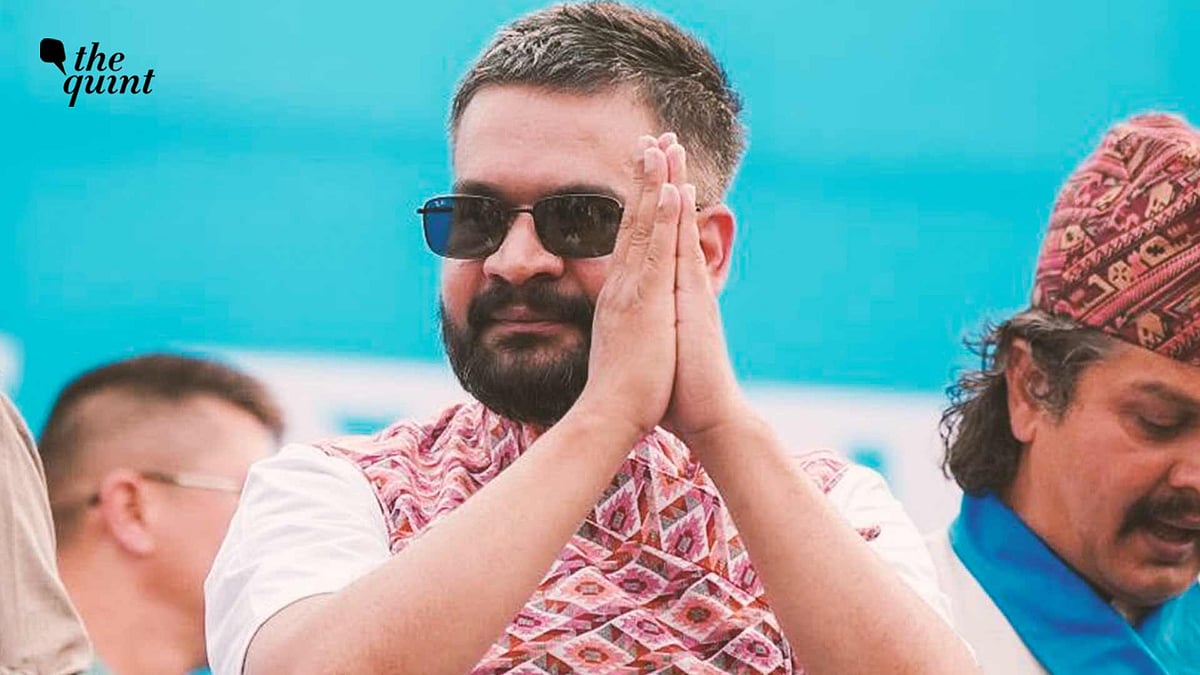
A former rapper, structural engineer, Kathmandu mayor and now Nepal's Prime Minister, Shah is not merely another political personality to be accommodated within India's established understanding of its Himalayan neighbour.
He represents something considerably more inconvenient i.e., a generation that does not regard India's historical intimacy with Nepal as an entitlement to contemporary deference. His politics is organised around a simple proposition—respect between neighbours must be earned, not inherited.
Consider the lyrics of Balen Shah’s Nepal Haseko, released in 2015. Shah writes of oppression, aggression, crime and misunderstanding; of a country rendered helpless, described as a beggar by foreign banks; of predatory politicians masquerading as revolutionaries while soldiers suffer, children lose their futures and stomachs remain empty.
The PM Who Rapped
There is something revealing about the fact that Nepal's Prime Minister once articulated his political imagination through hip-hop. Rap is an inherently democratic form of cultural expression. It speaks from below, distrusts inherited authority, and makes dissent audible.
Previous generations of Nepali leaders approached India through two broad frameworks. The first was civilisational romance—shared Hindu heritage, religious pilgrimage, open borders and the supposedly natural intimacy between two ancient societies. The second was geopolitical resistance—ideological positioning against India, frequently accompanied by strategic courtship of China. One offered emotional familiarity; the other diplomatic leverage.
Neither adequately describes Shah's political appeal.
His proposition is neither that Nepal belongs within India's civilisational imagination nor that its sovereignty requires permanent suspicion of New Delhi. It is more contemporary and, for India, more demanding—Nepal should be treated as an equal, because it is a sovereign country, not indulged as a smaller relative because it is culturally familiar.
Civilisational affinity can be a powerful foundation for friendship, but it becomes counterproductive when mistaken for political consent. India's tendency to assume that shared religion, culture and history should automatically translate into diplomatic goodwill has periodically produced the opposite reaction. Nepalis do not need reminding that their country has a distinctive national identity. They certainly do not need India to certify it.
Playing 'Big Brother'
The “Big Brother” syndrome is not an invention of anti-Indian politicians. It is a lived political anxiety, reproduced through historical grievances and episodes in which India's considerable leverage has appeared insufficiently sensitive to Nepal's vulnerabilities. The 2015 border blockade remains an especially consequential reference point. Such memories need not translate into hostility towards India. They do, however, make condescension particularly expensive.
Shah's Madhesi ancestry, rooted in Nepal's southern plains, makes his political journey especially significant. Madhesi identity has historically occupied an uneasy position within Nepal's national imagination, often treated by Kathmandu's political establishment as culturally proximate to India and consequently politically suspect. The old Madhesi-Pahadi binary has shaped debates about citizenship, representation, federalism and belonging.
It would be a mistake to interpret his Madhesi background as an automatic Indian strategic advantage, just as it would be foolish to assume that his nationalism makes him susceptible to Chinese influence. Identity is not foreign policy. Geography is not political obedience.
Indeed, Shah's relationship with Beijing could prove more pragmatic than ideological. Nepal cannot afford to turn China into a substitute patron any more than it can afford to remain dependent on India. China's infrastructure ambitions and political influence offer opportunities, but they come with their own asymmetries. A leader whose legitimacy rests on national dignity would be unwise to exchange one uncomfortable dependency for another.
There will be limits to the efficacy of symbolism. Temple visits, civilisational invocations, ceremonial embraces and the familiar vocabulary of special relationships cannot substitute for a credible economic partnership. Nor should India imagine that access to its political establishment will automatically translate into influence over a prime minister whose political capital comes from rejecting precisely those familiar ways of doing business.
Seeing Nepal Eye to Eye
What should Delhi offer? Practicality, equality, and dignity. Reliable connectivity, energy cooperation, cross-border trade, investment, educational opportunities and employment pathways. Greater sensitivity towards Nepal's sovereign choices, particularly where India's security concerns are involved. Above all, a willingness to engage Kathmandu as a negotiating partner rather than a geopolitical constituency.
There is a reciprocal responsibility. Shah must understand that India's security concerns are not simply expressions of hegemonic anxiety. Nepal's position between India and China makes strategic prudence indispensable. An open border and extensive people-to-people connections create obligations on both sides. Sovereignty cannot become a convenient justification for ignoring the consequences of strategic decisions.
The challenge is to construct a relationship in which neither country needs to diminish the other to assert itself.
In Nepal Haseko, Shah imagines a country where different flowers make a beautiful garden, where every community receives equal dignity and collective happiness matters more than individual ambition. His politics began with a language of frustration and arrived at a vocabulary of dignity. Delhi should listen to both.
Balen Shah may be a political experiment, and experiments can disappoint. His government will be judged on jobs, institutions, governance and the material conditions of ordinary Nepalis, not the cultural novelty of its prime minister. But India's immediate test is whether it can recognise a neighbour whose aspirations are no longer explained by the old categories.
Nepal is not looking for a new “Big Brother”, however benevolent. It is looking for a neighbour capable of understanding that proximity is not permission, history is not ownership, and friendship without equality is merely another name for hierarchy.
That may be the most important lesson Delhi can learn from the man who once wanted Nepal to smile.
(Bhopinder Singh is the former Lieutenant Governor of the Andaman and Nicobar Islands and Pondicherry. This is an opinion piece and the views expressed are the author’s own. The Quint neither endorses nor is responsible for them.)
- Access to all paywalled content on site
- Ad-free experience across The Quint
- Early previews of our Special Projects
Published: undefined