
Balen Shah's India Challenge: Put 'Nepal First' Without Ruffling New Delhi
Balen Shah's shift is best seen as a tactical pause rather than a lasting change in outlook, writes Bharat Bhushan.
advertisement
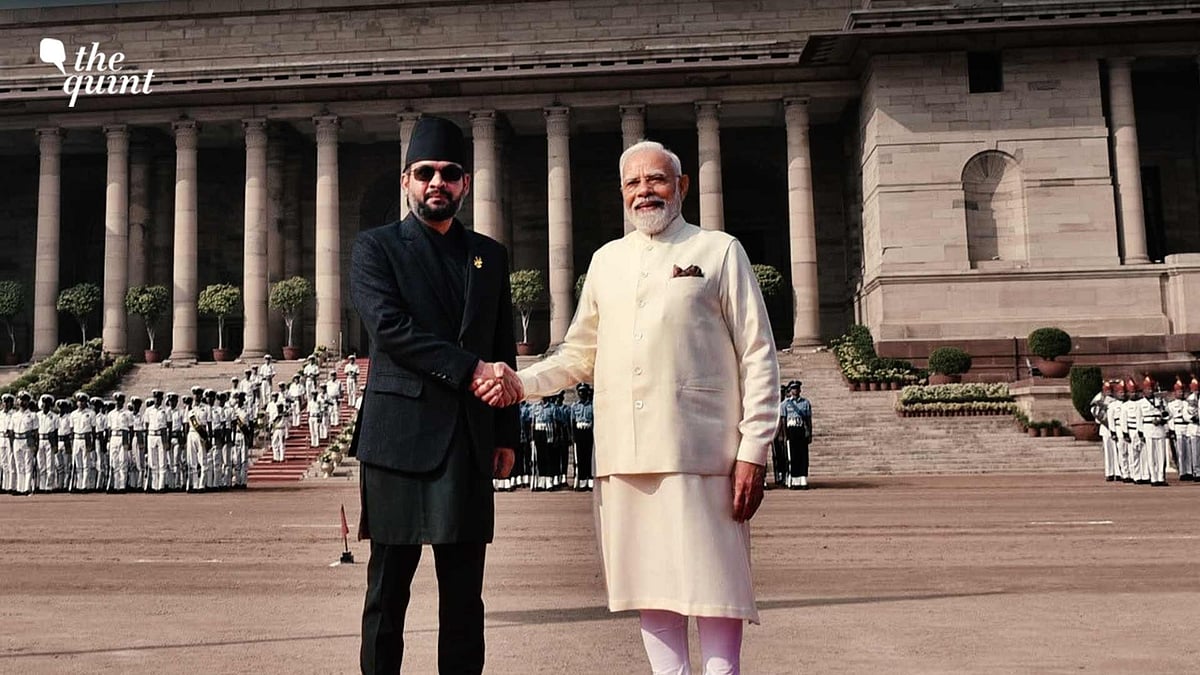
Nepal Prime Minister Balenda “Balen” Shah’s much-awaited visit to India was driven more by necessity than by an ideological change of heart.
Shah had projected himself as someone who would not be beholden neither to India or China unlike the traditional political parties of Nepal. His visit, avoided deliberately since he took over power in March this year, was necessitated by the urgent need for reconstruction after the devastating floods in Nepal in August and October.
Shah’s visit followed the visits of Rabi Lamichhane, chairman of the ruling Rashtriya Swatantra Party (RSP); Finance Minister Swarnim Wagle; and Foreign Minister Shishir Khanal. Perhaps, in retrospect, some quiet diplomacy was going on between the two countries.
Shah returned with the largest-ever financial assistance package to Nepal, worth Rs 15,000 crore, and access to two new Indian ports—Kandla in Gujarat and Paradip in Odisha, once the supporting infrastructure is ready.
Shared religious underpinnings were symbolically emphasised by jointly flagging off with Modi, the Saray-Kamala Express from Ayodhya in India to Janakpur in Nepal.
Roadmap for Renewed Bilateralism
Eight MoUs were signed, which covered, among other things, setting up an offshore campus of IIT in Nepal, a startup excellence centre in Kathmandu, and a Digital Nomads and Innovation Hub in Pokhara. This seems a nod towards Shah’s Gen Z constituency, which catapulted him to power.
In a sense the visit managed to reformat India-Nepal relations. The established bilateral relations were disrupted when Shah came to power and his behaviour made it difficult to establish new ones.
Shah had famously hung a map of “Greater Nepal” in his office when he was the Mayor of Kathmandu. As prime minister, he imposed an impractical protocol, refusing one-to-one meetings with foreign envoys or officials ranked below foreign ministers and heads of governments. In May 2026, he declined to meet Indian Foreign Secretary Vikram Misri, saying he wanted to meet someone of equivalent rank.
Shah’s inexperience of governance and aversion to advice threatened to complicate relations further. India’s traditional diplomacy was ineffective. New Delhi was also relying on Hindutva functionaries close to the Rashtriya Swayamsevak Sangh (RSS) in Nepal—whose influence, along with that of some Opposition politicians with open channels to Shah—helped moderate his attitude towards India.
At home, there was criticism of his isolationist policy vis-à-vis India as counterproductive and damaging Nepal’s economic interests.
A Tactical Pause?
Despite his party’s two-thirds majority, Shah faced serious internal challenge from party chairman Lamichhane. The “dual power centre” government—Shah as Prime Minister and Lamichhane as party chairman—had of late become a turf war between the two leaders. What had further escalated the tension between the two was a “veto” clause introduced in the RSP’s constitution in July 2026 which empowered the party chairman (Lamichhane) to remove the parliamentary party leader (Shah), if he acted against party policies.
Shah’s centralising style and governance through a non-party coterie of advisors had alienated party MPs, while the rivalry with the party chairman spilled over into institutions like the judiciary, police leadership, and bureaucracy.
Lamichhane’s highly publicised June visit had head-of-state optics. His extraordinary reception in Delhi, despite holding no government post, suggested that India had an alternative and willing interlocutor to deal with in Kathmandu. Shah risked allowing his party rival to monopolise Nepal’s relationship with its most influential neighbour. Reopening diplomatic channels was also, therefore, a way of reclaiming control over international relations and demonstrating that India must deal with him directly.
The pragmatic shift made by Shah is perhaps best seen as a tactical pause rather than a lasting change in outlook. The contentious border claims and the demand to renegotiate the 1950 Peace and Friendship Treaty remain unaddressed. He may have kept them on whether he keeps them on the back burner while addressing more urgent economic issues will indicate whether he intends to avoid nationalist friction with India.
At the same time, Shah has to keep his “Nepal First” credentials intact without appearing overly deferential to India. His dispatch of a 20-member delegation to China days before his own visit to India was possibly meant to indicate strategic independence.
However, playing the “China card” for domestic audience may not pay dividends as his predecessors, including King Birendra discovered. Sustaining India-Nepal ties will require more than transactional pragmatism and much depends on how Shah balances these competing political and strategic pressures.
Shah's Unpopular Isolationism
Domestically, Shah has reclaimed the primary diplomatic channel to India. Returning from India with tangible gains blunts the domestic criticism of his isolationism. By shortening his visit to barely 25 hours he has retained his business-like, no-frills, nationalist image.
His reported consultation with Lamichhane over his New Delhi agenda may have been aimed at projecting unity before his first bilateral visit abroad. After the visit, Shah may have temporarily bolstered his position vis-à-vis Lamichhane, but this cannot be construed as a permanent reconciliation. The implementation of the Indian assistance package will be an important test. Shah’s preference for running the executive through a coterie of non-party advisers and missteps in implementation could invite renewed demand for party oversight if delivery fails.
KP Sharma Oli (2020-21), Sher Bahadur Deuba (2022), and Pushpa Kamal Dahal aka Prachanda lost their top jobs when the party president/central committee turned against them.
Without the party machinery’s support, Shah cannot function as prime minister for long. Changes in the party constitution could further weaken him if the rivalry escalates. There may be a temporary truce, but the Shah-Lamichhane partnership remains a marriage of convenience, vulnerable to their competing ambitions, and functioning styles.
(The writer is a senior journalist based in Delhi. This is an opinion piece and the views expressed are the author’s own. The Quint neither endorses nor is responsible for them.)
- Access to all paywalled content on site
- Ad-free experience across The Quint
- Early previews of our Special Projects
Published: undefined