
Nepal Flash Flood Disaster: The Himalayan Crisis India and China Must Address
Amid this tragedy, India and China have a chance to demonstrate collective leadership in enabling the Global South.
advertisement
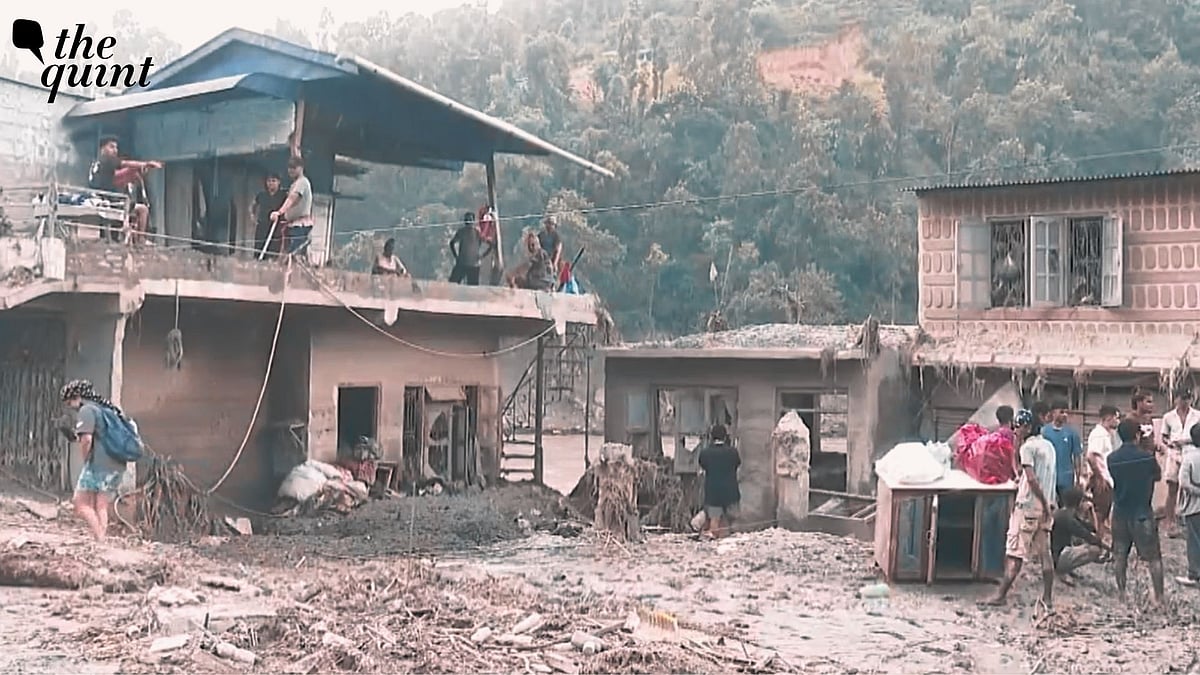
Nepal is currently coping with a massive natural disaster near its border with China, and the scale of the death and destruction is catastrophic.
On Wednesday, 26 August, a massive flash flood originated on the northern flank of Langtang Lirung (7,234m) in Nepal, after a rock and ice collapse triggered a huge debris flow down the Bhote Koshi-Trishuli river system.
By Wednesday evening, the Rasuwagadhi crossing that links Nepal and Tibet had vanished. Social media was flooded with tragic images of the devastation. High-resolution images comparing April 2024 and 27 August 2026 showed the scale of the destruction: China-Nepal border infrastructure, the dry port, and the road, which is also the hydropower lifeline, were all reduced to rubble.
From 2025 to 2026: The Warning Signs Were Already There
This was not new. On 8 July 2025, the same river system, the Lhende Khola that becomes the Bhotekoshi, produced a flash flood after a supraglacial lake at 5,150 metres, 36km north of the border in Tibet, shrank from 0.74 sq km to 0.60 sq km in hours.
That 2025 flood took the Miteri Friendship Bridge and left nine dead and 19 missing, including six Chinese nationals.
At the time, Nepal’s Department of Hydrology and Meteorology, backed by ICIMOD (International Centre for Integrated Mountain Development), called it a supraglacial lake outburst.
To compound the tragedy, on Friday, 28 August, a second threat was looming: the earlier debris created a barrier lake 10km upstream, holding roughly 1,000 Olympic swimming pools’ worth of water. It briefly overflowed, forcing a second evacuation in Rasuwa and sending fresh panic down to Bidur Municipality.
Geologists say such barrier lakes from ice-rock avalanches are now the classic Himalayan secondary disaster.
Nepal Responds, but Data and Trust Still Fail
Nepal’s response since 2015 has significantly changed, and this is the first positive lesson.
In 2015, Kathmandu needed foreign assistance for search and rescue (SAR) operations.
This week, to its credit, Nepal mobilised within 24 hours. The Nepal Army, Armed Police Force and NDRRMA evacuated more than 485 people and deployed two Army helicopters for SAR, with Prime Minister Balen Shah holding coordination meetings while district disaster committees issued downstream alerts for the Trishuli.
On 28 August, Nepal’s Foreign Ministry declined offers of foreign rescue help, saying, “our agencies are doing it.” That decision, deemed controversial given that 540 foreigners were missing, reflected a new confidence in Nepal’s national capacity, carefully built up over the last decade.
However, Nepal has since requested specialised foreign technical equipment that India and China have provided.
But two things have not changed since 2015, and both were revealed on 8 July 2025 and again now.
First, the absence of sustained, trans-boundary cryosphere data.
The Lhende catchment is transnational by definition, and there is no robust regional data sharing.
Instead, data sharing remains transactional. India and China both suspend hydrological data when relations sour, as they did after Doklam in 2017 and Galwan in 2020.
Alas, the cost is paid by Nepal's local residents, tourists and pilgrims.
The Alps have a far more negative specific balance than the Himalaya; the Himalaya’s danger is not uniform melting, but episodic, compound failures: rock and ice collapse plus glacial lakes triggering a quake.
This cannot be tracked with rainfall radars and needs more refined, open-source cryosphere data that is glacier-specific.
Second, the blame game that followed was reminiscent of COVID.
Last year, in July 2025, a Nepali minister suggested China was hiding information about the lake breach; Beijing pushed back. This week saw the same script being pulled out. Chinese media called Nepali warnings “fake news” and blamed a Nepal-side quake; sections of the Nepali press accused China of withholding early warning about the barrier lake.
Doubts were expressed about the origin of the current tragedy. Was it Nepal or Tibet/China?
However, this spat has since been resolved, and President Xi Jinping has extended both condolences and rescue assistance.
A Chance for India, China and Nepal to Act Together
Against this tragic backdrop, India and China have a chance to demonstrate collective leadership in enabling the Global South, and the timing matters.
The most appropriate deliverable would be a joint India-China-Nepal announcement of a Himalayan Glacial Hazard Early Warning System, with a standing protocol for cryosphere and hydrological data, glacial lake area change and real-time river levels from Tibet to the Ganga plain – not as a goodwill gesture after a disaster, but as a regional obligation.
Further, the region needs a second deliverable: a pre-authorised Himalayan HADR compact.
South Asia has the SAARC Disaster Management Centre in Gujarat; ASEAN has the AHA (ASEAN Humanitarian Assistance) Centre in Jakarta, but the India-Nepal-China border has no similar rapid-reaction, cross-border protocol.
The flood of 26 August could not have been anticipated by rainfall forecasting alone. Hopefully, the next one can be better tracked and better responded to if hydrological and cryosphere (glacier-related) data is treated as a public good, not as leverage.
In the interim, prayers for those still missing and deepest condolences to the families of the bereaved.
(C Uday Bhaskar is a leading expert on strategic affairs. He is currently Director, Society for Policy Studies. This is an opinion piece. All views expressed are the author’s own. The Quint neither endorses nor is responsible for them.)
- Access to all paywalled content on site
- Ad-free experience across The Quint
- Early previews of our Special Projects
Published: undefined