
As FCRA Fear Grows, India’s Churches Rally Under a Contested Umbrella
In reality, the panic button was the FCRA regulation being used in its most ruthless form, writes John Dayal.
advertisement
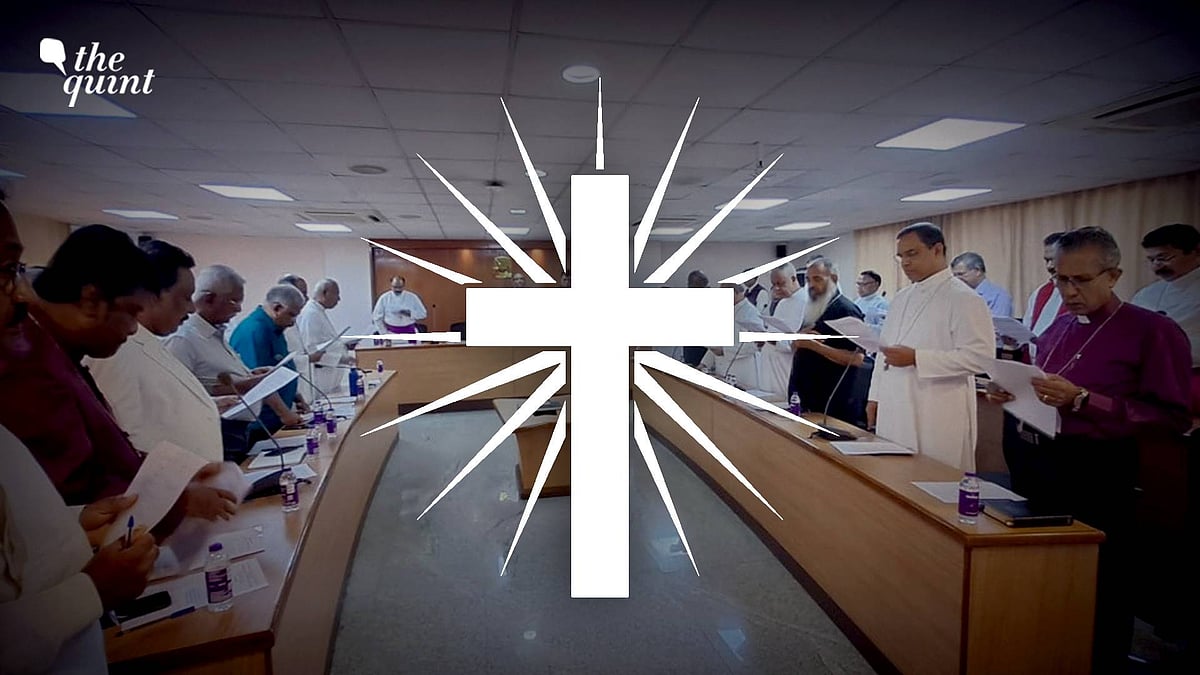
In a historic effort to unite many diverse Christian groups, 45 church leaders formally launched the National Federation of Churches (NFCI) in Bengaluru last week. The participants included archbishops, bishops, some self-styled archbishops, heads of a few independent evangelical and pentecostal churches, and their delegates.
The timing was described by its architects as urgent, even inevitable, as churches face violent attacks on pastors and faithful; stringent anti-conversion laws in 12 states; and attempts to seize Church properties through amendments to the FCRA [Foreign Contribution (Regulation) Act] and the proposed Christian Welfare and Property Board.
In reality, the solitary panic button was the FCRA regulation being used in its most ruthless form—allowing the government to confiscate properties and other assets bought or built with money received from foreign donors if the government cancelled registration, did not renew it for another five-year term, or if the church or NGO ceased to function.
The birthing of the NFCI is one of the most recent attempts to bring together Indian Christians who belong to the many denominations, rites, dissent, and reform movements, and several who wanted to return to a simpler, early-church faith. To no one's surprise, Cardinal Anthony Poola, Archbishop of Hyderabad and President of the Catholic Bishops' Conference of India (CBCI), was elected its inaugural chairman.
The Shadow of FCRA and Property Seizures
Vast properties have been built across the country by Christian groups since Prime Minister Indira Gandhi introduced the FCRA during the Emergency in 1976 to monitor the flow of funds from German church and political groups to George Fernandes and other opponents of the Gandhis.
Some institutions built were exemplary—Mother Teresa's ashrams and orphanages, schools, colleges, and dispensaries—but about as many were homes and prayer halls constructed by "Mom and Pop" and father-son NGOs operating on church FCRA licences.
Some once-independent evangelical and missionary groups have over two decades metamorphosed into "regular" Protestant churches, some seeking linkages to classic Syrian groups in Kerala, with former directors and pastors designating themselves Bishops and Archbishops—titles commonly associated with the Catholic Church and former colonial era denominations.
The Missing Giants of Indian Ecumenism
Not sheltering under this slightly soiled umbrella are two major formations: the Evangelical Fellowship of India (EFI) and the National Council of Churches in India (NCCI), the latter even older than Cardinal Poola's CBCI.
When the proposal was discussed in May 2025, some delegates sought clarification on the NFCI's relationship with existing ecumenical bodies such as the National United Christian Forum, formed earlier by the CBCI, the EFI, and the NCCI.
The question was never satisfactorily answered. Archbishop Thazhath, summarising the consensus, declared there should be one national apex body and others could function as subsidiaries under its umbrella—an elegant formulation, and a breathtaking one.
The National United Christian Forum, formed through a landmark MOU signed by the CBCI, the NCCI, and the EFI, had committed all three to shared goals and cooperative arrangements. It has held national consultations and issued joint statements on the Uniform Civil Code (UCC), the National Education Policy, the Juvenile Justice Act, anti-conversion laws, and electoral rights. In the difficult years since 2014, it has been a credible and functioning voice.
Neither the NCCI nor the EFI appears to have been genuinely consulted before the NFCI was announced, and the ecumenical community woke on 9 May to find a new apex body declared that proposed to supersede them.
Criminal Cases and Questions of Credibility
State CID have filed criminal cases against some senior non-Catholic “bishops” in the new umbrella, accusing them of misleading foreign donors, siphoning funds, money laundering, and buying real estate in prime locations through "proceeds of crime."
Many properties have been seized, and high courts have refused to entertain appeals against ED action. The Telangana High Court held ED actions to be "within criminal jurisdiction, and not amenable to intra-court appeal under Clause 15 of the Letters Patent," with interim restraints on alienating properties remaining in force.
The NCCI is the oldest ecumenical body in the country. Established in 1914 as the National Missionary Council, it constituted itself in 1923 as the National Christian Council of India, Burma and Ceylon, and transformed in 1979 into the NCCI. It brings together 32 member churches, 18 regional Christian councils, and 18 all-India Christian organisations, headquartered in Nagpur, affiliated to the World Council of Churches and the Christian Conference of Asia. It cannot be waved aside in institutional arrogance as insufficiently inclusive.
Old Institutions, Deep Faultlines
The Evangelical Fellowship of India, founded in 1951 in Yavatmal, Maharashtra, represents over 54 smaller Protestant denominations and some 65,000 churches, and is now celebrating its 75th year.
It runs, with the Delhi-based United Christian Forum, the authoritative helpline for victims of persecution, and its Religious Liberty Commission publishes annual reports with authoritative data on violence against pastors, churches, and communities across the country.
The CBCI itself is, ironically, the youngest of the three founding pillars of Indian ecumenism, constituted at the Metropolitans' Conference held in Madras in September 1944.
The Catholic Church has further complexity in the Syro-Malabar and Syro-Malankara Rites operating across all of India, and in the Conference of Catholic Bishops of India, the Latin Rite body, which is the largest bishops' conference in Asia and the fourth-largest in the world.
Persecution Takes a Back Seat
The question of what the NFCI is actually for cannot be separated from what it is reacting to—the FCRA Amendment Bill of 2026 as the proximate cause. Since the Modi government came to power in 2014, more than 20,000 FCRA registrations have been revoked or suspended, with more than 70 percent of lapsed religious-category licences aligned with Christian programmes.
The amendments are a sword that could slice through a century of Christian social service.
Yet, this becomes the NFCI's main focus, rather than the cause of Dalit Christians, persecution of pastors and churches, or violence against Catholic Women Religious. Last year, more than 1,000 cases were registered by Christian minority groups, including the EFI and the UCF, with 125 more on Christmas Day 2025—even as Prime Minister Narendra Modi was seen praying at the Cathedral Church of the Redemption in New Delhi.
Hundreds of pastors have spent months in jail in Uttar Pradesh on charges of forcible or fraudulent conversions; others have been killed in the tribal belt of Central India and Orissa.
The Catholic Church does not document violence against fellow Christians and responds only when its own institutions, priests, or nuns are impacted.
Can the NFCI Truly Speak for India’s Christians?
Cardinal Poola is a man of dignity and learning, and his election as CBCI president, representing the historic Hyderabad See, commands respect—especially in the large Dalit Christian community across denominations. Having assumed the CBCI presidency only on 7 February this year, he had not been privy to the consultations, or lack thereof, leading to the St John's meeting.
The NCCI and the EFI were not consulted, though the new body's leaders have argued that existing bodies lacked full denominational representation or a specific platform for bishops and heads of churches.
India's Christians—all 2.8 crore of them, some 2.3 percent of India's 1.40 billion people—deserve a federation that is truly national, genuinely ecumenical, and constitutionally impeccable in its internal conduct.
No religious group in India in reality has such a comprehensive umbrella: Hinduism is an uncounted number of groups, the Muslim Personal Law Board has but a narrow mandate, and the SGPC does not represent all Sikh sects and does not manage all gurdwaras in the country.
Christians have a history of working towards a united voice in political and civil forums, though they have so far not succeeded in any great measure.
What they have been given in Bengaluru may be something rather different—with the Telangana High Court's order of 13 May the sharp tip of a sword that may yet pierce both credibility and unity.
(John Dayal is a writer and activist. He is a former President of the 106-year-old All India Catholic Union. This is an opinion piece and the views expressed above are the author’s own. The Quint neither endorses nor is responsible for the same.)
- Access to all paywalled content on site
- Ad-free experience across The Quint
- Early previews of our Special Projects
Published: undefined