
Modi’s Peace Pitch to Putin Has One Big Problem—India’s Own Foreign Policy
It is difficult to overlook the transaction-driven cynicism undergirding India's approach to Moscow and Tehran.
advertisement
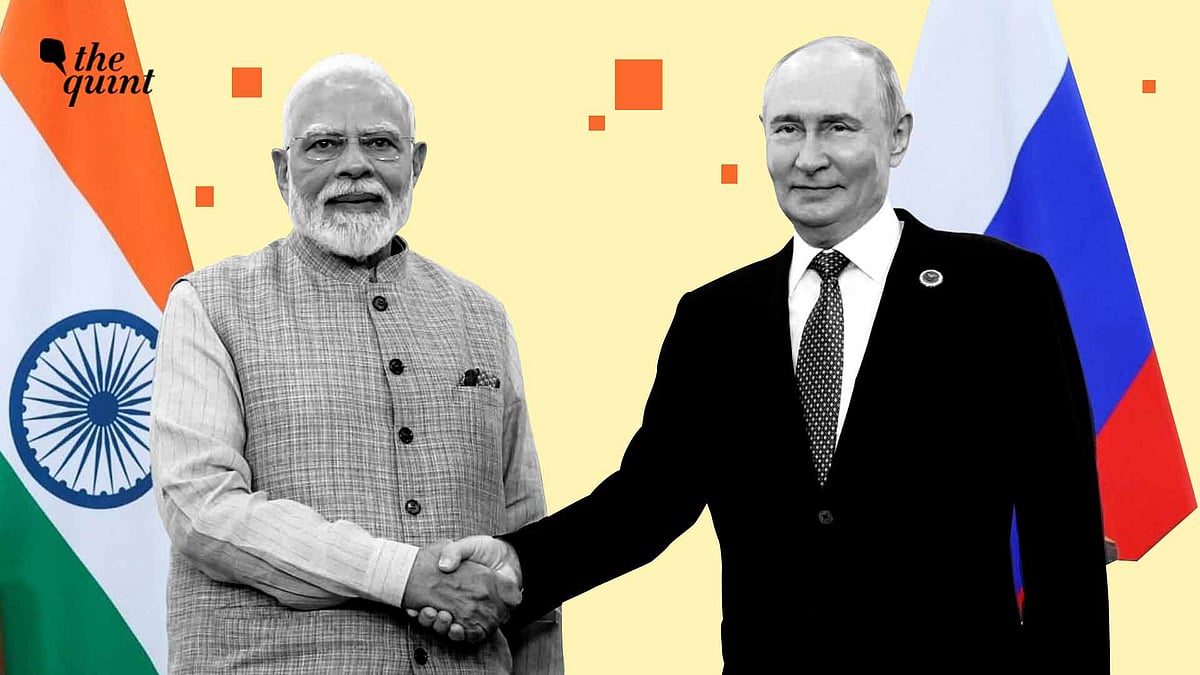
Prime Minister Narendra Modi met Russian President Vladimir Putin in Bishkek on the sidelines of the Shanghai Cooperation Organisation (SCO) summit for their first meeting of the year.
What stood out in the meeting was Modi’s admonition to Putin that “we must move from ‘endless war’ to ‘end of war’ for the benefit of humanity,” in an explicit reference to the Ukraine conflict. This was an echo of his 2022 message at the Samarkand SCO summit, where he told the Russian leader that “now is not an era of war.” At the time, the remark was widely praised and cited across global diplomatic circles.
This time around, however, the fact that Modi read the statement off a slip of paper in his hand robbed the moment of its spontaneous gravitas.
In his broader remarks, the Prime Minister invoked “the path to peace” as the foundational message from the land of Gandhi and Buddha, noting that “every day spent in war sets humanity back, whereas every step taken towards peace fills humanity with new hope and enthusiasm.” It was a statement clearly tailored to garner headlines back home—and, predictably, main national daily newspapers led with it the following morning.
Yet, just as Putin paid little heed to the message in 2022, he is unlikely to act on it now.
Modi’s Peace Message Rings Hollow
Questions also remain over how seriously Moscow or the wider international community can take moral exhortations from a leader who maintains a muted posture on other major conflicts, such as the American-Israeli confrontation with Iran. On that front, New Delhi has confined its posture strictly to routine calls for restraint, dialogue, and diplomacy.
Even on the day he met Putin, Modi also held bilateral talks with Iranian President Masoud Pezeshkian. In a post on X, Modi framed the exchange in broad terms, noting simply that they discussed ongoing conflicts and that “India will continue to support all efforts aimed at ensuring lasting peace.”
The official readout of the talks noted that the PM “reiterated India’s consistent positions that all issues must be resolved through dialogue and diplomacy.” And in an oblique dig at Iran, also called for safeguarding the freedom of navigation and commerce.
In a striking development, India has even exported refined gasoline back to Russia to offset domestic refining disruptions caused by Ukrainian strikes.
India’s Russia-Iran Balancing Act
In their discussions, Modi and Putin would have almost certainly discussed the looming threat of US secondary sanctions—specifically proposed 100 percent tariffs on nations continuing robust trade with Russia and Iran—as Washington pushes New Delhi to diversify toward American and Venezuelan crude.
Defense procurement remains another critical friction point. Despite supply-chain disruptions stemming from the Ukraine conflict, Moscow has offered India five additional units of the S-400 long-range surface-to-air missile system, which proved pivotal during Operation Sindoor last year.
As for Iran, oil trade which was once flourishing is now dead, strangled by the American secondary sanctions. Iran is the closest source of hydrocarbons to India, yet New Delhi has had to forgo imports because of American policy. Again, India had a flourishing export trade in agricultural products like tea and rice, and pharmaceuticals, which has now been disrupted by war and will now be further affected as UAE, which functioned as a transhipment hub has blocked trade with Iran.
Bilateral trade has fallen more than 90 percent since 2018-19 on account of US pressure.
The Cost of India’s US Tilt
Ultimately, it is difficult to overlook the transaction-driven cynicism undergirding New Delhi’s approach to both Moscow and Tehran. Pressed against the wall, Iranian leadership had little choice but to publicly appreciate “New Delhi’s support and cooperation with the Islamic Republic of Iran during the recent war.”
In a comprehensive three-page statement following the Modi-Pezeshkian , the Iranian leadership quoted Modi directly, noting that even through this difficult period, both sides “sought to maintain and preserve our cooperation and communications.” In another telling excerpt from the Iranian statement, Modi reportedly agreed that there were “groups that see their interests in the continuation of war,” while adding that in his view, “ultimately peace and security will prevail.”
India’s grand strategy requires a vigourous balance between continental Eurasian realities and maritime Indo-Pacific commitments. At present, however, that strategy appears dangerously out of alignment: the continental dimension is being sidelined, even as the maritime pillar struggles to stay afloat while Washington steadily undermines the vitality of the Quad.
(The writer is a Distinguished Fellow, Observer Research Foundation, New Delhi. This is an opinion piece and the views expressed are the author’s own. The Quint neither endorses nor is responsible for them.)
- Access to all paywalled content on site
- Ad-free experience across The Quint
- Early previews of our Special Projects
Published: undefined