
NRC in Manipur Would Test Citizenship of Those Displaced by Violence
NRC can't determine how communities divided by conflict share territory or how displaced people return home.
advertisement
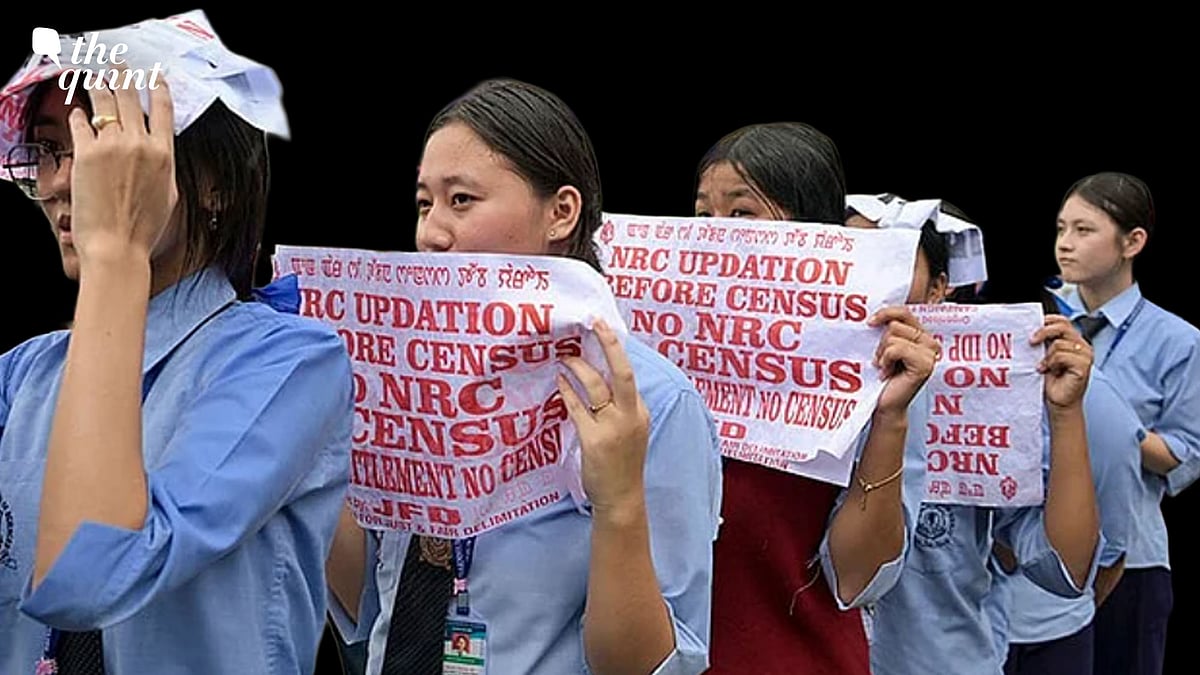
In Manipur, where the violence of 2023 remains unresolved and fresh conflict has emerged in 2026, the Census was put on hold a day before house-listing was to begin. On 31 August, the Union government deferred the exercise after a meeting chaired by Union Home Minister Amit Shah considered demands for a National Register of Citizens (NRC) to precede it. The decision has given an administrative exercise greater political significance: before Manipur conducts a fresh population count, it is being asked to determine who belongs.
The demand for an NRC is not new: 14 civil society organisations (CSOs) representing Meitei and Naga interests have called for it to precede the Census and delimitation, while sections of the campaign have proposed 1951 as the reference point.
Manipur shares a porous international boundary with Myanmar, and migration across it has long been a political concern. Amid the ongoing conflict, the demographic consequences continue to unfold, giving population change an even sharper political meaning.
On 2 September, the Manipur Assembly renewed its demand for an NRC before the Census, although a proposal to specify 1951 as the base year was not included in the final resolution.
Census, NRC, Delimitation and Manipur
A population figure describes the size of a population; it does not establish the cause of its growth. Population change can have several causes operating at the same time. Natural increase, movement from rural areas to towns, internal migration, displacement, the creation or alteration of administrative units, changes in the reach of enumeration, and cross-border migration can all affect the number recorded in a particular place.
A Census can show that a population has changed; it cannot, by that figure alone, assign responsibility for the change to any one of these processes. That distinction becomes especially important when a demographic increase is subsequently presented as evidence of a particular migration pattern.
Manipur’s own demographic history illustrates the complexity of these changes. NITI Aayog data show the state’s urban population rising from 8.8 percent in 1961 to 29.4 percent in 2011, with a projected 32.4 percent in 2023. The shift illustrates how changes in where people live can alter the demographic profile of a state without, by themselves, establishing the causes of demographic change.
That distinction matters because of what is proposed to follow: an NRC, the Census, and eventually delimitation. An NRC seeks to establish citizenship; a Census counts the population; delimitation translates population into political representation.
If a future delimitation were to reflect a substantially different demographic balance, would the Valley be willing to give up some of its existing 40 Assembly seats to make greater room for the hills? Would it accept, for instance, a 30-30 distribution if that were what a future delimitation produced?
Once population becomes the basis for representation, how that population was counted and what produced its growth can acquire consequences far beyond statistics.
Assam provides a useful comparison. Its NRC, published in 2019 after a Supreme Court-monitored process, included 3.11 crore people and excluded 19.06 lakh. Establishing citizenship required documents linked to “legacy data”, including the 1951 NRC and electoral rolls up to midnight on 24 March 1971.
Seven years on, the exercise has yet to reach administrative closure, with questions over the issuance of identity cards to those included and questions over the commencement of the appeals process for those excluded. Its experience shows how a citizenship register can acquire a life beyond the publication of a list, generating documentary disputes, claims and questions about how the state should treat those who fall on either side of the register.
Identity and Politics of Representation
For Manipur, where citizenship is already entangled with questions of migration, indigeneity, and political representation, the significance of an NRC would extend well beyond the publication of the register itself.
The distinction is significant. “NRC first” sounds like a settled procedural demand; the moment the question becomes what documents should establish citizenship, which date should govern eligibility and how claims should be verified, the political disagreement moves into the details of the exercise itself.
All of this would unfold while thousands remain displaced after the 2023 violence and relations among the state’s major communities remain unsettled. The recent violence in the Senapati-Kangpokpi belt has opened another dangerous Naga-Kuki fault line. Four Naga civilians were killed in an ambush on the Imphal-Tamenglong road on 27 August, followed by fresh violence in Kangpokpi on 31 August.
The deeper difficulty is visible within the government itself. On 31 August, Deputy Chief Minister Losii Dikho and eight other Naga legislators wrote to Home Minister Shah seeking action against “Kuki-Zo” militant leaders and against fellow Deputy Chief Minister Nemcha Kipgen, alleging links between her office and the Kuki National Front-P led by her husband, Thangboi Kipgen. They also demanded the abrogation of the Suspension of Operations agreement and warned that continued support for the government could become difficult to defend.
These are allegations by the legislators, not established findings. The fact that one group of legislators is appealing to the Centre against a fellow member of the state's own executive, however, is difficult to separate from the larger question of political trust.
The government formed after President's Rule was lifted brought together competing political interests, with a Meitei Chief Minister and Naga and Kuki deputy chief ministers.
That matters because an NRC would not be administered in a political vacuum. Decisions about documentation, verification, disputed claims and administrative implementation would be made by institutions whose authority is already contested by different sections of the state. Even where procedures are formally neutral, their acceptance depends partly on whether the communities subject to them regard the institutions administering them as credible.
In a deeply divided society, administrative legitimacy can become almost as consequential as administrative legality.
Testing Citizenship of the Displaced
An NRC is designed to answer a legal question about citizenship. It cannot determine how communities divided by violence should share territory, how displaced people should return, or what political arrangement can make competing claims of belonging coexist.
Manipur has a legitimate interest in establishing who is an Indian citizen. Before those records are used to establish a demographic baseline, and before that baseline eventually shapes political representation, the government must be able to establish what those numbers actually capture.
The more consequential question, therefore, is not whether Manipur can count its citizens. It is whether the state can build sufficient agreement around the meaning of that count for it to serve as a credible basis for the political decisions that may follow. The question is no longer simply who should be counted. It is whether counting can produce certainty in a state whose politics remain profoundly uncertain.
(Sangmuan Hangsing is a policy researcher based in Manipur. This is an opinion piece, and the views expressed above are the author’s own. The Quint neither endorses nor is responsible for them.)
- Access to all paywalled content on site
- Ad-free experience across The Quint
- Early previews of our Special Projects
Published: undefined