
India's Recruitment Crisis Is No Longer About Jobs. It's About Waiting
Jharkhand protests aren't a local flashpoint but visible edge of a system that quietly redefined merit as endurance.
advertisement
Every few months, another crowd of young people gathers outside a government office, carrying the same objects. Admit cards folded into plastic sleeves. Photocopies of certificates. Handwritten placards. The slogans shift with the state and the examination. The faces keep growing older. The files keep growing thicker.
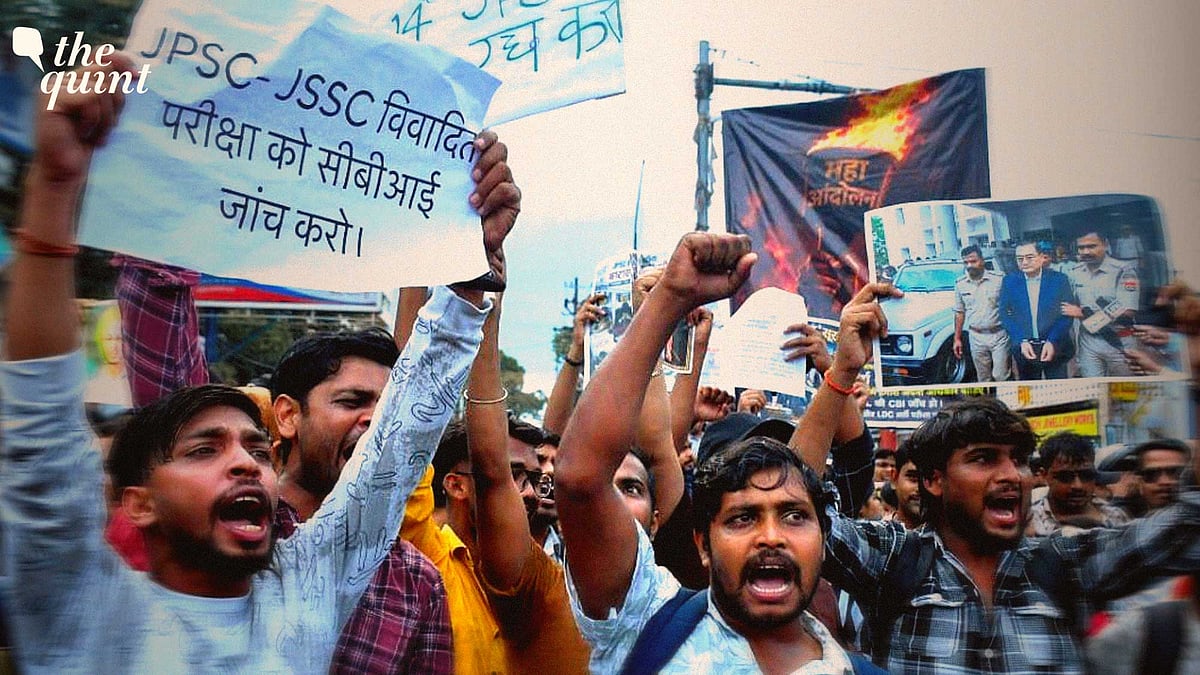
Ranchi supplies the latest instalment, and the specifics are worth setting down before drawing any larger lesson. On 25 July 2026, students began gathering to protest alleged irregularities in the 14th Jharkhand Public Service Commission's (JPSC) preliminary examination, held on 19 April, after its results in early July set off accusations of leaks and manipulation.
By 29 July, groups had converged at Jaipal Singh Munda Stadium for what organisers called a Constitution March, and on 2 August student leader Devendra Nath Mahto began an indefinite hunger strike, demanding a CBI and Enforcement Directorate probe into both the JPSC prelims and the separate Jharkhand Staff Selection Commission Combined Graduate Level (JSSC-CGL) recruitment.
One protester, an aspirant named Devashish, put the arithmetic of despair in plain terms. JSSC-CGL application forms have been filled out six or seven times in ten years because the exam keeps being cancelled or postponed, and hopefuls surviving on three to three-and-a-half thousand rupees a month end up sleeping on railway platforms and office floors whenever an exam finally happens.
The Current Crisis in Jharkhand
This pattern predates July. Jharkhand's recruitment troubles have persisted since the state split from Bihar in 2000, cycling through paper leaks, cancelled papers and stalled results with grim regularity.
In September 2024, thousands of candidates walked up to a hundred kilometres to Ranchi to protest alleged malpractice in the Jharkhand General Graduate Level Combined Competitive Examination. By December, security forces had barricaded the JSSC office simply to let 2,231 shortlisted candidates, out of the 3.04 lakh who had appeared, get through document verification. Seen individually, each episode reads as an isolated administrative lapse. Seen together, they describe a system functioning very much as it has been allowed to function.
It would be a mistake to read the Jharkhand protests as an eruption caused by one exam or one government. What is unfolding on the streets of Ranchi is the visible edge of a far larger institutional transformation. Across India, government recruitment has quietly stopped being a process for selecting candidates. It has become an elaborate machinery for managing waiting.
Competitive examinations exist, in theory, to distinguish between knowledge, preparation and ability. In practice, success increasingly depends on surviving an obstacle course that starts only once the exam itself has ended. Notifications trail vacancies by years. Dates get postponed. Question papers face legal challenge. Results sit pending for reasons nobody quite explains. Court cases interrupt the sequence at will. Merit lists get revised, sometimes more than once. Verification drags on for months. Joining letters vanish into files that no one seems able to locate. By the time a candidate finally enters government service, the examination often turns out to have been the shortest leg of the journey.
This has quietly changed what competition means. The decisive test is no longer who scores the highest marks. It is who can stay suspended, economically, psychologically, socially, for the longest stretch without breaking down.
Waiting is rarely counted as work. A graduate preparing for exams looks idle because nothing measurable gets produced. Yet every delay demands fresh months of study, renewed coaching fees, another year of hostel rent, another postponed pay cheque, another round of reassuring anxious parents that the result is still pending. None of this shows up in Gross Domestic Product, which measures output and keeps no column for wasted years.
The Struggle is in the Wait
The scale of that waiting is not small. Among Indian graduates, the unemployment rate stood at 11.2 percent in 2025, more than three times the national average of 3.1 percent, according to the Periodic Labour Force Survey. Postgraduates fared little better, at close to 10 percent.
Economists tend to describe unemployment as an absence of work. For aspirants caught in this loop, the deeper injury lies elsewhere. Their days are full. They study, revise, travel for exams, refresh result portals and chase rumours on Telegram groups late into the night. Their lives orbit an employment that stays permanently one administrative order away. The state has managed something unusual. It occupies their time without ever employing their labour.
The fallout is not constrained to the examination halls. Families postpone weddings because employment remains uncertain. Loans pile up against the promise of a salary that keeps receding. Migration plans get shelved year after year. A younger sibling grows up watching an elder brother or sister occupy the same study table for five or six consecutive years. Households begin arranging their emotional calendar around notifications, answer keys and court hearing dates. Bureaucratic delay, over time, acquires the intimacy of family life, settling into dinner-table conversation the way illness or debt might.
The narrower test-preparation segment alone, worth an estimated 311.8 million dollars in 2025, is projected to grow at nearly 27 percent a year through 2034. Every postponed examination produces another coaching batch. Every cancelled recruitment round means another year of hostel rent, another test-series subscription, another stack of guidebooks, another lecture promising that this attempt will finally be the last.
Coaching centres cannot fairly be blamed for responding to demand; that is what businesses do. The uncomfortable question is why public institutions have become so reliable at manufacturing that demand in the first place.
The supply side of the story is just as telling. As of March 2023, close to 9.64 lakh posts stood vacant across central government ministries and departments alone. States carry their own backlog on top of this figure. Vacancies of this size do not appear overnight; they accumulate because recruitment cycles stall for years at a stretch. The state, in other words, is not merely slow in hiring aspirants who stand ready to work. It is frequently sitting on the very positions those aspirants are queuing up outside commission offices to fill.
Age isn't Just a Number
The politics of age limits sharpens this injustice into something harsher still. Every recruitment postponed by two or three years silently pushes thousands of candidates toward the upper age ceiling. When vacancies are delayed but eligibility windows stay fixed, the state effectively converts its own administrative inefficiency into a candidate's permanent exclusion. Disqualification arrives without misconduct, without poor performance, without any failure of preparation.
Time itself becomes the examiner, and it fails people quietly, through a notification nobody reads until it is too late. Governments like to describe young people as the nation's demographic dividend, yet the recruitment system consumes precisely the resource youth holds in greatest supply. Years that could have gone into building a career instead disappear into procedural limbo.
Jharkhand's protesters say their own resolve hardened after watching the Cockroach Janta Party protests in Delhi over the NEET-UG 2026 paper leak, which ended with the resignation of the Union education minister. Public agitation has effectively turned into an informal administrative mechanism, doing work that ought to have been finished quietly inside government offices. The street increasingly performs tasks the bureaucracy has stopped performing on its own.
This carries consequences that reach well past employment statistics. Modern states draw legitimacy not only from their laws but from the predictability of their procedures. Citizens tolerate competition because they trust that rules will hold and outcomes will arrive within a reasonable stretch of time. Administrative uncertainty corrodes that trust from the inside. Aspirants stop asking whether they will succeed and start wondering whether the examination itself will survive the year. Merit loses its credibility once the process surrounding it looks permanently provisional.
Political theorists sometimes distinguish between power exercised through force and power exercised through time. Delay can discipline a population as effectively as any prohibition. A file kept pending changes behaviour without a single order being issued.
The students camped out at Jaipal Singh Munda Stadium deserve to be read in this fuller light. They are demanding appointments and clean examinations, certainly. They are also, in effect, demanding ownership over their own futures. Every postponed recruitment quietly appropriates years that cannot be given back. Lost income can eventually be earned. Lost time cannot.
India debates unemployment mostly through vacancy counts, fiscal limits and labour statistics, and those conversations remain necessary. What they routinely miss is the institution quietly growing inside the recruitment system itself. The gravest shortage in India today may not be jobs. It may be predictability. A republic that asks its young citizens to compete owes them a functioning process rather than an endless corridor of waiting, and the assurance that the time they invest in public institutions will eventually be honoured by those institutions in return.
(The author works in corporate sector and writes on contemporary issues spanning public policy, politics, education, technology, and society in both English and Hindi. This is an opinion piece and the views expressed are the author's own. The Quint does not endorse or is responsible for them.)
- Access to all paywalled content on site
- Ad-free experience across The Quint
- Early previews of our Special Projects
Published: undefined