NTA Rot Much Deeper Than Pradhan: Documents Show Why Exam Agency Keeps Failing
NTA Governing Body met twice in 30 months, faces staff shortages and ignored recommendations, RTI responses reveal.
advertisement
(The Quint has consistently reported on the crisis in Indian education. Help us do more such stories by becoming a member.)
Every year, millions of Indian students put their future in the hands of the National Testing Agency (NTA). The government body conducts some of India's biggest competitive examinations, including NEET (for medical college admissions), JEE (for engineering admissions), CUET (for university admissions), and UGC-NET (for teaching jobs). Since its establishment in 2018, NTA has conducted more than 270 examinations and handled over 6.6 crore candidate registrations. In 2026 alone, the agency has already conducted 12 examinations involving more than 65 lakh registrations.
NTA describes its mandate in ambitious terms. It states that its objective is to conduct examinations that are "valid, reliable, efficient, transparent, fair" and ensure that "the right candidates" reach "the best institutions."
However, information obtained through the Right to Information (RTI) Act, responses provided in Parliament, and findings of Parliamentary Standing Committee reports present a very different picture of the agency's functioning. The records point towards deeper governance concerns — the governing board that does not meet frequently, limited transparency in the implementation of statutory mechanisms to prevent unfair means and examination fraud, significant vacancies in sanctioned posts, and inconsistencies between information provided by NTA and facts recorded by Parliament.
Together, these findings raise questions not only about individual examination failures but also about the institutional systems responsible for safeguarding the country's largest entrance examinations.
Governing Board Met Only Twice in 30 Months — Not Even After the NEET-UG Crisis
The job of overseeing NTA belongs to its Governing Body, think of it as the board of directors for the whole agency. But an RTI reply shows this board met only twice in the 30 months between 1 January 2024 and 1 June 2026 — a period that covers both the NEET-UG cancellation and the CUET postponement. For the top body in charge of the country's one of biggest exam agencies to meet less than once a year, even while its exams are falling apart one after another, is itself a sign of neglect.
In fact, the Governing Body did not meet even after the NEET-UG exam was called off till one of the biggest exam crises the agency has ever faced, and the very crisis that would go on to trigger weeks of street protests and, eventually, a minister's resignation. (Note - NEET UG called off on 12 May and reply of the RTI is till 1 June )
This is made worse by secrecy. When I sought the for copies of the minutes of these meetings, NTA refused, saying the "Minutes cannot be shared as contains information that is confidential in nature and may hamper the integrity of the examinations." So the public has no way of knowing what, if anything, the Governing Body actually discussed.
What Happens After a Paper Leak? NTA Isn't Sharing the Answers
The secrecy does not stop at board minutes. NTA has also refused to share basic details about how it is dealing with paper leaks and cheating, the very problem that the government has now moved to address at the legislative level.
In 2024, Parliament passed a law called the Public Examinations (Prevention of Unfair Means) Act, 2024. Section 9 of this Act says every public examination authority must set up a mechanism for monitoring how the Act's provisions are implemented. An RTI request asked NTA to explain the system it has set up for this. NTA's reply simply said it has formed a committee — called the Unfair Means (UFM) Committee — to look into cheating cases and recommend action. It gave no further details on how this system actually works or how it is monitored.
The same RTI request also asked for details of every reported cheating case or offence — including copies of complaints or police FIRs, and the current status of each case. NTA said this information is "not maintained in the format sought," meaning it does not keep records in the way the applicant asked for, and that the RTI Act does not require it to create new information just to answer a question.
NTA also refused to hand over two specific documents — called Form 1 and Form 2 — that the 2024 law requires officers in charge and examination centre to fill out whenever a cheating case or offence is detected. NTA said these records are part of an ongoing investigation and are therefore exempt from disclosure under a specific section of the RTI Act meant to protect investigations.
This matters more than ever now. The Cabinet's newly cleared amendments to the 2024 Act raise jail terms for organised examination fraud from three-to-five years to five-to-ten years, raise the maximum fine to ₹10 crore. Tougher punishment on paper may mean little if the agency responsible for detecting and reporting cheating in the first place will not even disclose how its own internal monitoring system works, or hand over the basic case records the law requires it to keep.
Information Mismatch: When NTA's RTI Replies Differ From Parliament's Record
An RTI query sought information from NTA to list every exam and result that was postponed, cancelled, or re-conducted between January 2024 and May 2026, and reasons for the same. NTA's answer named only two events: a UGC-NET re-exam held in computer-based mode between 21 August and 4 September 2024, and a NEET-UG re-exam held in pen-and-paper mode on 21 June 2026.
That short list does not match what the Parliamentary Standing Committee itself has recorded. The Committee found that of the 14 competitive exams NTA ran in 2024, at least five ran into serious trouble: UGC-NET, CSIR-NET and NEET-PG all had to be postponed; NEET-UG saw paper leaks; and CUET (UG/PG) had its results delayed. The Committee did not mince words, saying "NTA's performance in the last year has not inspired much confidence."
The committee also noted that in JEE Main 2025, held in January 2025, at least 12 questions had to be withdrawn due to errors found in the final answer key of this major engineering entrance exam. The Committee noted that mistakes like this shake the confidence of students in the whole system, and said NTA "need[s] to quickly get their act together" so that such fully avoidable errors do not happen again.
NTA's RTI reply tells a very different story from the findings of the Parliamentary Standing Committee. This raises an obvious question: why is the information given to RTI different from what Parliament itself has recorded?
Recommendations on Paper, Reforms Missing on Ground
In a letter posted on Twitter (X), the then education minister Dharmendra Pradhan had said that he was committed to ensuring that no deserving student's future would be ruined by what he called the "examination mafia," and that no student would suffer injustice. Information provided by the Education Ministry itself suggests his ministry's actions did not fully match that promise.
In its report tabled in Parliament in December 2025, the Parliamentary Standing Committee said that private companies banned by one state or organisation for problems such as paper leaks, conducting exams, or evaluating answer sheets are still able to get contracts elsewhere. To stop this, it recommended that the government create a single nationwide blacklist of such companies and the people behind them.
To check whether this had been done, an RTI application was filed with the Education Ministry asking for a copy of the blacklist. In its June 2026 reply, the Ministry said it did not have any such information. This shows that, even months after the Committee's recommendation, the nationwide blacklist had still not been created.
The Committee has also asked, twice now, most recently in its 364th Report — that NTA publish a full Annual Report describing its work in detail and submit it to Parliament every year, instead of just an audited financial statement. When an RTI request sought copies of the Annual Reports NTA had actually submitted to Parliament, the agency simply replied: visit the official NTA website. As of 25 July 2026, no such report exists there.
A Crackdown Without Capacity: NTA's Empty Chairs Problem
Amid the fallout from the paper-leak scandals, the Government has announced that it has terminated (removed from service) 47 officials of NTA. News reports say legal and criminal action may follow against some of them. This has been presented as a strong step towards reform.
But the RTI data points to a deeper problem than punishing a few individuals. NTA's sanctioned permanent staff strength, the number of permanent posts the government has officially approved is only 39, backed up by 124 people working on a temporary basis. Of the 39 permanent posts, 38 percent are vacant, meaning empty and unfilled. The gap is worst at the senior level: of 13 sanctioned Director posts, only 4 are filled — a vacancy rate of nearly 70 percent as per the RTI reply.
An agency running national exams where millions of candidates apply every year by its own numbers, working without close to a third of its permanent sanctioned staff — and without most of the senior directors who would normally be expected to watch over exam integrity. A new law with harsher penalties will still need people to enforce it; on current numbers, NTA does not have them.
A Cash-Rich Agency With a Capacity Gap
If NTA's record on running exams and governing itself looks weak, its finances tell a different story. A reply given in the Rajya Sabha on 22 July 2026 lays out, year by year, how much NTA earned and spent from 2019-20 to 2023-24 and in every single one of those five years, the agency earned more than it spent. Add up the last column and NTA saved close to ₹520 crore over just these five years.
This matches what Parliament's own Standing Committee had already found. The Committee's 371st Report, titled "Review of Autonomous Bodies and Institutions" and presented to the Rajya Sabha on 8 December 2025, noted that NTA collected an estimated ₹3,512.98 crore while spending ₹3,064.77 crore on conducting exams over six years, leaving a surplus of ₹448 crore.
The Committee recommended that this money be used to build NTA's own ability to run exams itself, or to strengthen its checks on the private vendors it depends on. The RTI record shows no sign that this has been carried out, even though that surplus could, in principle, have funded exactly the kind of staffing and oversight capacity the agency is now shown to lack.
NTA reforms: Another Committee, Two Years later
The Prime Minister's announcement of a new task force to reform the National Testing Agency (NTA) comes nearly two years after the Centre had set up a similar high-level committee following the 2024 NEET-UG controversy.
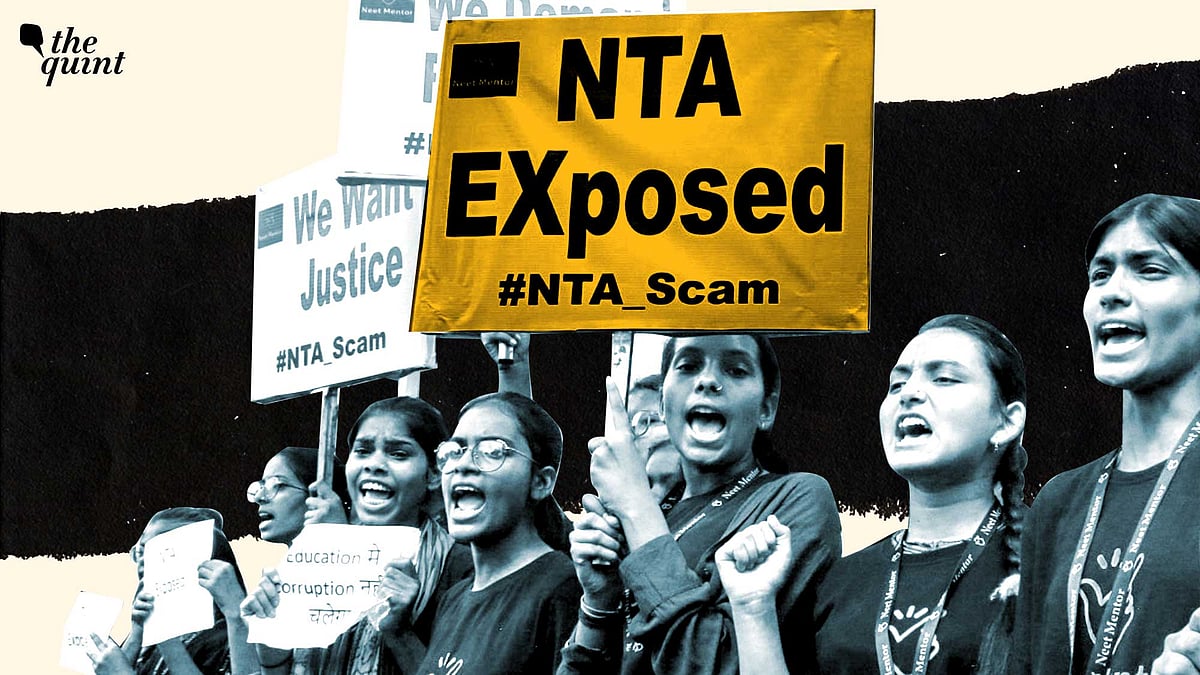
The NTA came under severe criticism in 2024 after allegations of irregularities in the NEET-UG examination and the cancellation of the UGC-NET exam over concerns about its integrity. The controversy triggered nationwide protests, with students and opposition parties demanding sweeping reforms and, in some cases, the agency's dissolution.
In response, the Ministry of Education constituted a seven-member High-Level Committee of Experts on 22 June 2024 under the chairmanship of former ISRO Chairman Dr. K. Radhakrishnan. The committee was asked to recommend reforms to improve the examination process, strengthen data security, and review the NTA's structure and functioning.
The committee submitted its report to the government on 21 October 2024.
After the NEET-UG 2026 paper leak, the NTA announced on 19 May 2026 that it was strengthening its leadership and institutional framework. In a press release, the agency said four senior officers from the Government of India had been posted to the NTA, including two Joint Secretary-level officers who would serve as Additional Director Generals "as per the recommendations of the Radhakrishnan Committee."
This indicates that at least some of the committee's recommendations had begun to be implemented even before the Prime Minister announced a new task force headed by Infosys co-founder Nandan Nilekani to recommend further reforms for NTA-conducted examinations.
The announcement of another expert panel, however, raises important questions. How many of the Radhakrishnan Committee's recommendations have been implemented? Which recommendations remain pending? If the earlier reforms were implemented, what shortcomings remained that required a fresh committee? If they were not implemented, why was another panel constituted instead of acting on the existing recommendations?
The Bigger Picture
A minister has resigned. A tougher law is on the way. Fast-track courts will be set up to deal with exam fraud. These are major steps, taken after weeks of protests by students. But changing the law and replacing people addresses only the immediate crisis, not the deeper problems.
The findings in this investigation point to those deeper issues: a Governing Body that rarely meets, secrecy over how paper leaks are handled, RTI replies that do not match Parliament's records, recommendations that remain unimplemented, large vacancies in key posts, and hundreds of crores of rupees lying unused despite repeated calls to strengthen the agency.
Taken together, these are not isolated administrative lapses. They point to weaknesses in the way NTA is governed. Every year, the agency collects thousands of crores of rupees in exam fees from students and their families. Yet the body responsible for overseeing it meets infrequently, key information remains hidden, and many senior positions remain vacant.
Unless the next Education Minister and the next NTA leadership fix these structural problems—not just punish individuals or pass stricter laws—the same failures are likely to happen again, no matter what the law says on paper.