
Ranji Trophy Final Beckons: Jammu & Kashmir Rewrite Their Cricketing Story
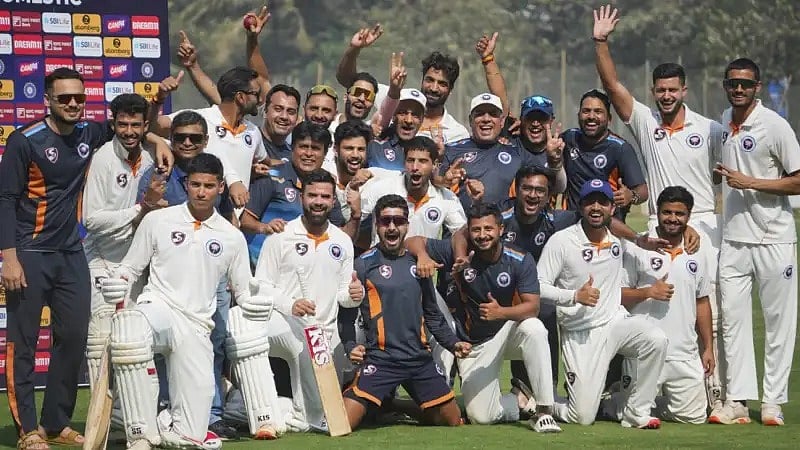
History made! J&K qualify for their first Ranji Trophy final after 67 years in Indian domestic cricket.
advertisement
On 18 February 2026, Indian domestic cricket witnessed a moment not many would have dared to imagine a few years ago. Jammu & Kashmir qualified for the final of the Ranji Trophy, India’s premier First-Class tournament, for the first time in history — 67 years after their maiden season in 1959-60.
This isn't just a win — it is a seismic shift in sporting culture for a region long written off as perennial underdogs.
For decades, the J&K team existed on the margins, stitched together with raw talent but starved of infrastructure, opportunity, and continuity. That context makes this achievement all the more extraordinary.
A Win Etched in History
In a dramatic semifinal at the Bengal Cricket Academy Ground, Kalyani, J&K chased down a modest target of 126 runs against Bengal with a six-wicket victory — a result that electrified fans across the Union Territory and beyond.
The match’s final act was crafted by Vanshaj Sharma (43 not out) and Abdul Samad (30 not out), who steadied the chase with an unbroken 55-run partnership. It was a calm, composed finish that belied years of struggle.
Behind the scenes, pace bowler Auqib Nabi was the architect of the team’s semifinal dominance, claiming nine wickets across both innings and dismantling Bengal’s batting lineup.
It was a day of milestones, and for captain Paras Dogra, it added personal history to the collective one. Dogra, a veteran who has played domestic cricket for 24 years and became only the second batter ever to score 10,000 runs in Ranji Trophy history, finally saw his leadership culminate in something monumental.
“It’s a big achievement,” Dogra said after the match, reflecting on a journey marked by patience and resilience. “We just have to be stubborn.”
From Underachievers to Contenders
To understand how this chapter unfolded, we must go back to where it began and how circuitous the path has been.
The Jammu & Kashmir Cricket Association (JKCA) was established in 1957, driven by local clubs seeking to bring formal cricket to the region. The J&K team first competed in the Ranji Trophy in the 1959-60 season, but victories were rare and progress slow. Their first match win came only in the 1982-83 season, against Services — a long wait of more than two decades.
Through the 80s and 90s, the sport in the region was shaped not just by players but by the socio-political upheavals that shook everyday life. Militancy and factionalism took a toll on sports structures, and cricket was no exception. Yet incremental progress continued.
The late 2010s saw Irfan Pathan mentor the squad, a tenure that unearthed raw talent and instilled a more professional ethos. Players like Abdul Samad, Rasikh Salam, and Vivrant Sharma began to attract attention for their consistency and skill.
In recent seasons, under the watchful pairing of captain Paras Dogra and coach Ajay Sharma, the team’s evolution accelerated from a hopeful outpost to a serious contender. A discipline-first mindset, structured training, and exposure tours helped convert occasional triumphs into sustained success.
The Road to the Final Was Anything But Easy
Though their semifinal win felt clinical, J&K’s journey to this point was grueling. This season alone, the team overcame several cricketing giants, defeating former champions like Delhi and Madhya Pradesh to qualify for the semis.
The team’s bowling unit, led by Nabi, Sunil Kumar, Yudhvir Singh Charak, and others, often forced collapses even on unresponsive pitches. Their ability to extract movement and challenge elite batters became a defining strength. In batting too, contributions were broad rather than singular.
In Abdul Samad, Paras Dogra, Abid Mushtaq, and Kanhaiya Wadhwan, Jammu & Kashmir have four batters who scored over 400 runs this season.
What This Means for J&K — Beyond Cricket
In a region often stereotyped through the prism of conflict and terrorism, sport has long been a unifying force. The team’s success transcends cricketing statistics; it’s a narrative of resilience, aspiration, and identity.
Local fans from Srinagar to Jammu, from Poonch to Baramulla, celebrated on social media and in the streets, with many noting that this moment brings a sense of pride that cuts through everyday challenges.
For young cricketers in the Valley and the broader UT, this performance is a beacon — proof that talent combined with commitment and institutional support can challenge the best sporting events in India.
The JKCA’s Role: From Struggle to Structure
From corruption to financial irregularities to lack of resources, the J&K Cricket Association’s journey has been marked by growing pains. Early on, the association wrestled with logistical and financial challenges compounded by the region’s broader socio-political context. Yet over time, strategic decisions have paid dividends.
The introduction of more red-soil pitches for practice, mirroring conditions common in other Indian centres, helped bridge technical gaps players once struggled with.
From grassroots coaching to improved tournament exposure, the JKCA has steadily professionalised its approach, making dreams of national recognition more attainable for its players.
J&K’s contribution to Indian cricket is no longer peripheral. Parvez Rasool, the first cricketer from the region to don the Indian jersey, laid the foundation.
Since then, players like Abdul Samad have emerged as match-winners not just in domestic arenas but on bigger stages, including the IPL. Auqib Nabi, for instance, was signed by Delhi Capitals for a whopping sum of Rs 8.40 crore.
Achievements like Samad’s record-breaking centuries and Shubham Khajuria’s historic high scores hint at a deep reservoir of talent that was once untapped.
A Moment, A Movement
Reaching the Ranji Trophy final for the first time in history is more than a sporting achievement for the Jammu & Kashmir cricket team. It’s a testament to perseverance amid adversity, institutional evolution, and collective belief.
When the final is played, whether J&K lifts the trophy or not, this team will have already redefined possibility for a generation. The echoes of this achievement will reverberate through stadiums, streets, and school grounds across the region — a reminder that the long shadow cast by years of struggle can also be the backdrop for history in the making.
(Kanwal Singh is a writer and columnist from J&K and Damanjeet Kaur is a writer from Punjab. This is an opinion piece. All views expressed are the author’s own. The Quint neither endorses nor is responsible for them.)
- Access to all paywalled content on site
- Ad-free experience across The Quint
- Early previews of our Special Projects
Published: undefined