
Will Putin Now Help India Counter Trump's Bullying? All Isn't As Meets the Eye
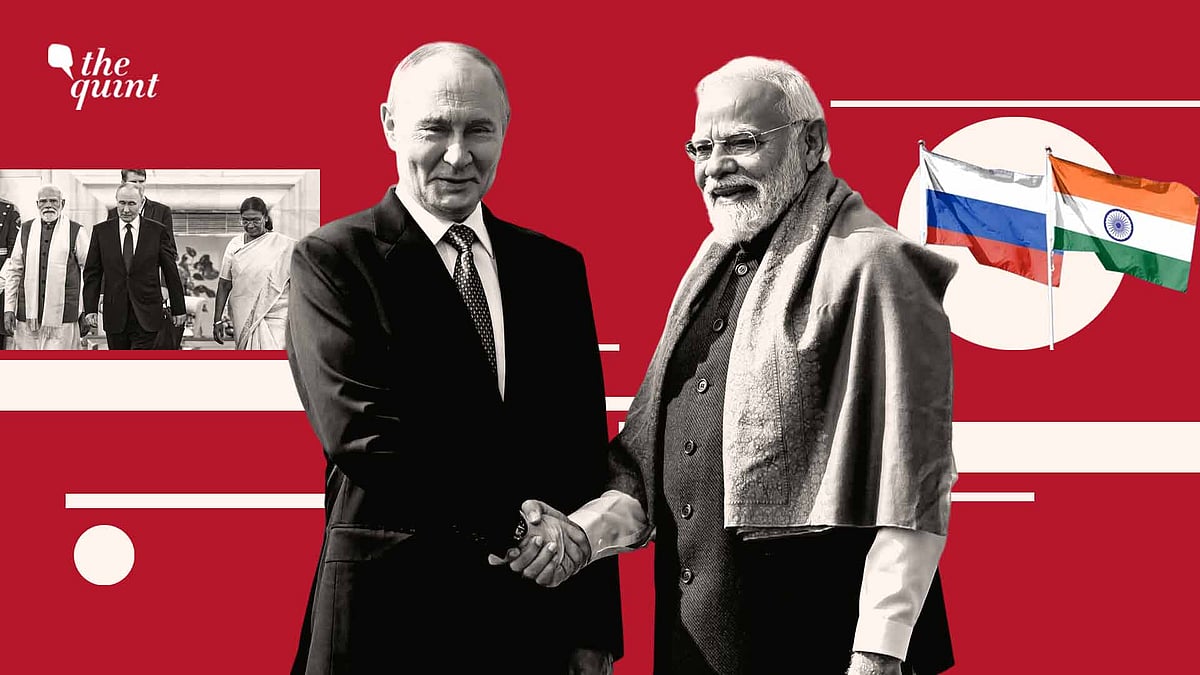
Putin’s visit was part of a diplomatic game that India is currently playing with US & Russia, writes Vivek Katju.
advertisement
While responding to a question on 6 December about Russian President Vladimir Putin’s recent visit to India, External Affairs Minister S Jaishankar said, “India has relations with all the major countries of the world. I think for any country to expect to have a veto or a say in how we develop our relations with others is not a reasonable proposition because the others can expect the same."
"I think we've always made it very clear that we have multiple relationships, we have a freedom of choice, we talk about what is called strategic autonomy,” he added.
He rose to be India’s Foreign Secretary. He would, therefore, be undoubtedly aware that the propositions he advanced on inter-state relations are essentially theoretical.
These are far removed from the cruel reality which confronts almost all countries, including India. Indeed this is borne out by the way India is seeking to navigate a path to secure its interests through the global churn brought about this year by US President Donald Trump.
Global Geopolitics and India
While India is seeking to emphasise its strategic autonomy—and the extraordinary welcome given to Putin was meant for this purpose—it has to deal with Trump’s continuing negativity on trade issues.
The tariffs include 25 percent that have been imposed for India’s purchase of Russian crude oil. Jaishankar used to loudly defend India’s off take of Russian oil in his public statements till Trump imposed the 25 percent tariff. It still continues to maintain that it will not compromise on its energy security but the fact is that it has reduced its imports of Russian oil crude. Initially Indian public sector refineries began to do so but now the private sector refineries have also fallen in line.
This shows the real world where countries which can, to put it politely, influence others to change course.
Thus, despite US' pressures, India continues to buy Russian military equipment, including the S-400 batteries. If that requires that a price has to be paid then it is so.
During Putin’s visit one of the most significant areas of discussion were on defence and security.
It would have been preferable for Jaishankar to have given a nuanced response on how the game of nations is played instead of making categorical assertions on strategic autonomy. Such comments may warm the hearts of a section of the ruling dispensation’s supporters but they erode his credibility.
Balancing Giants
Indian diplomacy has to currently find a path through an interplay with four major powers at a time of great global uncertainty. These are the US, China, Russia and the European Union (EU). The EU does not have a common policy on many issues. That requires a complicated and simultaneous interaction with its member states and the group itself.
That does not mean that India will deliberately downgrade the Russian relationship but in overall terms its involvement with the US is greater, and this reality cannot be wished away.
India has great difficulties with China. Apart from the border dispute, China is aggressively intruding in India’s immediate neighbourhood. That is making it more difficult to manage South Asia, where it is the dominant power.
Till now, it had to deal with the Sino-Pak nexus. But now China’s increased footprint is further complicating South Asia. India has to keep a wary eye on how the other three powers are relating with China, whose great rise has led to the formation of what Trump called a G2, meaning that the US and China are currently the two real great world powers. Russia has excellent ties with China, and Putin has said he would like the India-Russia relationship to be like the Russia-China one. This is not possible for Russia is dependent on China in many ways, especially because of Western sanctions. That is not the case of Russia with India.
Now, Trump is indicating that he wants India to have a restricted role in regional security management: he has improved US-Pakistan ties and is not interested in India playing a role in West or Central Asia but be focussed on the Indo-Pacific region. This is so because the US will, at best, have both a competitive and also in some areas a cooperative relationship with China.
Naturally, India cannot accept these restrictions because of its interests in West Asia, and it is here that it will really have to apply the principle of ‘strategic autonomy’ and pursue its interests. It will have difficulties—as it has had in the past—with developing ties with Iran because of US-Iran ties. There it may have to make compromises with its pursuit of strategic autonomy.
While West Asia figured in Prime Minister Narendra Modi-Putin discussions, the reality is that neither country can effectively influence the course of events in this region.
India and the EU are discussing ways of enhancing ties in the commercial and other sectors. A basic point that divides the two is the Ukraine war and the approach to Russia. Putin has upset the European security order. He has become a pariah for the EU but that is obviously not the case with India. India also wants the Ukraine conflict to end but Modi used much softer language on the issue than he had in September 2022 when he had told Putin directly that this is not an era of war.
India and EU can take ties forward despite differences on Russia.
This is a challenging time for Indian diplomacy. These will not go away by making facile assertions.
(The writer is a former Secretary [West], Ministry of External Affairs. He can be reached @VivekKatju. This is a personal blog, and the views expressed above are the author’s own.The Quint neither endorses nor is responsible for them.)
- Access to all paywalled content on site
- Ad-free experience across The Quint
- Early previews of our Special Projects
Published: undefined