
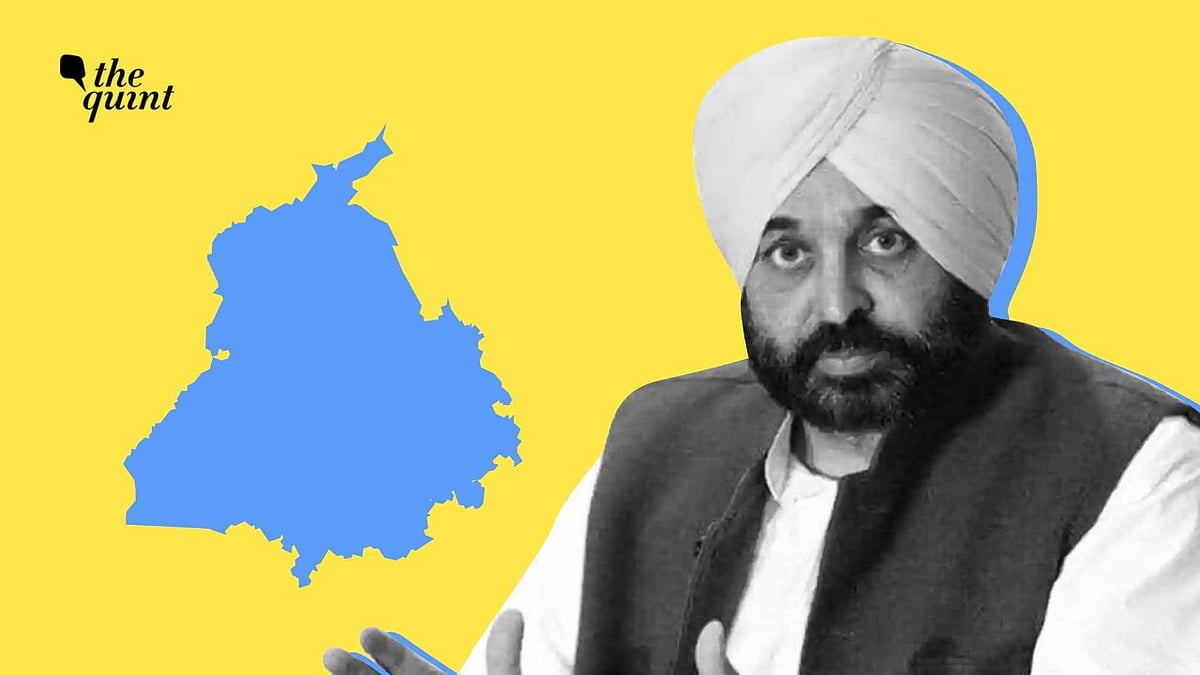
Why Bhagwant Mann-Akal Takht Row Could Reshape Punjab Politics Ahead of 2027
The controversy is no longer merely about a viral video; it has evolved into a contest between competing narratives.
advertisement
Just days after Aam Aadmi Party (AAP) national convenor Arvind Kejriwal formally declared Bhagwant Mann as the party's chief ministerial face for the 2027 Punjab Assembly elections, the ruling party finds itself grappling with a controversy that threatens to complicate its political calculations.
Akal Takht Jathedar Giani Kuldeep Singh Gargajj declared Mann a "Guru Dokhi", "Khalsa Panth Virodhi", accusing him of acting against the interests of the Sikh community. The Akal Takht also called upon the Sikh community to socially and religiously distance itself from the chief minister.
The development came alongside another unprecedented move. The Akal Takht summoned Sikh ministers in the Punjab Cabinet and Sikh MLAs across party lines to appear before it on 29 June and explain their role in facilitating the passage of the Jaagat Jot Sri Guru Granth Sahib Satkar (Amendment) Act, 2026.
However, Punjab Finance Minister Harpal Singh Cheema presented findings from two government-recognised forensic laboratories, which the party claimed conclusively established that the individual seen in the controversial video was not Bhagwant Mann.
According to Cheema, the forensic examination was conducted by laboratories outside Punjab and involved analysis of 1,191 reference points, including facial recognition, height comparison, gait analysis, body posture assessment, and frame-by-frame examination.
Akal Takht Jathedar Giani Kuldeep Singh Gargaj addresses a gathering at Sri Akal Takht Sahib, declaring Punjab CM Bhagwant Mann Guru Dokhi and Khalsa Panth Virodhi
Historian Dr Gurdarshan Singh Dhillon described the controversy as deeply hurtful for the Sikh community and argued that the implications extend beyond routine politics.
"This has come as a big shock to the Sikh community, and it will not be easy for many Sikhs to come to terms with it," he said.
Why the Akal Takht Matters in Politics
To understand the political significance of the controversy, it is important to understand the role of the Akal Takht and its Jathedar.
Established by Guru Hargobind Sahib in 1606, Sri Akal Takht Sahib is regarded as the highest temporal seat of Sikhism. Historically, it has functioned as the institution through which matters concerning the collective political, social and religious life of the Sikh community are addressed.
This explains why political leaders across party lines have traditionally exercised caution when responding to pronouncements from the Akal Takht. Whether they agree or disagree, few can afford to ignore it.
When Leaders Faced the Takht
Punjab's political history is replete with examples of leaders finding themselves at odds with Sikh religious authority.
Perhaps the most notable example is former Chief Minister Surjit Singh Barnala. During the turbulent years following Operation Blue Star, Barnala frequently found himself balancing the demands of constitutional governance with expectations emerging from sections of Sikh religious leadership.
Former Akali minister Sucha Singh Langah also remained excommunicated for years despite later being acquitted by a court in a rape case. The episode illustrated how religious legitimacy and legal vindication often operate separately in Punjab's public life.
Does the Jathedar Still Command Unquestioned Authority?
While Congress, the Bharatiya Janata Party (BJP), and the Shiromani Akali Dal have rallied behind the Akal Takht's criticism of Bhagwant Mann, the controversy has also revived an uncomfortable debate within Sikh politics: does every pronouncement by a Jathedar still carry the same authority it once did?
The distinction is significant because, while the Akal Takht continues to enjoy immense reverence among Sikhs, the office of the Jathedar has increasingly become the subject of political contestation.
The current controversy is unfolding against that backdrop.
Ironically, one of the most prominent examples came only months ago when the Akal Takht imposed religious punishment on Shiromani Akali Dal president Sukhbir Singh Badal. At the time, many within the Sikh community praised the institution for asserting its independence from the Akali Dal.
However, critics now argue that some of the recent interventions appear to disproportionately target the AAP government, raising fresh questions about political influence over religious institutions.
Giani Kuldeep Singh Gargajj himself did not enjoy universal acceptance when he was appointed acting Jathedar. Sections of Panthic organisations had questioned the process of his appointment, while some critics viewed him as a choice acceptable to the Shiromani Akali Dal establishment.
Over the past year, Gargajj has attempted to broaden his acceptability by engaging with various Sikh organisations, including groups outside the traditional Akali sphere. Yet, the latest confrontation with Bhagwant Mann is once again drawing attention to the debate over the independence of Sikh religious leadership.
Senior journalist and Sikh affairs commentator Jaspal Singh Sidhu argues that the latest directive goes beyond expressing concern over a religious issue and enters the political domain.
Why Things are Different for AAP
The controversy presents a unique challenge for AAP because of the nature of the party's political rise in Punjab.
Unlike the Shiromani Akali Dal, which historically positioned itself as the principal representative of Panthic politics, AAP built its support on promises of governance reform, anti-corruption measures, welfare delivery, and dissatisfaction with traditional parties.
Since coming to power in 2022, the Mann government has attempted to supplement that governance-centric image with symbolic outreach towards Sikh institutions and issues.
Against this backdrop, accusations that the government ignored the wishes of Panthic institutions while passing the law pose a political challenge.
Manjit Singh, former professor of Sociology at Panjab University, said the Akal Takht's decision has placed Sikh ministers and legislators in a difficult position at a politically sensitive time.
The Mann Factor
For AAP, the controversy is particularly sensitive because the party's electoral strategy increasingly revolves around Bhagwant Mann himself.
Punjab Chief Minister Bhagwant Mann visits Sri Akal Takht Sahib in Amritsar
The Akal Takht's criticism strikes directly at that strategy.
The issue is no longer confined to legislation or administrative decisions. Instead, the opposition is attempting to frame it as a question of Mann's personal standing within the Sikh community.
A Potential Opening for the Akali Dal
The controversy could also provide the Shiromani Akali Dal with an opportunity to recover some lost political ground.
Since the 2015 sacrilege incidents and subsequent electoral setbacks, the Akali Dal has struggled to reclaim its traditional Panthic space. The party's credibility on Sikh issues suffered considerably, allowing AAP to make significant inroads into sections of the Sikh electorate.
The current controversy offers the Akalis a chance to reposition themselves as defenders of Sikh institutions and religious sentiment.
The party's challenge, however, is that many voters still associate it with the very controversies that weakened its standing in the first place. While the issue may help the Akalis regain visibility, whether it translates into substantial electoral gains remains uncertain.
Can the Controversy Hurt AAP's Electoral Prospects?
The answer is not straightforward.
Punjab's voters have repeatedly demonstrated that they do not vote solely on religious issues. Governance, local leadership, welfare schemes and economic concerns often play a more decisive role.
Professor Manjit Singh argued that the timing of the development, with Punjab gradually moving towards the 2027 Assembly elections, makes it particularly significant.
"When elections are approaching, political parties are reluctant to alienate even a small dera or support base. In such circumstances, it becomes difficult to ignore the sentiments of a much larger Sikh community," he said.
The Road to 2027
For now, the Akal Takht's intervention does not appear to pose an immediate electoral threat to AAP. However, it has created something the opposition desperately needed: a political issue capable of shifting attention away from governance and placing the ruling party on the defensive.
The real test for AAP will be whether the controversy remains confined to political statements and television debates or begins influencing opinion among ordinary Sikh voters in villages, towns and religious congregations across Punjab.
The Akal Takht may not determine election results. History suggests no institution can.
But its pronouncements have often shaped the political conversation. As Punjab inches closer to the 2027 Assembly elections, that alone may be enough to make this controversy one of the most significant political challenges Bhagwant Mann has faced since coming to power.
At the same time, Punjab's political history suggests that controversies linked to Sikh religious sentiment can linger far longer than conventional political disputes. The sacrilege issue, for example, continued to shape Punjab politics for years after the original incidents occurred and contributed significantly to the decline of the Akali Dal.
The controversy is no longer merely about a viral video or a piece of legislation. It has evolved into a contest between competing narratives. On one side stands the Akal Takht. On the other stands the AAP government, armed with forensic reports that it claims exonerate the chief minister and prove he is not even the person in the footage.
The eventual political impact may depend less on the existence of the video and more on which version of events Punjab's voters choose to believe.
(The author is a journalist based in Punjab, reporting on politics and governance.)
- Access to all paywalled content on site
- Ad-free experience across The Quint
- Early previews of our Special Projects
Published: undefined