
Moral Power vs Politics: Why Punjab CM Appearing Before Akal Takht is Historic
Akal Takht cannot impose legal penalties. Yet for over 400 years, it has functioned as a parallel moral institution
advertisement
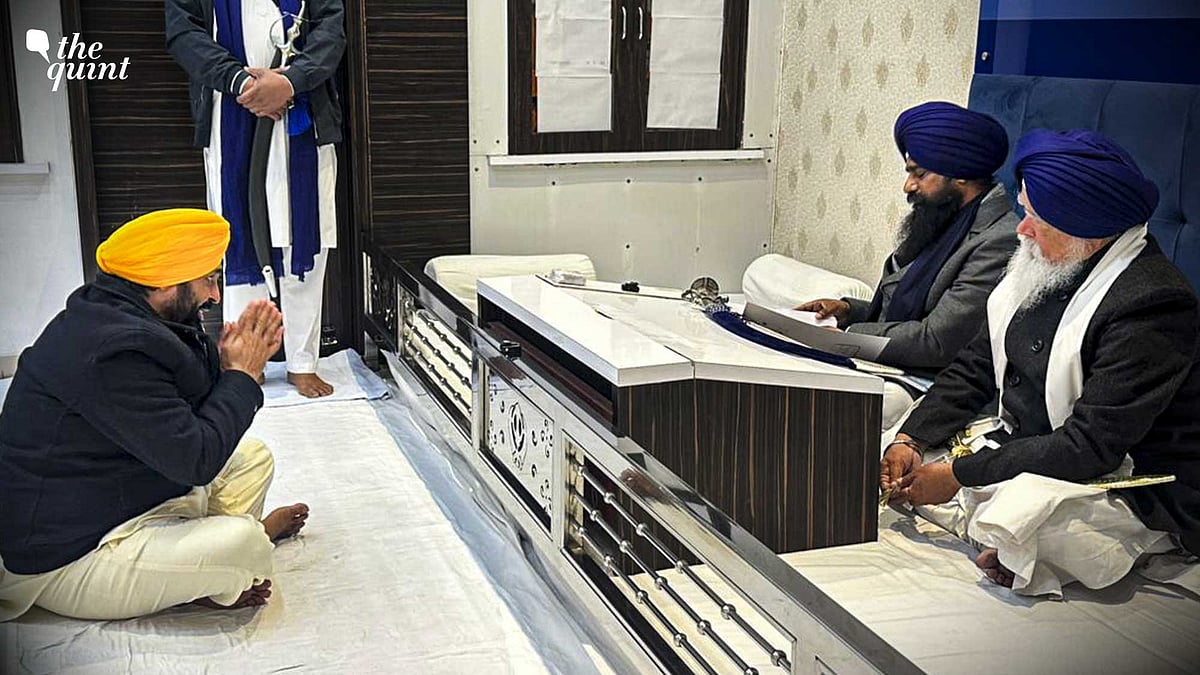
When Punjab Chief Minister Bhagwant Mann appeared before Sri Akal Takht Sahib on 15 January, the moment was less about personal faith and more about institutional authority. At a time when political legitimacy is increasingly defined by electoral mandates and executive control, the episode reopened an older, Punjab-specific question: who gets to hold elected power morally accountable?
The Akal Takht is not a constitutional body. It cannot overturn elections, dismiss governments, or impose legal penalties. Yet, for over four centuries, it has functioned as a parallel moral institution: one that political leaders across parties and eras have found difficult to ignore.
Mann’s appearance, following a summons linked to remarks and governance-related conduct, sparked predictable political reactions and social media debate. Some described it as religious overreach; others viewed it as a legitimate assertion of moral authority. In Punjab, political power has long existed alongside institutional moral scrutiny rooted in Sikh tradition, and the relationship between the two has never been simple.
What Summons Were the Summons About?
The Akal Takht does not issue summons casually, nor does it typically couch its concerns in dramatic language. Traditionally, such calls are made when Sikh clergy believe that a public figure’s actions or statements have hurt Sikh religious sentiments, interfered with Sikh institutions, or crossed ethical boundaries shaped by collective norms.
In Bhagwant Mann’s case, the summons reportedly related to certain remarks and aspects of governance that, in the view of the clergy, required explanation. Crucially, this was not a declaration of guilt. It was a call to appear, clarify one’s position, and engage.
That distinction matters, particularly in understanding why the summons carried weight despite lacking legal force.
The episode also drew responses from Sikh institutions. SGPC general secretary Gurcharan Singh Grewal said, "CM Mann had made light of a serious issue, adding that Sikh institutions funded through golak and dasvandh have carried out extensive relief work during natural disasters. He argued that while personal belief is a matter of choice, publicly questioning the Akal Takht from a position of power is morally inappropriate".
What Does a Summons from the Akal Takht Actually Mean?
Established in 1606 by Guru Hargobind Sahib, the Akal Takht was conceived as the seat of Miri (temporal responsibility) existing alongside Piri (spiritual guidance). The underlying idea was clear: even legitimate power must operate within ethical limits.
Four centuries later, that principle continues to shape Punjab’s political culture. The Akal Takht issues directives, intervenes in disputes, and pronounces on matters that sit at the intersection of religion, politics, and ethics. A summons is therefore symbolic, but in Punjab, symbolism has historically carried consequences. Leaders who chose to ignore the Akal Takht often paid a moral and political price, even when they enjoyed electoral legitimacy.
As Sikh scholar Dr. Gurdarshan Dhillon has noted, Sikh tradition does not place salvation in retreating to mountains or withdrawing from society. Instead, it locates moral guidance and collective responsibility within institutions like the Akal Takht. For Sikhs, seeking direction from the Akal Takht is not about renunciation, but about engaging with the world while remaining accountable to ethical principles.
At the same time, the institution itself is not immune to criticism. The Jathedar of the Akal Takht is appointed by the Shiromani Gurdwara Parbandhak Committee (SGPC), an elected body deeply influenced by party politics, particularly the Shiromani Akali Dal. Critics have long argued that some pronouncements of the Takht have reflected political alignments rather than independent moral judgment.
When Elected Power Faced Scrutiny
Bhagwant Mann is not the first chief minister to be summoned by the Akal Takht. Punjab’s political history is replete with examples where elected authority was subjected to moral scrutiny.
Surjit Singh Barnala was summoned during the height of militancy in the 1980s. Despite the political volatility of the period, he appeared before the clergy. In 1986, he was declared tankhaiya for ordering police action inside the Golden Temple.
Parkash Singh Badal, one of Punjab’s most influential political figures, was summoned in 1979 over his role in the Sikh-Nirankari clash that left 13 Sikh protesters dead in Amritsar. Giani Zail Singh, later President of India, was also summoned during his political career amid concerns over the use of state power in matters affecting Sikh institutions. In 2007, former Lok Sabha Speaker Buta Singh faced a summons following controversial remarks during a period of religious tension.
These precedents established a consistent pattern: electoral success did not place leaders beyond moral questioning.
Even Sovereign Power Was Not Absolute
The most frequently cited example predates modern democracy altogether. Maharaja Ranjit Singh, founder of the Sikh Empire and the most powerful Sikh ruler in history, was summoned by the Akal Takht after violating established religious norms within his court. Despite his absolute political and military authority, he appeared before the Takht and accepted punishment.
The episode remains central to Sikh political thought because it articulated a principle, one that continues to resonate in Punjab, that no ruler is entirely sovereign.
Why This Moment Matters Now
In contemporary India, debates around religion and politics are often framed in binaries, either as dangerous entanglements or as expressions of cultural identity. Punjab’s experience resists such simplification.
The Akal Takht has not functioned as a rival to the state. Instead, it has operated as a moral reference point, shaping public expectations of accountability without wielding legal power. Seen in this context, Bhagwant Mann’s appearance before the Akal Takht is neither unprecedented nor extraordinary. It reflects a political culture where authority has historically been expected to acknowledge ethical limits beyond constitutional mandates.
The immediate political impact of the episode may fade quickly. But its deeper significance lies elsewhere. It reinforces the idea that in Punjab, political authority has never rested on votes alone.
This does not imply that religious institutions dictate governance, nor does it place bodies like the Akal Takht beyond scrutiny. Rather, it points to a political tradition in which elected power operates under an ethical ceiling shaped by history and collective memory.
In an era where political authority increasingly resists accountability beyond elections, the Akal Takht’s continued ability to summon a sitting chief minister reveals a distinct Punjabi paradox: power here may be elected, but it has never been entirely absolute.
(Harsimran Kaur is a journalist based in Punjab, reporting on politics and governance.)
- Access to all paywalled content on site
- Ad-free experience across The Quint
- Early previews of our Special Projects
Published: undefined