
Bangladesh Elections: Tarique Rahman Emerges as Frontrunner, But Can He Deliver?
Muhammad Yunus's interim government has proven toothless time and again against the mob, writes Arka Deb.
advertisement
The political landscape in Bangladesh is buzzing with election fever. Many people are still bitter that they were barred from casting votes in the last two elections. The irony? The party that faced all those allegations—the Awami League—is now the one sidelined from the race.
On 12 February, Thursday, the country will hold its first general election since the ouster of former prime minister Sheikh Hasina's government.
But politics does not allow any blank space; it gets filled up quick.
From Sheikh Mujib's time to Ziaur Rahman's, then Hussain Muhammad Ershad's heavy-handed rule, Khaleda Zia's stint, and Hasina's grip on power where one party called all the shots—Bangladesh has seen it all.
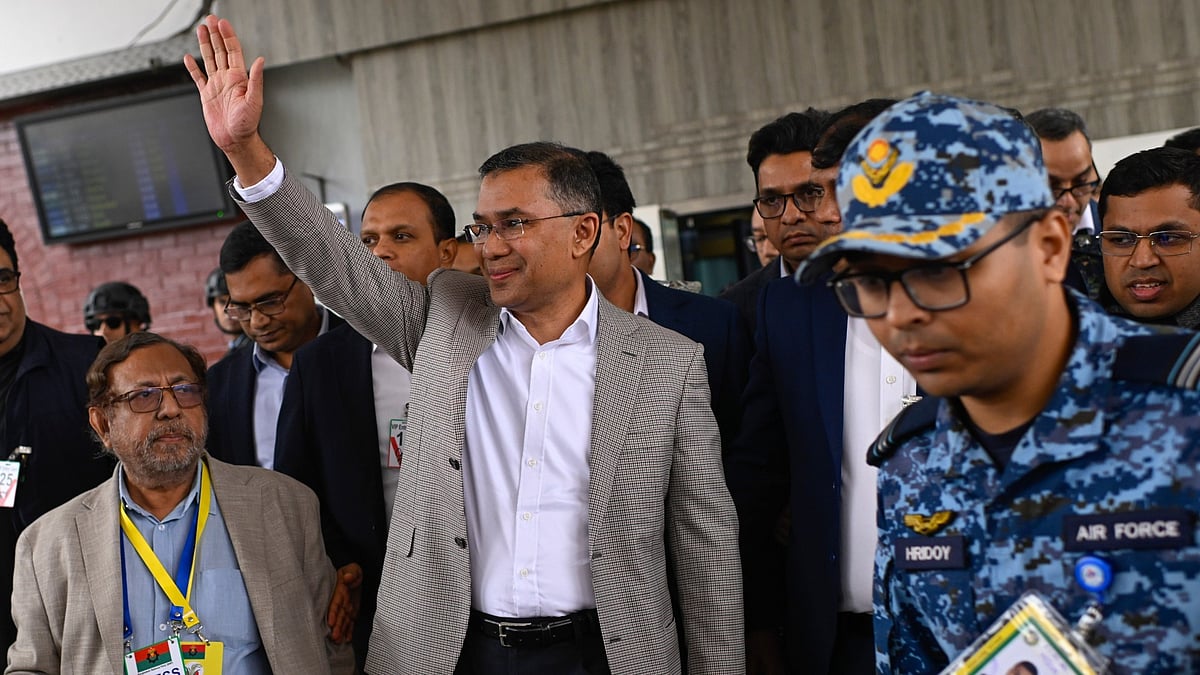
These days, the hopes are pinning on Tarique Rahman. The whole political scene is flipping fast.
During Hasina's reign, a big slice of civil society had turned anti-establishment without diving headlong into the BNP politics. Now, Rahman is strategically pulling them all under one big tent.
The Disarray in Post-July Uprising Bangladesh
Post-July uprising, the world watched Bangladesh stumble through political disarray. Those who hit the streets against Hasina's lawlessness and corruption saw their movement hijacked time and again by vested interests. Be it vandalism in Dhanmondi 32 or murder of Dipu Chandra Das in the recent past, the absence of a democratically elected government was turning into a massive roadblock.
For a whole year, Bangladesh has been gripped by waves of violence, clashes, and destruction. Journalists have been working without any protection. In December 2025, when mobs trashed Prothom Alo and The Daily Star offices, it wasn't just buildings that got wrecked—reporters trapped inside could easily have been killed.
Tarique Rahman's Role in the New Political Landscape
He gets it: the broader pro-Liberation War masses—consciousness of the majority of the country—are under threat, and a good many of them were even Awami voters. His intention is to prove the Awami League is not the sole owner of 1971 Liberation history.
He's out to fold every stakeholder in that 1971 ethos into his political fold, without giving Jamaat-e-Islami an inch. History is his weapon to push back their aggression. From his recent rallies, referencing the 1971 War, Rahman called out Jamaat-e-Islami for siding against the nation:
"Because of them, the honour of lakhs of mothers and sisters in this country was violated. The people of Bangladesh have seen through what they're made of," he said.
He is also challenging Jamaat narratives decorated to target ultra-religious Muslims.
So the narrative, Jamaat is the saviour of Islam is being diluted with his aggressive moves.
Beside the BNP's core voter, Rahman is active to engulf the vote from every corner by his calm, rational, non-aggressive appearance.
Last few months, 'revenge' was the keyword that was sincerely used by opinion leaders. Rahman, who witnessed his mother's immense suffering, never uttered a single word that triggers hatred. Hence, while touring district by district conducting campaigns, he is giving importance to listening alongside speaking. He is listening to the words of local van drivers, slum dwellers, trying to understand their daily shortages and complaints. His acceptability is increasing constantly.
His close associate AKM Wahiduzzaman, Information and Technology (ICT) Affairs Secretary of the BNP, said, "Tarique Rahman has nearly 37 years of experience in running political programmes. But because his style of politics was quite different, many people were not very hopeful about him at first."
"During political events, he often chose not to sit on the stage. Instead, he would sit among the audience and listen to ordinary party workers speak. At times, he would even take on the role of the anchor on stage, calling supporters up, chatting with them, and joking around in a friendly way.” he added.
Veteran political analyst Altaf Parvez observes the situation differently.
"Jamaat has created a robust network for a long time. They have a huge fund. They have reached the marginal section across villages. They are engaging people via door-to-door campaigns. But they don't have a trusted face like Tarique Rahman. It’s true the urban middle class is moved by his appearance," he opines.
From 2009 to 2024, Rahman's mother Khaleda Zia endured humiliation, accepted a lonely life in prison, and even had her family home taken away. She never left the country to save her life.
Her son knows these facts better than anyone. Rahman could have recounted each incident to further incite the dazed crowd—as this has happened repeatedly in Bangladesh over the past few months. He has chosen the path of tolerance. Neither Delhi nor Rawalpindi, his single point agenda is inclusive Bangladesh.
To heal, to restore the synthesis, Bangladesh perhaps has no other choice now.
(This piece was first published on 26 January. It has been updated and republished in the run-up to the general elections in Bangladesh. Arka Deb is a Kolkata-based independent journalist. This is an opinion piece. The views expressed above are the author’s own. The Quint neither endorses nor is responsible for them.)
- Access to all paywalled content on site
- Ad-free experience across The Quint
- Early previews of our Special Projects
Published: 26 Jan 2026,12:21 PM IST